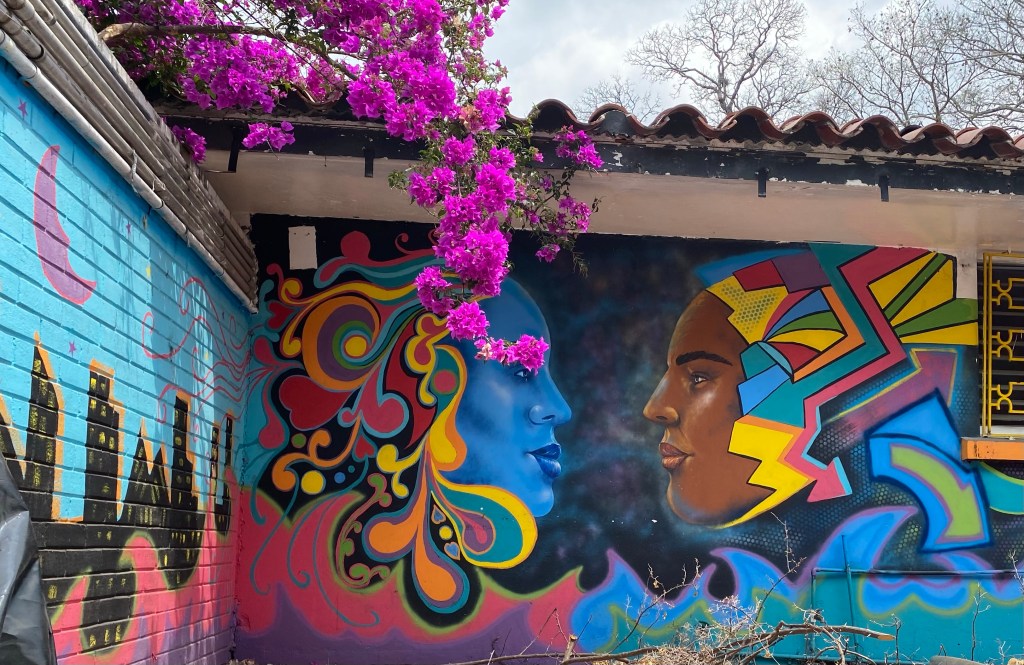
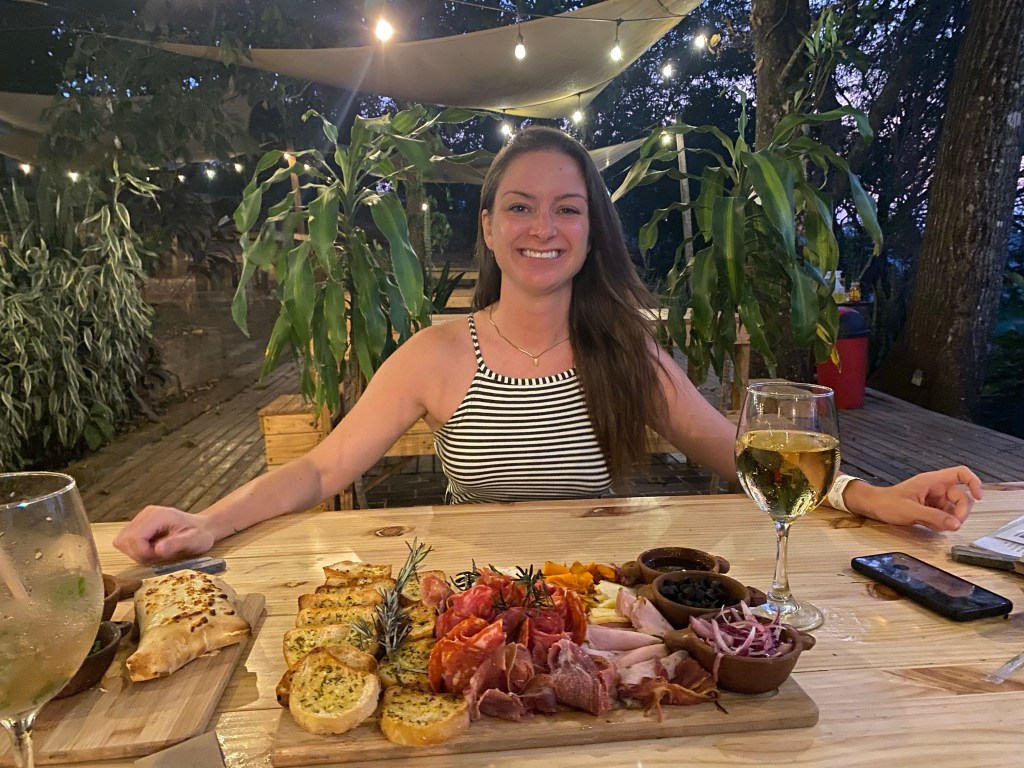
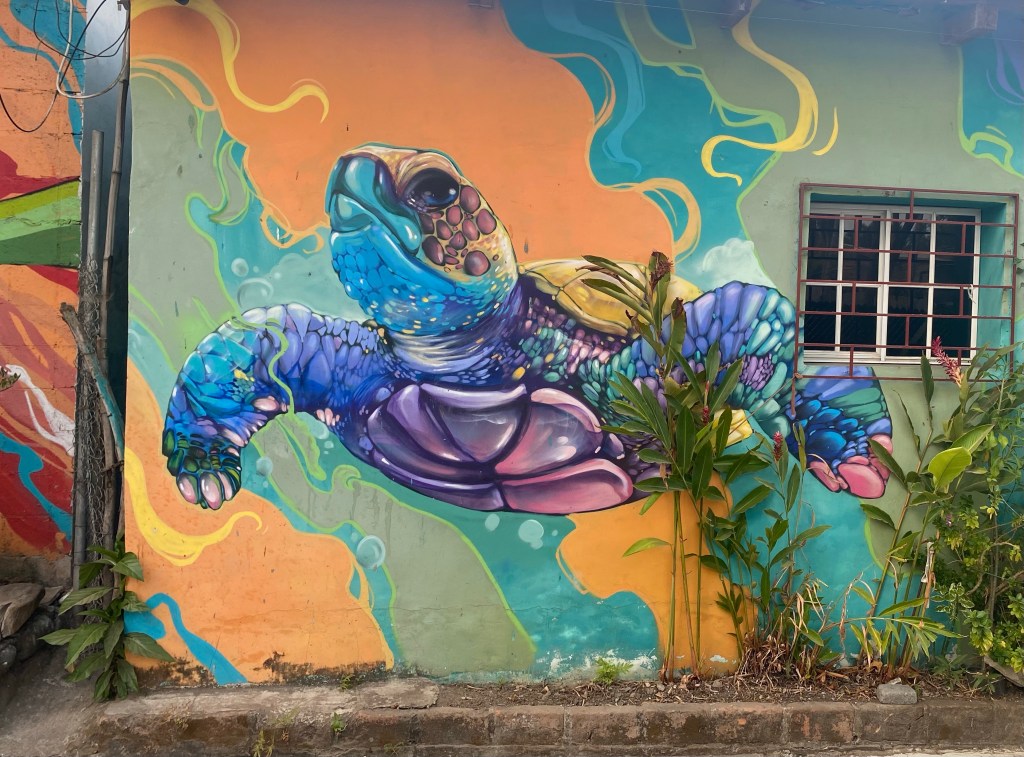
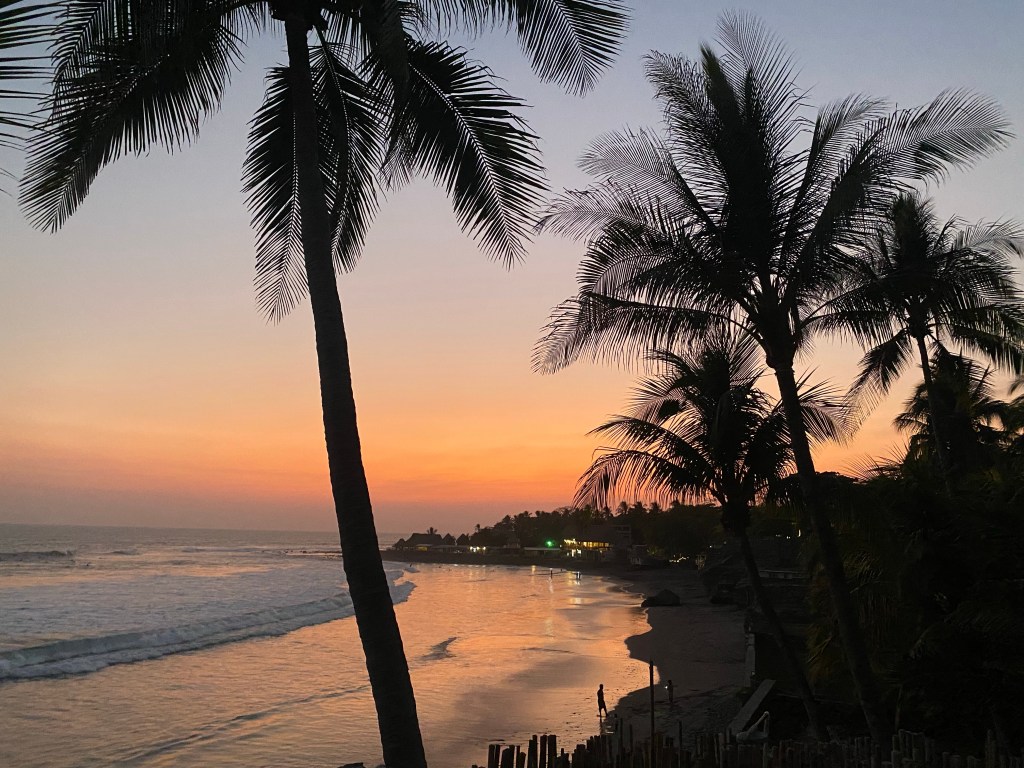
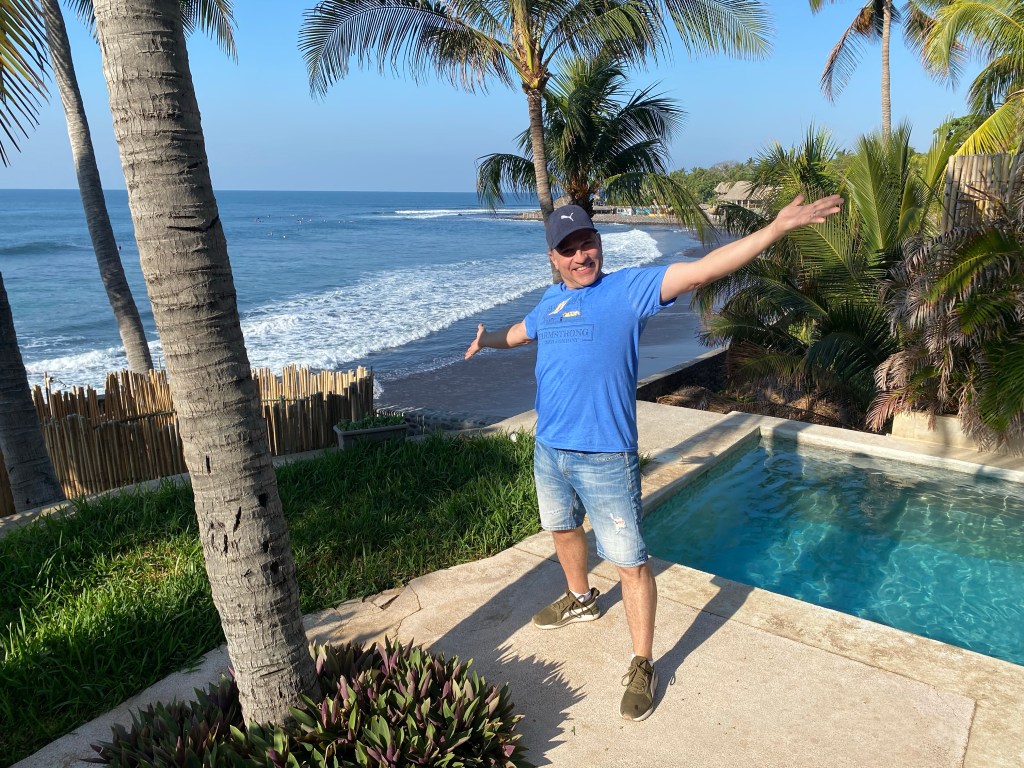
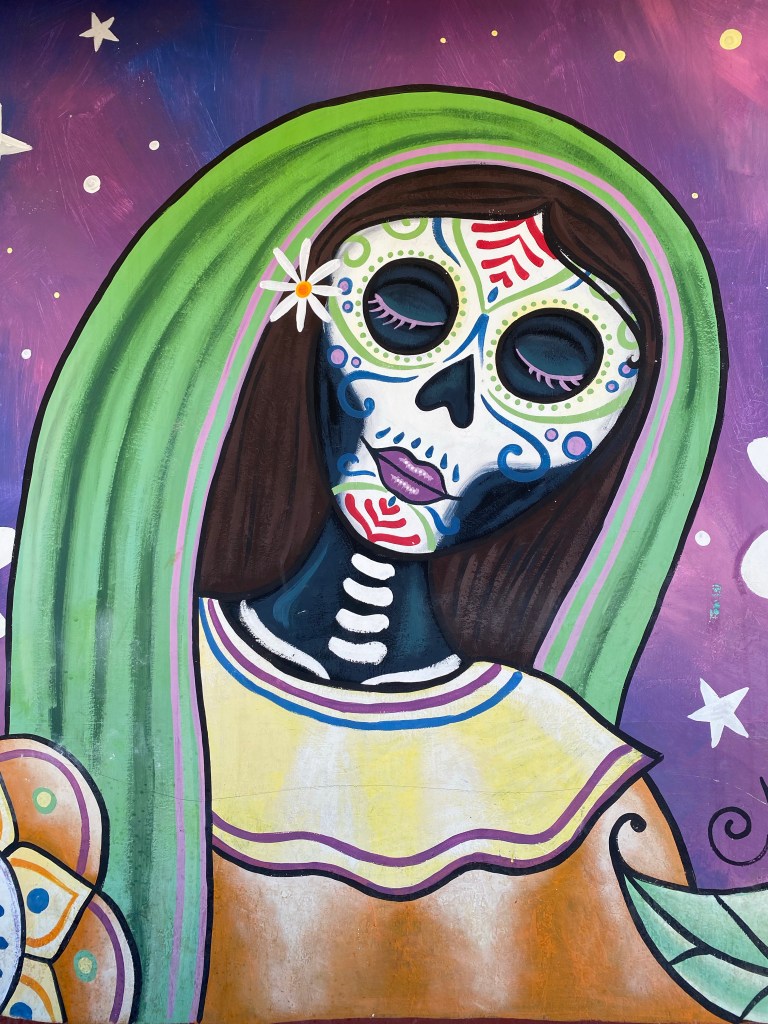
San Salvador street art Leighton taking in the San Salvador views
In my previous post I ended at the spa and I’ll start there now. We sent Leighton home on an evening flight and settled in for a good sleep in preparation for our trip out to Suchitoto. Not that it was a difficult trip – one hour and and half Uber ride and we’d arrived at our cute hotel – Casa 1800.
Our room at Casa 1800 – perfect beds, soft linens and sooo quiet!Breakfast views from the hotel restaurant
Suchitoto was as hot as San Salvador had been so we had some lunch and then (literally) chilled out in our room until early evening. It’s a relatively compact little colonial town with a pretty square surrounded by restaurants and stores and of course, a church. I had to include a still photo of the church lit with my favourite colour and a video of the light show and chiming bells.
Bells and a colour light show
The next day we set out to hike to the nearby waterfall – Cascada Los Tercios. We knew there’d be no water (dry season) but the hexagonal rock formations (basalt columns formed from cooling lava) still made for a fascinating visit. I didn’t have proper footwear so only hiked about 2/3 of the way down but Megan stepped up (and down) and got the prize photo from the very bottom. It was a hot, gruelling uphill hike back to town but all in all a great morning to follow with an afternoon at the pool!
📷 Megan Madden
We also took a boat trip to get out on the actual lake itself – Suchitlán. A pleasant trip with a Spanish speaking guide (I wasn’t able to barrage him with questions as usual) got us out on the water at sunset with one unusual stop.
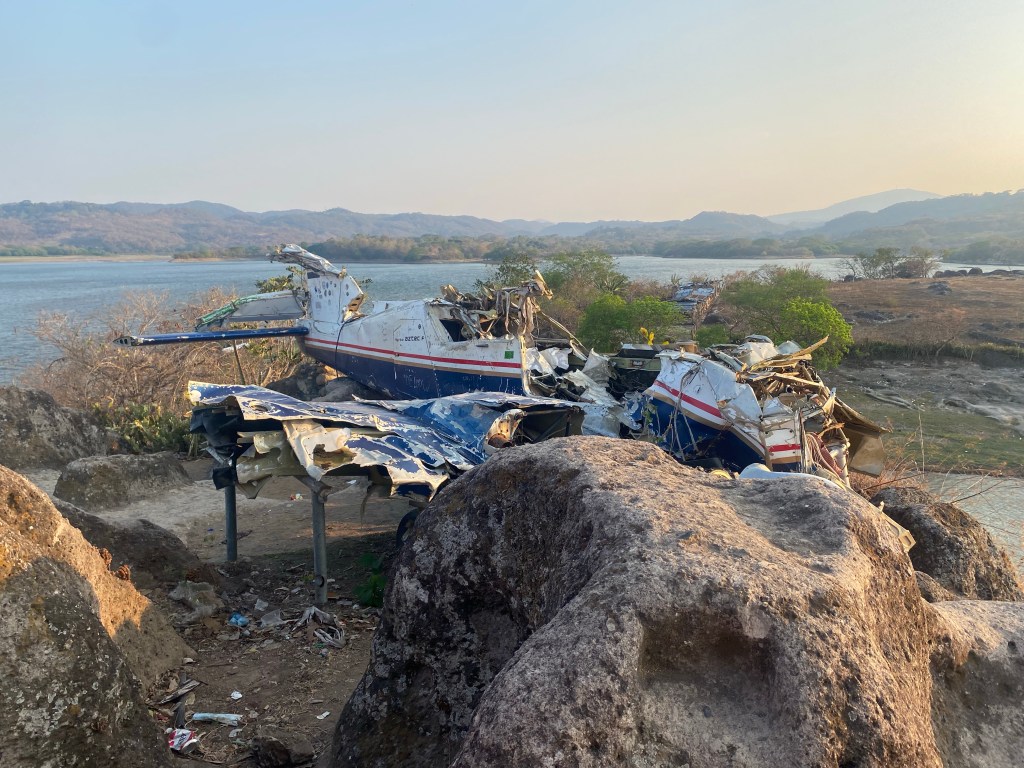
Our one stop on the boat ride
We were dropped off on Isla El Ermitano, climbed a rickety ladder to the top of the rock where the wreck of a small El Salvadoran Air Force Plane is permanently perched. Apparently it crashed into the lake during a post maintenance test run and 3 of the 4 people on board perished. After the investigation was completed it was dragged from the water and up the rock to be put on display. The epitome of dark tourism.
Super sketch ladder Main attraction of our boat ride on Lake Suchitlán
On the actual day of my 50th birthday, Megan had meetings scheduled most of the day (hence why we celebrated earlier in San Salvador) so I booked myself into an Indigo workshop. My host, Irma was absolutely lovely and I spent a couple of hours with her learning about El Salvador’s indigo industry and its history and just chatting about life in general. Briefly, El Salvador is the largest produce of indigo in Latin America and apparently their indigo is the most pigmented in the world. Indigo is extracted from the leaves of a plant that are macerated in concrete vats of water, left to ferment, oxygenated and then the pigment is collected from the bottom of the vats after it settles out and ground into powder.
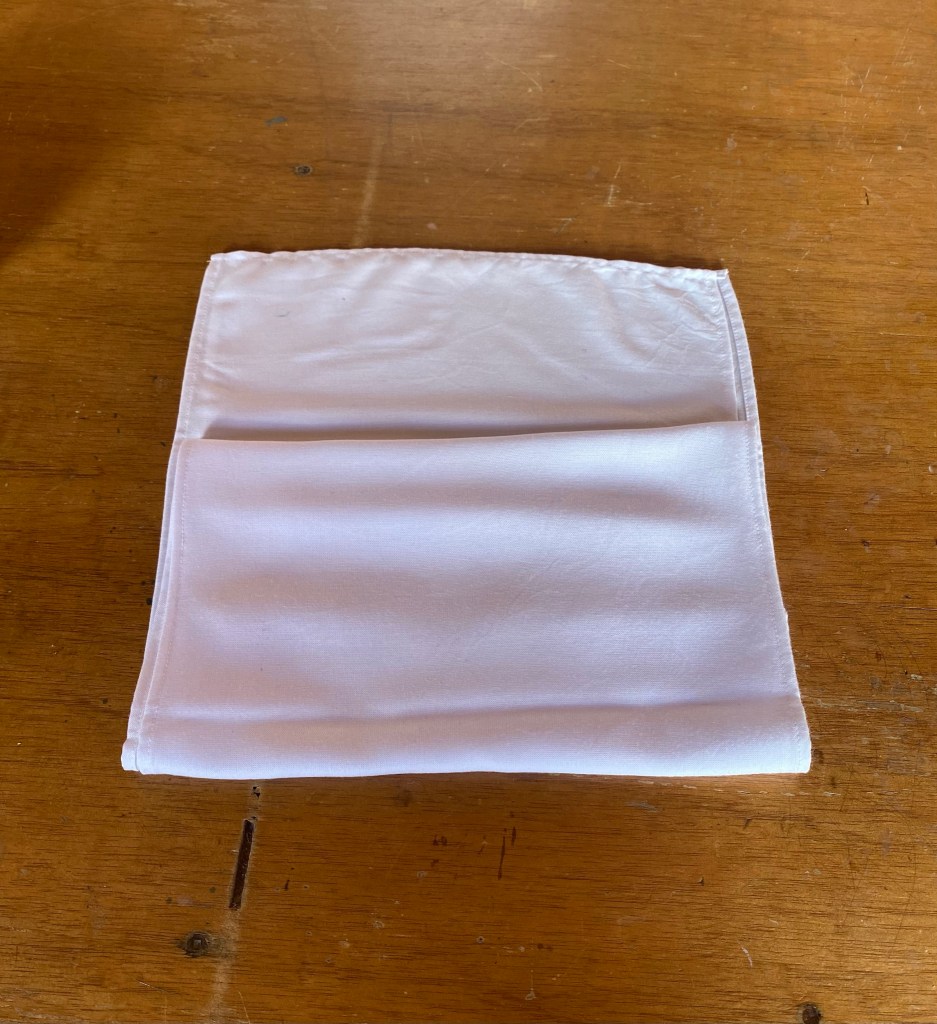
The scarf before
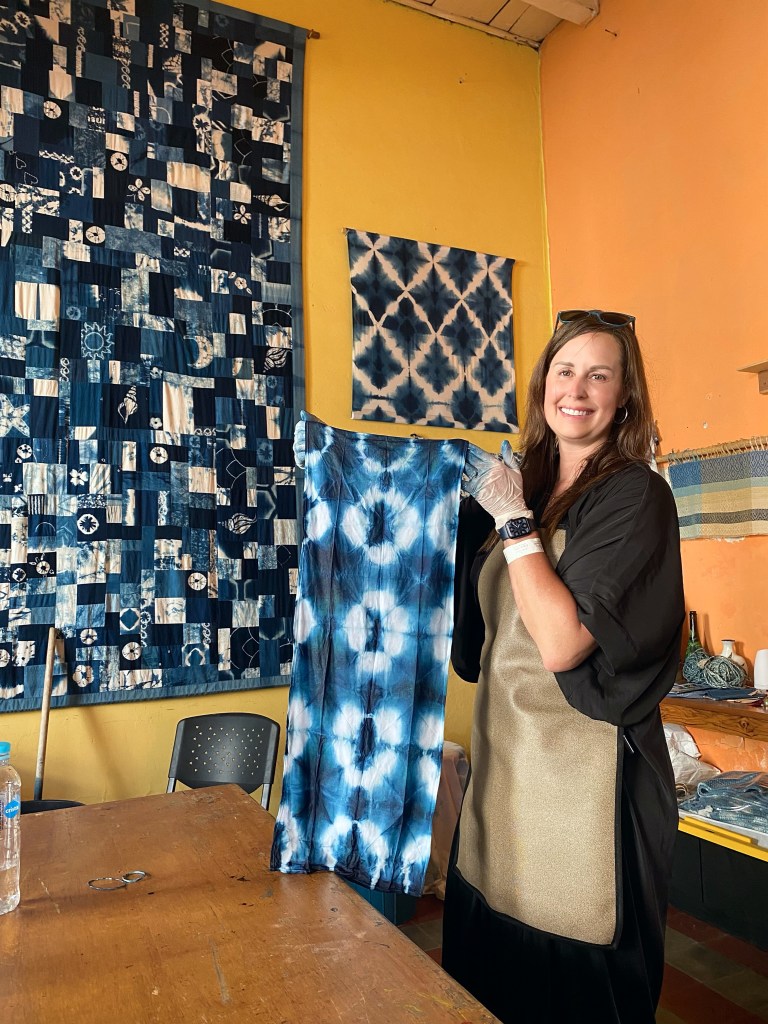
And then we dyed scarves. The process involved folding the scarf (has to be made of natural fibre, not synthetic) multiple times in order to achieve the desired pattern. And then dipping it into the fermented dye bath multiple times to deepen the colours. The dye originally looks green, but when exposed to air turns blue. And the fermented dye baths are made using various combinations of chemicals.
First round of dipping into the indigo dye bathThe final result! Irma was kind enough to dry it and sew in loops on the ends to make it into a wall hanging when I get home. Last night in Suchitoto and my birthday feast at our pretty exceptional hotel restaurant
We departed at 6am the next morning to travel back to the beach (El Tunco). We had an interesting trip with an American expat who’d been living in El Salvador for the past 17 years (he’s married to a Salvadoran). He was quite blustery over text so we weren’t sure what to expect and although he was definitely ‘a lot’, he did give us some good information!
El Tunco malecón
And the rest of our stay in El Salvador can be summed up with these 2 pictures. A few days of relaxation in the sun, in a fun little beach town!
View from Papaya Surf Club of the malecón and beach at sunset. Home of the perfect mojito Street art EL Tunco
Fitting to begin and end this last chapter of San Salvador with the most beautiful street art! Go to El Salvador if you get the chance!!
After a quick stop in Washington DC to see the White House, the Washington Monument and the Holocaust Museum, I met up with the hubs and our friend Megan in El Salvador. Megan had been there a week and a half already, Leighton joined her on Feb 24 and I flew in the night of Feb 27.
The two of them were settled in the beach house that would be our home for the next 3 nights until we left for 6 days to Guatemala.
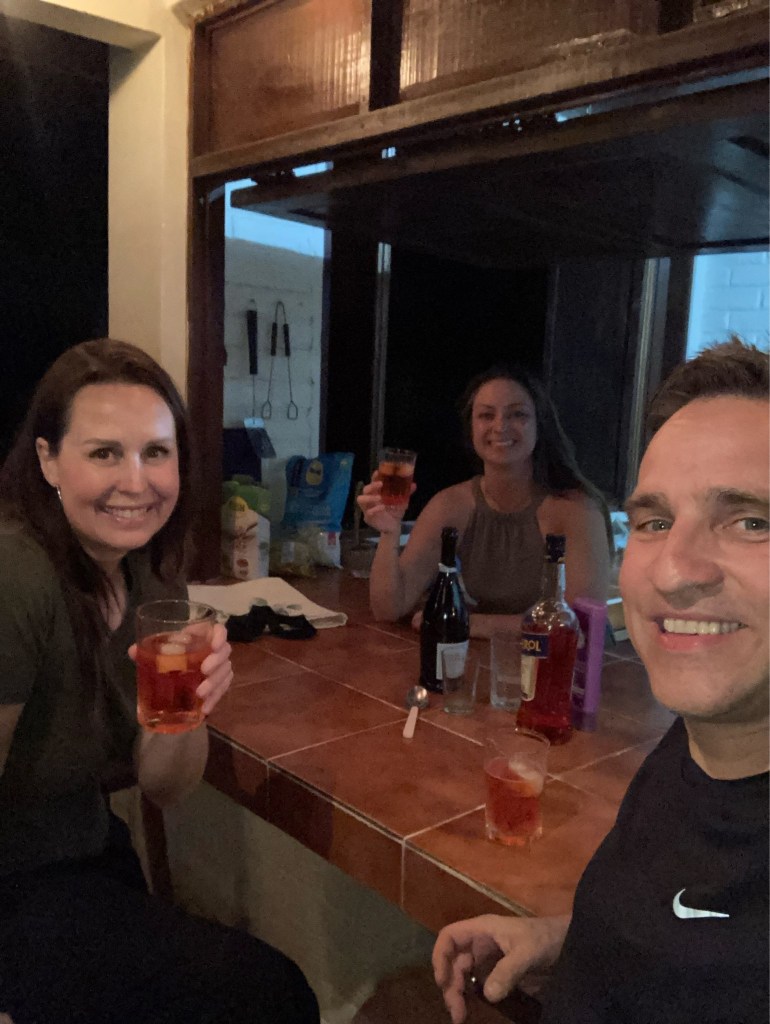
Sunset view at from our beach side house in El ZonteSame view – daytime, by the pool with the addition of this always entertaining human!Duty free Aperol Spritzes to celebrate all of us finally arriving!
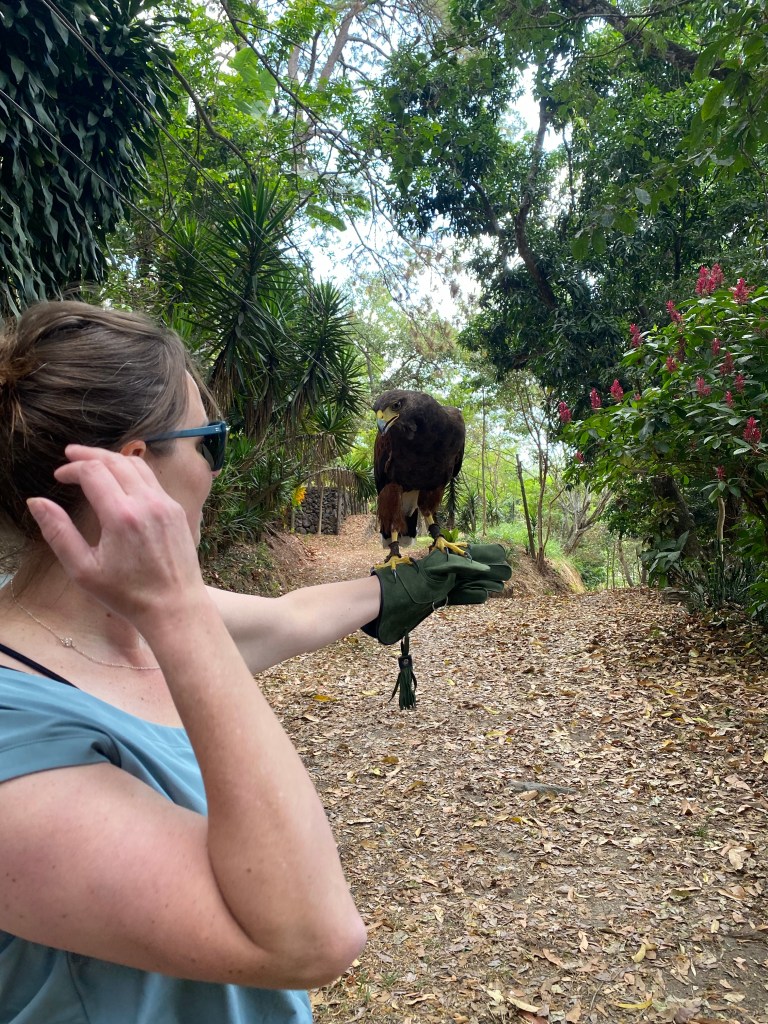
Megan, as usual, had done brilliant research on how we were going to spend our time in El Salvador and Guatemala and had made contact with a local woman, Vanessa, who would be our private guide for 4 days (2 of the days I was there and 2 days prior). So the very next day we headed out with Vanessa. Our first stop was to meet her dad to learn about falconry – definitely not something I would have pegged as my first activity in El Salvador! But it was fantastic – super interesting. It’s one of those things I’ve always wanted to read up on since I met someone else a few years ago who was really into it, but never got around to. Essentially falconry is the hunting of wild animals in their natural state and habitat by means of a trained bird of prey, in this case a Harris’s Hawk. Vanessa’s dad is a trained veterinarian who specializes in animal behaviour and he also has two beautiful Weimaraner dogs too. His English was impeccable and we spent a couple of hours learning about him, the birds and the dogs!
Step one of falconry – experience having a Harris’s Hawk perched on your thick leather glove adorned hand It’s intimidating when this somewhat large bird comes at you with wings and talons outstretched! Using a swing lure for training and exercise purposes, but also conditioning her to ‘give up’ her prey if needed without lashing out. Essentially a ‘bait and switch’
Our next stop was a local market for lunch and to pick up some groceries (mostly fruit and veg) for the house. After a leisurely lunch we went for coffee and ended up sitting there for more than an hour just peppering Vanessa with questions about El Salvador. Unfortunately, our day got a bit derailed and our other major stop, Los Chorros water park, didn’t happen (partly because we didn’t realize it closed at 4pm). The other reason we didn’t get as much accomplished as we wanted is the traffic in San Salvador, by the time we’d made two more stops (at a restaurant for takeout Salvadoran food for dinner and a mall for more groceries) we were ready to go back to the beach!
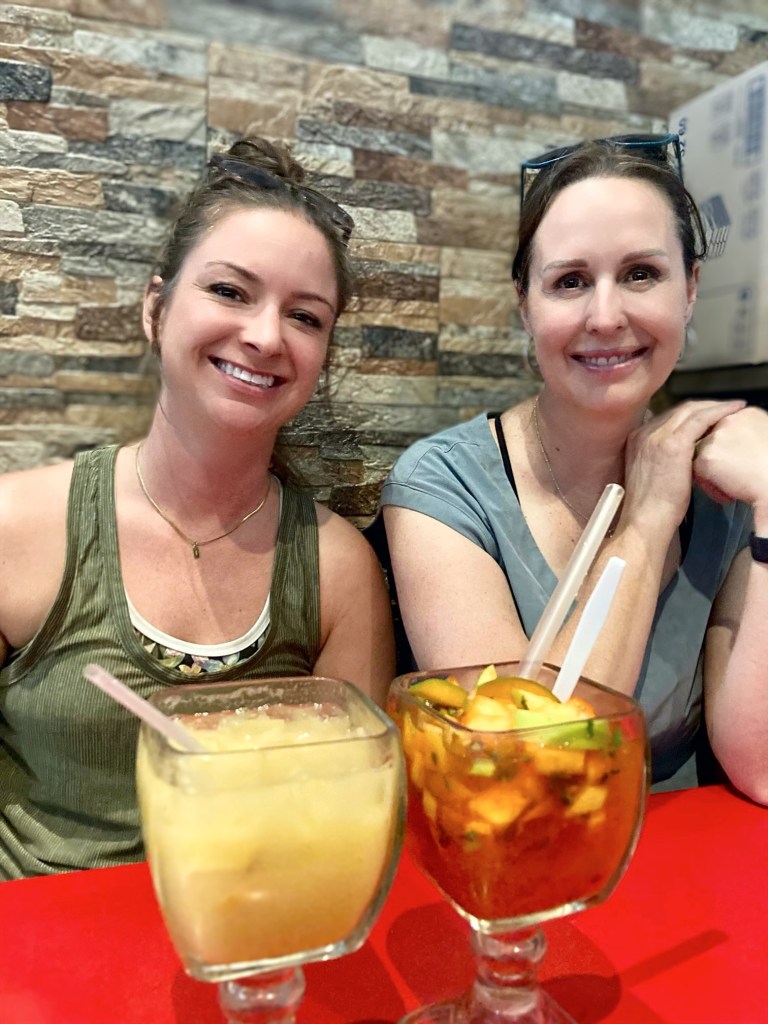
The drink on the right is fittingly called an ‘ensalada’ and is essentially fruit salad with some extra juice – it may be the best thing I’ve eaten? drank? in Central America Cashew fruits with the unshelled cashew nuts still attached. We also tried a drink made with the fruits and in India they use the fruit to make a (very strong and not very enjoyable) liquor. 📷 Megan MaddenRest day back in El Zonte – Leighton’s favourite spot, complete with an Aperol Spritz
The following day was a beach day for Leighton and I/work day for Megan. We also did some research on what our plan would be for our next day with Vanessa. We knew we’d be exploring the Ruta de las Flores but there’s so much to see and do we wanted to make sure we covered the most important things! The Ruta is a historic, cultural, gastronomic and natural route through 6 different towns northwest of San Salvador. We essentially made it to one town, Ataco, one waterfall and a rainbow slide. And we got to make the national dish, pupusas, in Ataco (which also happens to be Vanessa’s grandparents’ home town).
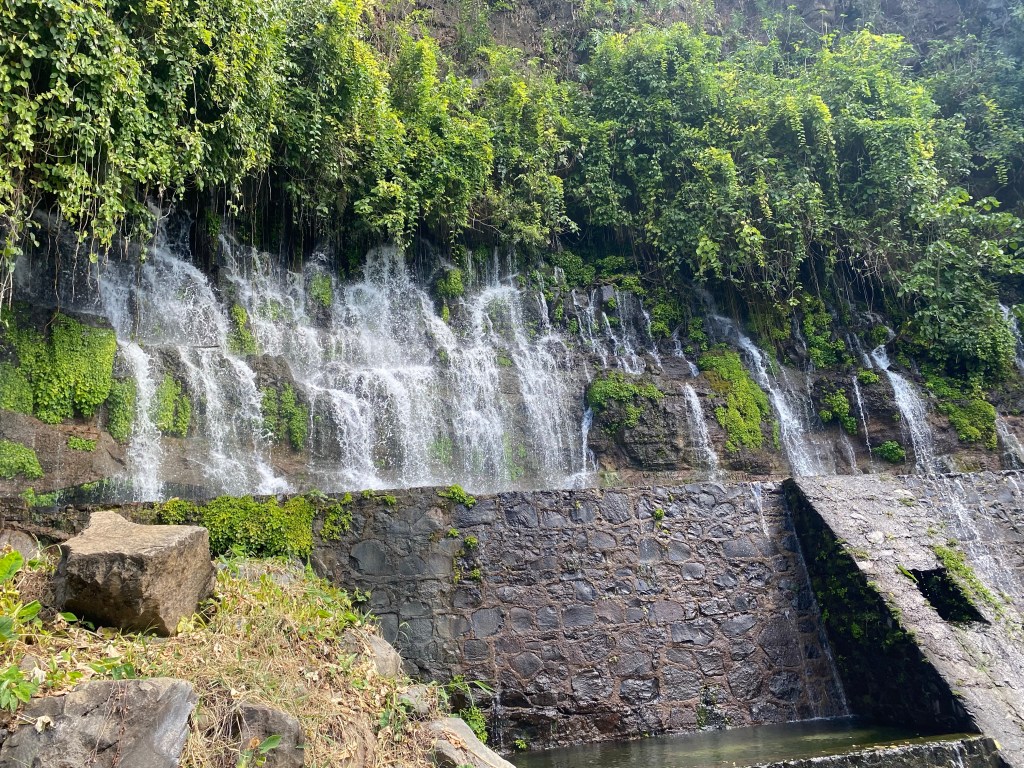
We have a bit of a running joke about walking/hiking in Central America. What is often referred to as a ‘short’ hike or walk mostly never turns out that way and our quick walk to Los Chorros waterfall was no exception. It may have at one time been a straightforward walk in on a partially cobblestone path but apparently the falls are on private property and access has been restricted to only those with a local approved guide. So we were about to walk right by the guy standing nonchalantly on the side of the road when Vanessa started talking to him and he explained that we needed to pay him 5 USD per person to have him take us there.
Now since the easy path is closed, we now have to hike up and down the side of the mountain on a narrow path. And as usual, it’s really, really hot! So instead of a quick 1km walk in, it’s probably twice that and it’s hard! Our quick 1 hour stop at a waterfall turns into 2 and a bit hours! But it was stunning! And the water was especially refreshing!
Stop #1 on our Ruta de las Flores tour – Los Chorros de La Calera waterfallsTaken from below – our first view
They have this thing in El Salvador that I hadn’t seen before (but probably exists in a lot of touristy places) in two locations – it’s a ‘rainbow’ slide that you tube down – no water involved, just tiny plastic rollers. At the same adventure park, they also had zip lining, a zip line you could ride a bike across, a labyrinth and an aerial swing. We opted for just the rainbow slide since we figured one ‘influencer’ activity for the day was enough 😆. It was super fun but not nearly long enough!!!
Leighton coming down the rainbow slide
Next stop was the charming town of Ataco for lunch. Not exactly local food this time but really exceptional Italian food in a beautiful garden setting – somewhere Vanessa had been many times.
Local weaver’s loom (in Ataco) 📷 Leighton BlashkoCouldn’t resist a photo of a pretty hydrangea arrangementStreet art in Ataco Making pupusas (basically stuffed corn tortillas). Harder than it looks!
At the end of our day with Vanessa, we met Carlos in San Salvador who would be delivering our rental car to take to Guatemala. Again, Megan’s resourcefulness was a lifesaver – apparently it’s difficult to find someone in El Salvador to rent you a vehicle to take to Guatemala but Carlos had everything organized including paperwork from his lawyer (now that we’re back I’m glad we didn’t have any reason to see if that paperwork was actually legit 😆). Driving through San Salvador back to the beach at night was a little stressful but nothing like what was to come!
The next day brought an uneventful drive from El Zonte to Antigua, after which we were happy to just go for a walk to dinner. We spent an entertaining hour at a roof top bar where the 3 stooges were bartending – long story short, we kept getting extra drinks because these poor guys had no idea what they were doing and they were repeatedly wandering around trying to figure out where drinks were supposed to go. So instead of them getting poured down the drain, we helped out and drank them!
Vanessa had recommended a ramen restaurant in Antigua so we had to check it out! The ramen was not the best I’ve ever had, but enjoyable!
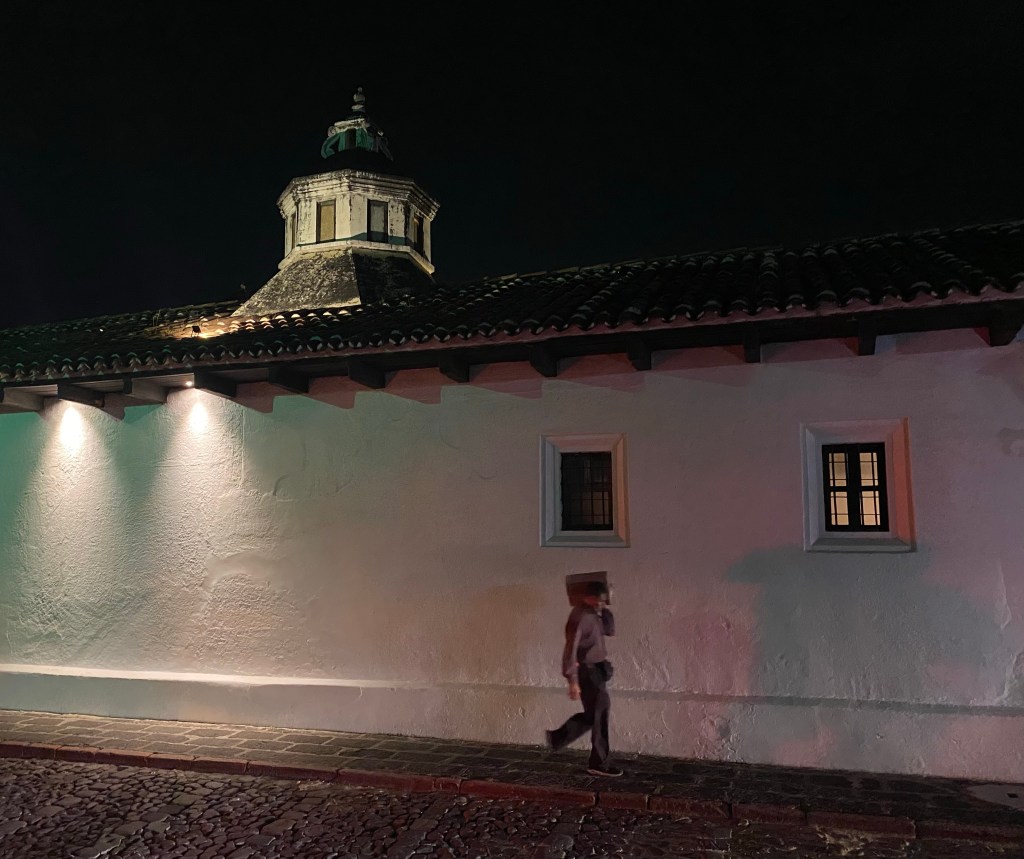
Evening in Antigua, GuatemalaJust another night shot in Antigua See photo explanation below. 📷 Leighton Blashko
This photo gives us lots to unpack. First and definitely most noticeable is the ‘chicken bus’ which is how they’re referred to by tourists and not the locals who actually use them for daily transportation. These are ubiquitous all over El Salvador and Guatemala and always brightly decorated by their drivers. Leighton got this shot from the terrace of our super cute heritage house. Still lots of overhead power lines in this old colonial city. Also notable are the cobblestone streets, the purple flowering tree (Jacaranda) and the tree covered hills in the background. The views in Antigua are stunning!
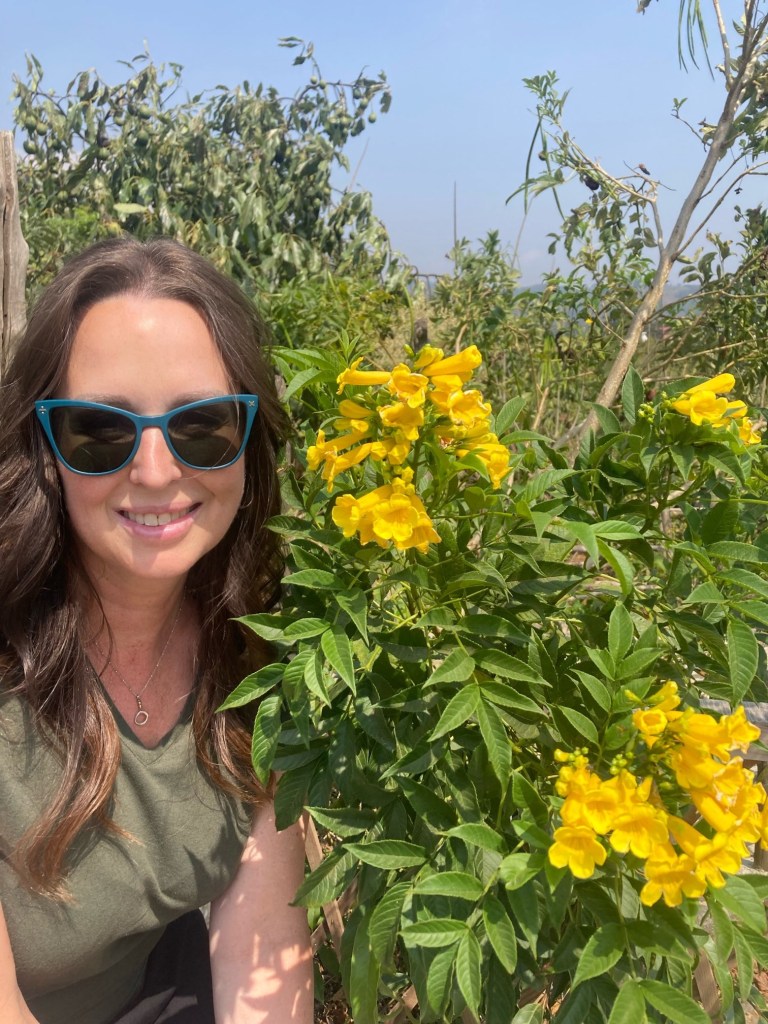
Day one in Guatemala saw us checking out a winery/avocado farm. Another entertaining excursion for sure! First we passed through a high mountain town with lots of traditionally dressed locals. Then we arrived at the winery where the tour was just about to get underway. Despite the website being in English and all the wines being labelled in English, no one there spoke any English. So we joined the tour in Spanish. I nearly broke my brain trying to understand but could really only pick out random words. Megan is far better after a few months of Spanish immersion in Nicaragua and some online tutoring! But there’s lots of obscure vocabulary associated with wine making so it was still difficult. All was not lost though, we saw avocado trees, took some cute photos, tasted some (pretty terrible) wines and had a nice lunch on a scenic patio!
I should mention in reference to the quality of the wines, that it’s the only wine tasting we’ve ever been to where no one bought any wine!!! And $70CAD for the best wine there was way out of our budget (and completely unreasonable)!
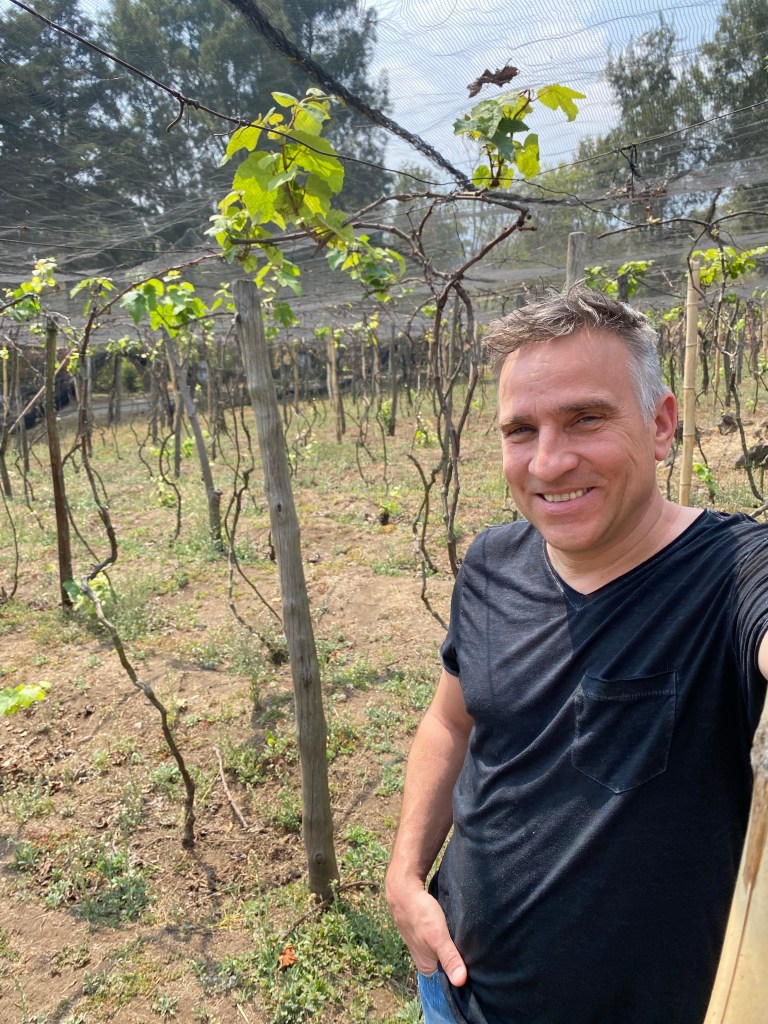
Megan adorning the ‘photo op’ sign at Chateau Viñedo Defay. Our (Spanish Only) tour through the vineyard and orchards led us to this elaborate stone structure in the middle of the field. Leighton and the grape vinesSince we couldn’t understand more than a few words here and there on the tour, we took photos! 📷 Leighton Blashko
I should mention here, that I obsessively (I’ll admit it) did all of the driving after we picked up our car in El Salvador. I really enjoy driving (usually) and I also really enjoy being in control 😆. Megan navigated and Leighton was designated as ‘photo journalist’ on our road trips. So you’ll see him credited in lots of my photos on this blog.
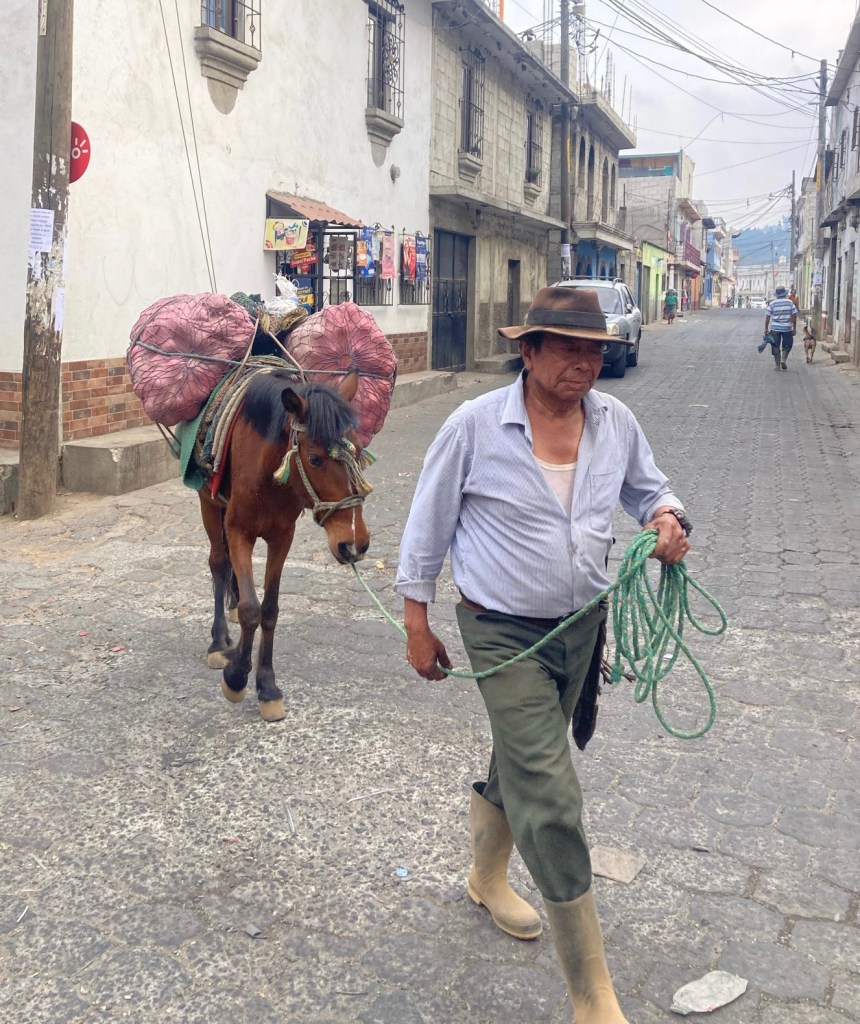
On the way back from the winery we took the opportunity to try to capture some photos of the locals. Leighton did pretty well while I maneuvered the streets and we both coached him on the upcoming photo ops!
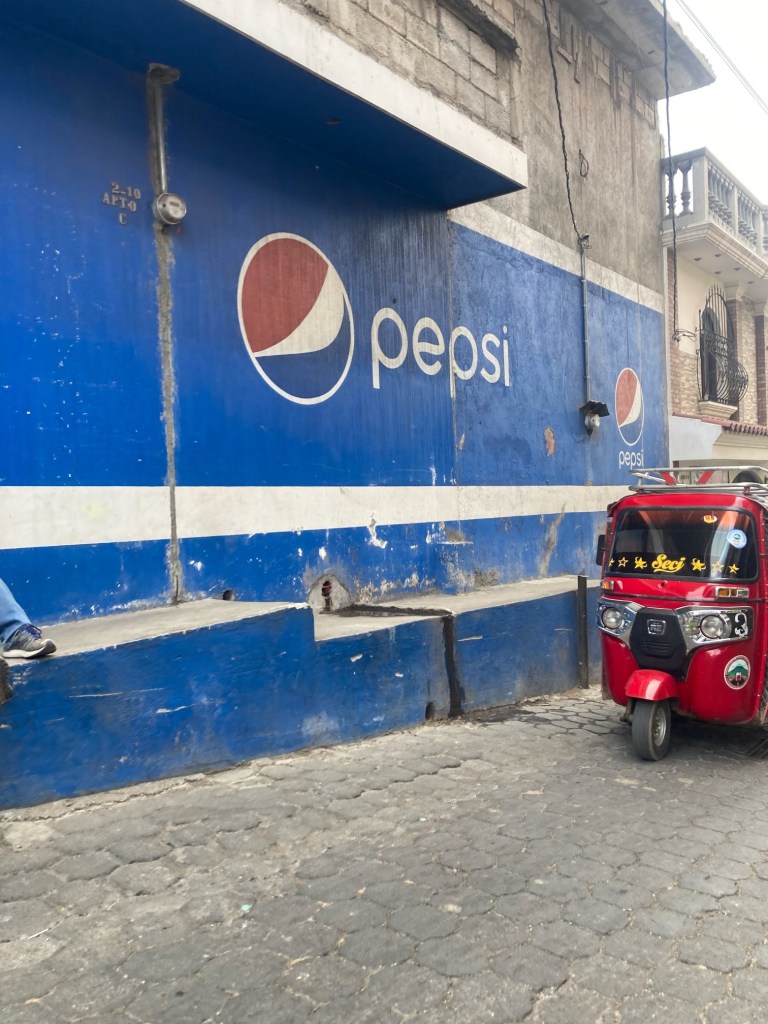
Small mountain town on the winery road with tons of character and local culture 📷 Leighton Blashko📷 Leighton Blashko We still can’t figure out if Coke or Pepsi won the cola wars in these two countries 😆 📷 Leighton Blashko
We stumbled on these beautiful creations as we left town on a sunny Sunday morning. These ‘carpets’ are actually flower petals meticulously placed on a bed of sawdust directly on the main roads in Antigua, and the photo was taken as we slowly drove by in the adjacent lane that wasn’t blocked off. We were fortunate to see them as they’re only found around Easter on Sundays during Lent and during the Holy Week, and only rotated through designated areas of the city. We could have easily been in Antigua on a Sunday when they were located in a completely different area of town! Or not even been there on a Sunday 😆
📷 Leighton Blashko
Our next destination after Antigua was Semuc Champey, a nature reserve near Lanquin. It’s 312 km from Antigua and can take anywhere from 6 to 7.5 hours to drive depending on traffic through Guatemala City and surrounding area. We were travelling on a Sunday and it was predicted to take around 6 hours. We made great time and arrived in Lanquin by 1:15pm. And that’s when the frustrating part of the trip started.
We arrived in town, met our contact on his motorcycle who took us to the ‘secure’ parking lot in town where our car was going to spend the next 2 nights. We then waited there, listening to the toucans, for our driver from the hotel to arrive with his 4 wheel drive truck to take us to the hotel. The 10km mountain road leading in to our Eco Lodge and Semuc Champey is partially under construction and partially an eroded, rocky trail that definitely requires a 4X4 to navigate and feels like it will rattle your teeth right out. It’s customary for everyone to ride in the back and they’ve kindly provided bars so you can stand up and brace yourself to hang on for dear life. Photo below is actually the good part of the road.
The other complicating factor about this trip is that the road is intermittently closed for periods of time for the construction. This meant that we showed up at 2:20 and couldn’t pass through the first closure (which we thought was the only one) until 3:10. We were relieved to be flying down the road on our way to cold beers in a hammock, only to be stopped again about 10 minutes later. This time we waited for over 2 hours. And a short 15 minutes after that we were at our lodge – arriving at 5:30, just before dark.
In case you haven’t added it all up, it took us 4 hours and 15 minutes to go 10km!!! The locals definitely capitalize on all the waiting time though and so we were offered lots of drinks and snacks along the way!
📷 Leighton Blashko
This little vignette was made possible by the fact that the power was out at the Eco Lodge when we got there. And stayed out until mid morning the next day. Dinner was partially by candlelight and partially by ‘smart phone placed on a glass’ light in order to see what we were eating, which in true Eco Lodge form was a vegetarian meal (the kitchen was being powered by generator).
📷 Leighton Blashko
After a typical jungle sleep with the chorus of insects that ramp up at night and the flowing river beside us in the background, we were up and formulating our plan for visiting the gorgeous natural pools of Semuc Champey. Our Eco lodge was still about 4km by road from the nature reserve and we were told about a 45 minute walk (partly on a riverside path, but mostly on the road). The lodge offers a tour that includes a sketchy cave tour, entrance to the park and a river raft back to the lodge but we weren’t interested in the caves and wanted to leave on our own time so our plan was to walk to the pools and then meet up with the tour at 3:30/4 to tube back with them.
You know when you travel and you end up with more experiences that are fodder for funny stories rather than mind blowing adventures? Guatemala kind of ended up being like that for us.
First of all, our little 45 minute walk ended up being more challenging than we thought. The combination of the heat and the constant hills and descents over the 4km (mostly on the dusty, rocky road in the direct sun) wasn’t the shady jungle walk we had imagined. The up side of this was that the pools were probably 10X more refreshing than they otherwise should have been!
📷 Megan Madden
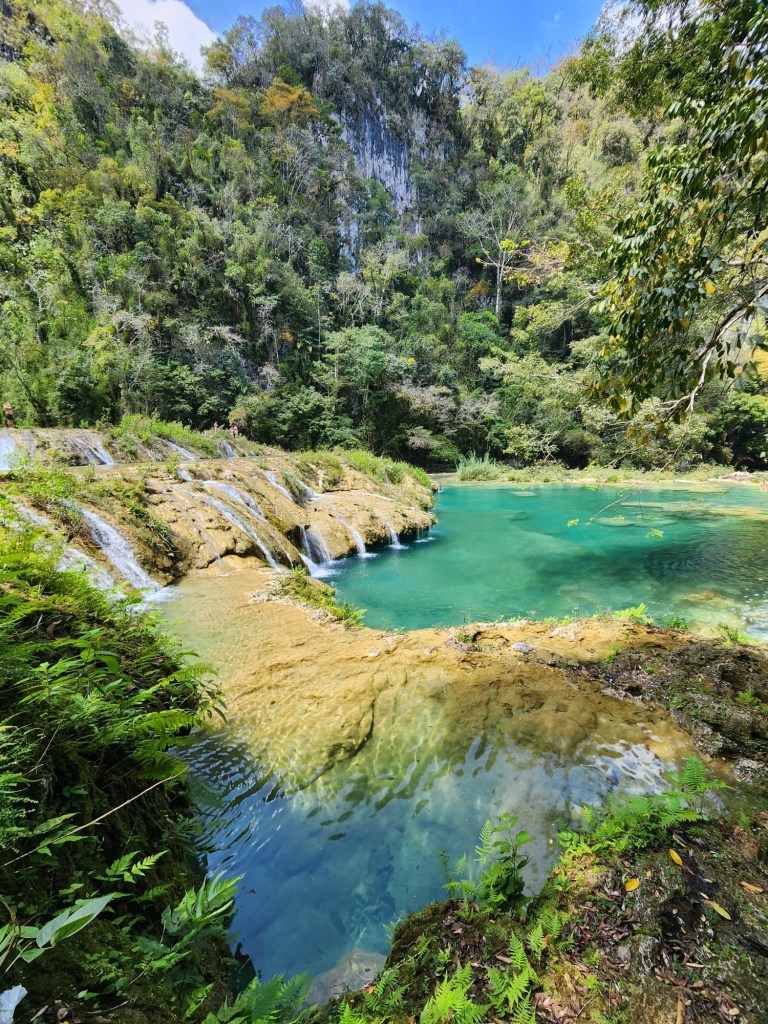
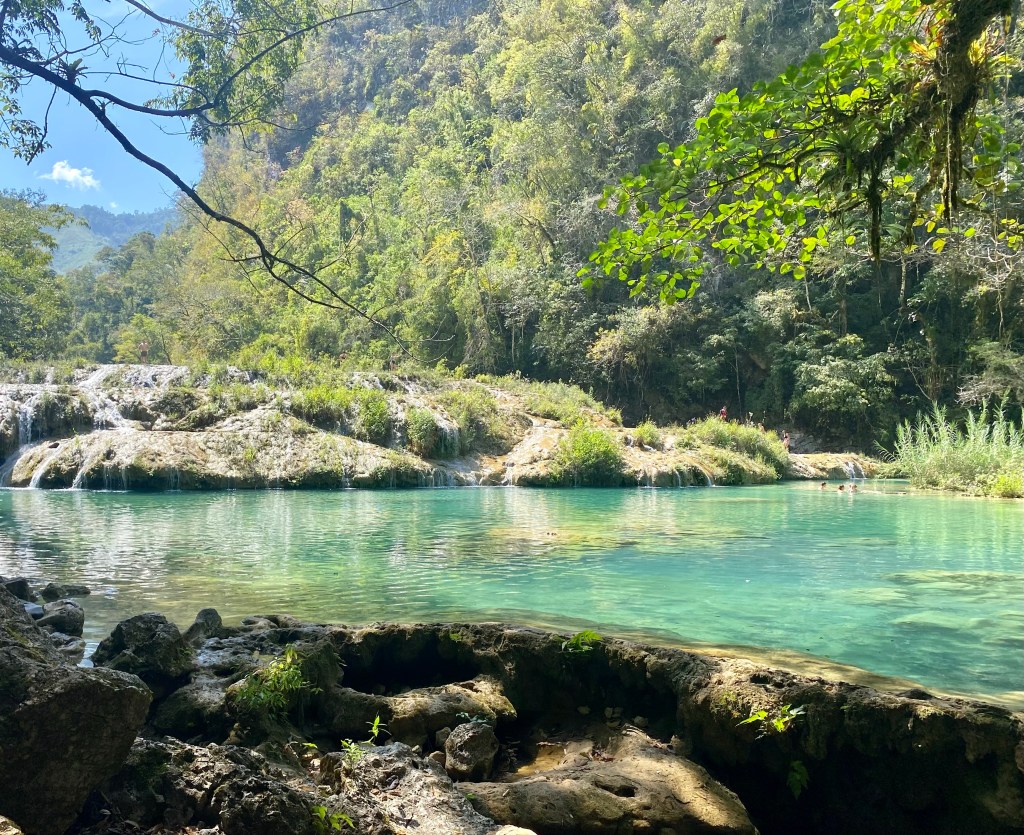
There’s no doubt this is a beautiful place with one pristine clear blue pool cascading into another. And the water was the perfect temperature! Hunger pangs finally lured us out of the water and we hiked back down to have lunch at a restaurant and be ready to start our tubing trip down the river. The ‘restaurant’ appeared to be run by a local matriarch who had young people out ‘recruiting’ customers. We had ‘Fred’ keeping us company from the moment we left the pools and agreed to come for his lunch ‘buffet’.
‘Cave FC’ as Leighton christened the restaurant….get it? 📷 Leighton Blashko
While we were eating, we negotiated with ‘Fred’ to take us in tubes down the river (we’d mentioned we were waiting for the group and he offered) because we didn’t want to wait the extra hour (or 2). This turned out to be a full out error in judgement on our part. I’ll fully admit I was losing patience as we stood around in our swimsuits waiting for ‘Fred’ and his buddies to inflate our tiny tire tubes and cap them with pieces of garbage bag that was supposed to hold for the entire float. We also had to carry all our stuff with us in a garbage bag (it would have gone by truck if we’d joined the group). But against better judgement we stuck with the plan and were eventually floating down the river in our unstable tubes with Leighton’s bubbling away and us praying it would make it to the end without losing all its air.
So, turns out this is a bit more technical float than we’re used to on the Pembina River or out in Penticton. There are rapids and there are ways to go through the rapids safely. The first set saw us going through mass confusion as ‘Fred’s’ limited English and our limited Spanish meant all 3 of us were completely confused by the instructions he was yelling at us and he was super frustrated. We ended up with our feet hooked in each other’s armpits to make a convoy of tubes but I was in the very back instead of him which wasn’t ideal but ended up working. He rearranged us for the next set of rapids and we navigated them uneventfully.
The third set of rapids was apparently too shallow to tube through so we portaged. Because Leighton and I didn’t have water shoes or running shoes we could sacrifice to the river, it meant hiking through the riverside gravel, leaves, sharp rocks etc. in our bare feet. Ask Leighton how happy I was and he’ll tell you he’s never heard that many ‘F sharps’ from me in all our years together. I was getting super creative at stringing together expletives over that 15 minutes or so…
Back in the water, we were soon upon the next (and as it turned out, our last) set of rapids. This one was also pretty shallow so we started navigating it in our little convoy again with repeated shouts of ‘asses up’ from ‘Fred’. Well ‘Fred’s’ tube gets caught on a rock and the next thing we see is it floating by us, just a little too far to reach. And he’s swimming the rapids behind us. I started paddling like my life depended on it to reach his tube but it wasn’t happening.
A few minutes before that, Megan had seen some rock formations that she thought she recognized from her short morning walk by the river. So when I saw a rocky beach a little ways ahead, I calculated that it must be where we needed to ‘dock’ to get to the hotel. At this point, I knew I wasn’t getting the tube, and there was no way I was going to risk floating past our hotel so I started paddling like hell for shore. I honestly don’t recall if I was just dragging Megan and Leighton or if they were on the same page as me but I was on a mission! Just as we touched shore, ‘Fred’ started calling and motioning to us from the middle of the river to keep going without him. At this point we were all in agreement – we were done with tubing and we knew the road should be somewhere close to the river despite the fact we now knew we were nowhere near our hotel.
We bushwhacked our way to a corn field (I only grabbed on to one thorny branch and stepped on a few prickly things….), skirted the edge and found a path that seemed to be heading in the right direction. I should also mention that ‘Fred’ had given up on his tube and randomly rejoined us about 20 minutes later so was at least able to confirm that we were going the right way. Shortly thereafter, we were all blissfully happy to rejoin the actual path along the river to our lodge!
We met some great people at dinner and had a good sleep in anticipation of our long (7+ hour) drive to Lake Atitlán the next morning and booked a 6:45 shuttle out in hopes of missing the construction and getting back to our car at a decent time.
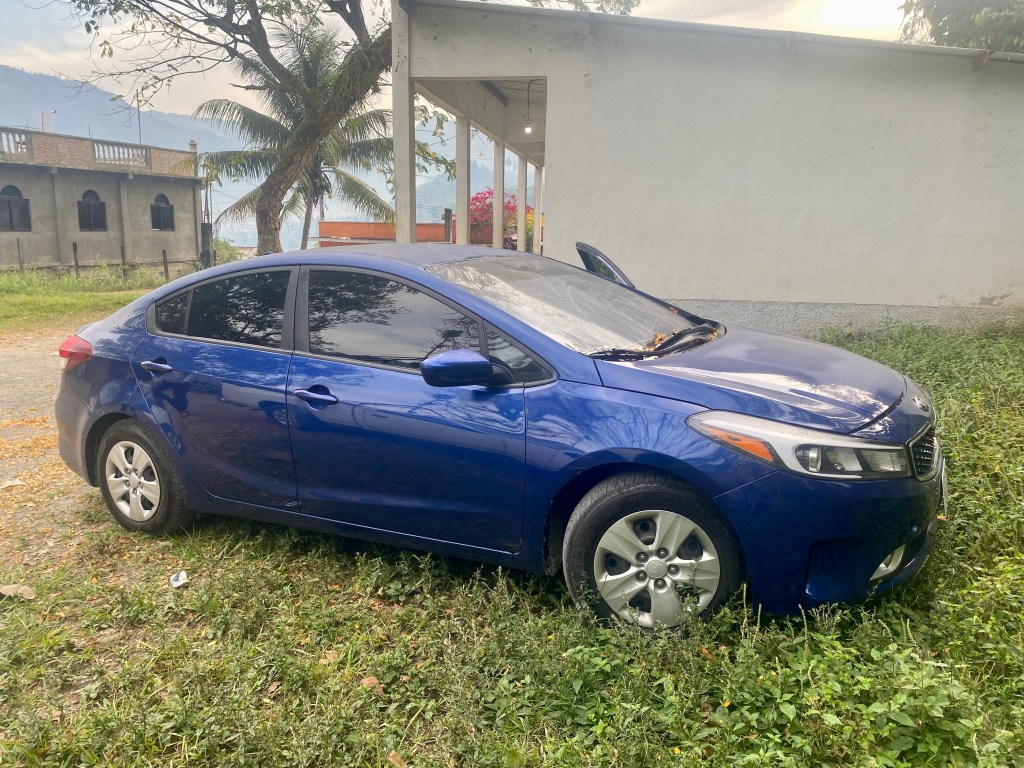
Our Kia Forte with blacked out windows all around (including the windshield). Like every vehicle in this country she’d seen some things in her 54,000 miles and definitely wasn’t pristine!
Now you may notice that there are no pictures of a lake to follow up my reference to traveling to Lake Atitlán…..
We drove 2 1/2 hours from when we jumped out of the back of the 4X4 through some of the most winding, steep, speed bump riddled mountain highways I’ve ever driven on only to find ourselves parked on the side of the highway behind cars and truckloads of locals, truckloads of Brahma bulls, motorbikes etc., without a clue as to why we were stopped. We joined the line and scoped out the situation for half an hour or so before I got brave asked the woman selling snacks ‘Accidente o construcción?’. Her reply was ‘No, manifestación’ and mine was ‘Oh, gracias’. Now somewhere I recalled learning ‘manifestación’ on Duolingo but it took google and our limited service to recall that it meant ‘protest’. So we sat with that for a while and decided we needed more information.
So I started to ask everyone walking by ‘Hablas inglés?’ and was successful on my second try! A Salvadoran from Iowa on holidays in Guatemala who’d also been at Semuc Champey the day before was on his way back to Guatemala City. He was able to tell us it was military veterans protesting public programming and that they had stopped protesting at 4pm the day before but they weren’t giving any clues as to what their plan was for that day. At this point it was 1:30 and we were still 4.5 to 5 hours away from Lake Atitlán even if we got through the protest right away. We were glad to have our new Salvadoran friend there to see what he would decide to do because turning back meant 2 hours and 15 minutes on the same treacherous roads back the way we’d come. And the only other way to Atitlán would be through Guatemala City and Antigua for another 9 hours of driving from where we sat. He turned back.
We made the group decision to turn back and stay in Antigua 2 more nights and scrap our visit to Atitlán. There’s so much more to see in Guatemala that we’ll just have to come back someday! The other complication was that Megan had multiple meetings booked for the next day and couldn’t be traveling so we couldn’t just stay part way and then go the rest of the way to the lake the next day – we needed to be somewhere with reliable wifi. I was happy to go back to Antigua – it’s an ‘easy’ city with a great food scene and I hadn’t had the chance to delve into it’s history during our previous brief stay.
The 7.5 hours back to Antigua was undoubtedly the most challenging and dangerous drive I’ve ever done. Part of what made it difficult is that I didn’t wholly trust our car mechanically – the brakes were pulsating and it was underpowered for the steep climbs we were making. I had one hand on the park brake at all times going downhill. But we made it safely through the 2+ hours of steep climbs and descents and thought we were through the worst of it. Turns out not, the number of sketchy transport trucks on the winding roads through tiny towns was unfathomable. And some of them crawled up the hills at 10km/h and others were bearing down on us from behind. So I had no choice but to pass when at all remotely reasonable. Then it got dark… I also now have an irrational fear of speed bumps – the speed bumps in Guatemala are vicious. Even at normal speeds I was grinding the undercarriage off the car. I had to approach every one at an angle and even then the odd one would attack! So at night I was terrified I was going to miss seeing one and hit it at full speed!
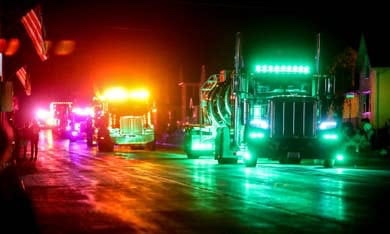
And the sketchy transport trucks – we were discussing whether it would be better to be in front of them or behind them in the event that their brakes failed because there’s absolutely nowhere to go to avoid an accident. And these trucks look rough! Also – there are so many vehicles, commercial and private, on the road with no tail lights or even headlights! In contrast (see below) most of these trucks have been decked out in lights of all colours of the spectrum – the tail lights might not work but the ‘hot tub’ lights do!! Our conversation revolved endlessly around speculating about the motivation behind all of this and who was legislating around safety in commercial hauling!
📷 Megan Madden
We made it to Antigua at about 9:30pm and immediately fell into bed in the villa Megan found us at the last minute for $90 a night. The next day I slept in til 9 and then Leighton and I left Megan to her conference calls and went to explore Antigua before our walking tour at 3pm. We could have potentially day tripped to Atitlán but there was no way I was sitting in a car for even a minute again that day!
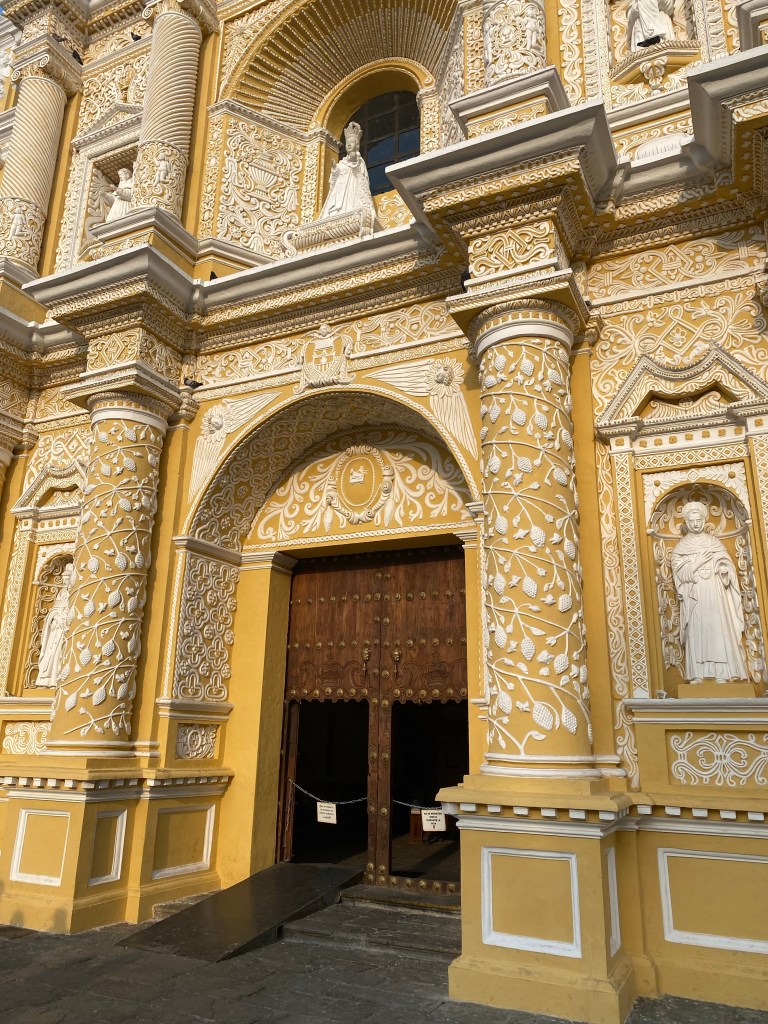
La Iglesia de la Merced – baroque church
Love the colonial architecture of this city. Even though, just like so many places in the world it all came with a price paid by the indigenous cultures and was procured as ill gotten gains by the Spanish and the Vatican. Later, the Americans and the Germans resettled the abandoned city after the capital was moved and everyone left for Guatemala City. The upside of that was the restoration of Antigua as it’s definitely a gem! It’s also a UNESCO world heritage city.
Santa Catalina Arch – built in 1694 and used by nuns to cross over the street and between buildings incognito Antigua museum with a purple Jacaranda in the foreground from the Parque Central
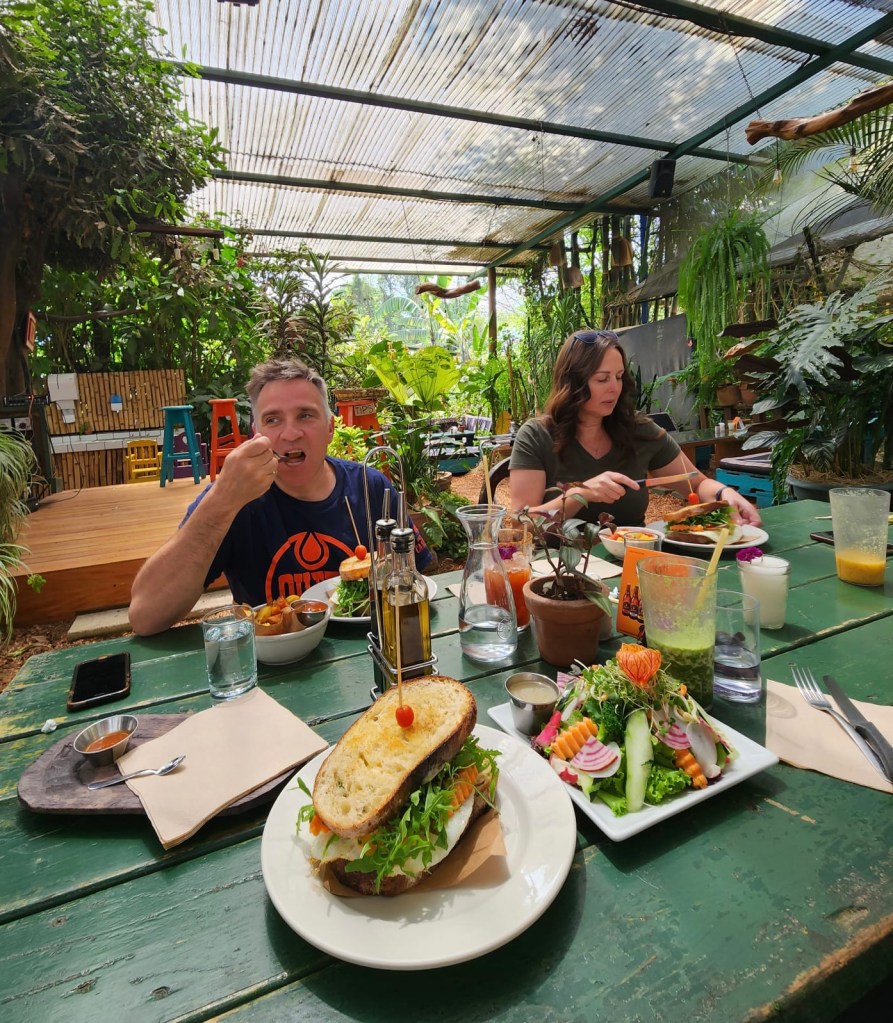
I had to include at least one food picture. We’ve definitely been eating a mix of local and international food. A lot of the local food here is pretty ‘brown’ and fried and sometimes my craving for fruits and vegetables is overwhelming! We stopped at a local farm for breakfast on our way out of Antigua back to El Salvador and it was delicious! Full of fruits and veg!
Caoba Farm restaurant – Antigua
After a second great sleep in our villa in Antigua we were on the road again back to San Salvador to return the car and get ready to send Leighton home the following morning. We were slightly worried about running into another protest and getting delayed or even not being able to get back to El Salvador but there were no issues and the drive was relatively uneventful. Oh, except for the part where we almost weren’t able to cross the border! Apparently when we crossed into Guatemala we were supposed to get a stamp in our passports. Now the border crossing between Guatemala and El Salvador is a mess. On the way into Guatemala, first we had to drive into oncoming traffic to go around all the trucks waiting to cross (not sure how long they have to sit there but people were waving us by). Then we stopped at immigration, someone took our passports and handed us a piece of paper. And despite looking everywhere for another ‘legitimate’ check before proceeding, one guy just took a quick glance at our passports and waved us through.
Turns out someone on the Guatemala side was supposed to stamp our passports. But none of us can figure out where that was supposed to happen! So coming back, after again maneuvering past the long line of trucks, we stopped at the immigration office and the stamp issue was brought to our attention. We were sent around the building where everyone just shrugged and finally we were waved on with a ‘no posible’ as our parting words! The next immigration officer (presumably Salvadoran) also asked where our stamps were. He spoke some English and made Megan and Leighton come with him to check the passports in the system. Everything must have been fine because he sent us on our way! Another big sigh of relief!
We finished the day by checking in at Hotel Fotherhouse and going out for dinner at Merkato close by for many cocktails and some exceptional sushi!
Oh – and I forgot to mention that one leg of Leighton’s flight got cancelled so instead of leaving at 9:45am he left at 11:30 the next night so we had him for one extra day! And it just so happened that it was the day that Megan surprised me with a spa visit for a slightly early birthday gift! So Leighton got to celebrate with us too!!! Megan totally spoiled me at the spa with a massage, facial and lunch! Super sweet!!!
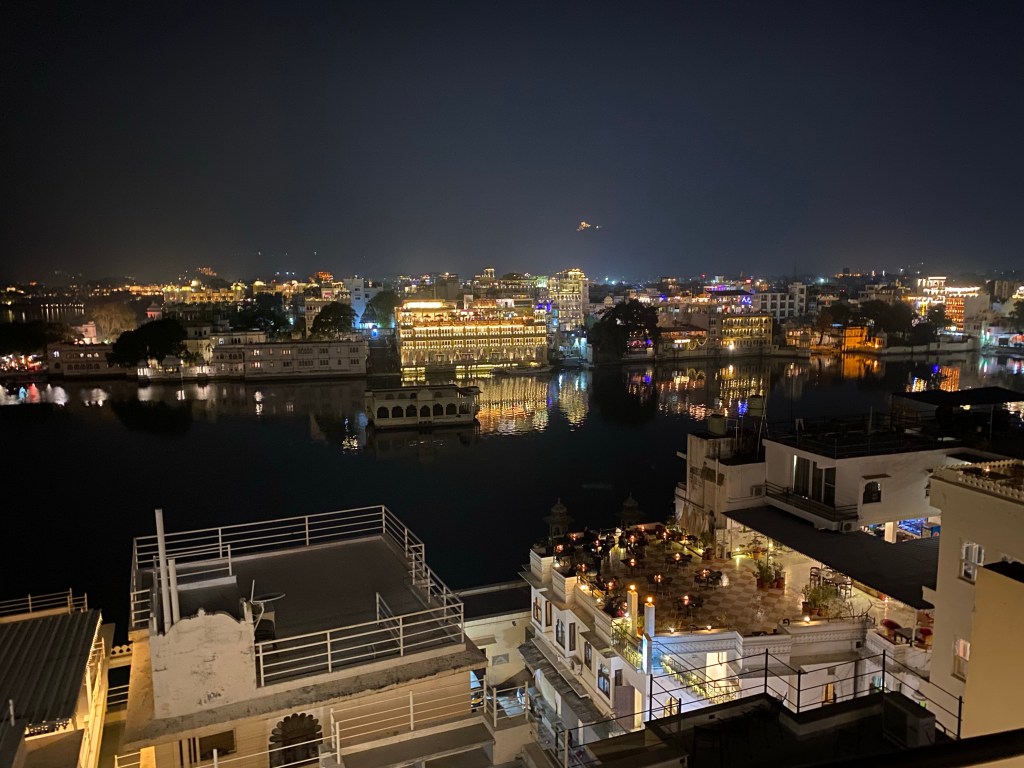
City views from the spa
And that wraps up El Salvador and Guatemala with Leighton! Megan and I are in El Salvador for another week but I’ll cover that off later.
Attempting to get Leighton’s attention but it really just looks like I’m waving goodbye 😀
I spent a week in Rome after Egypt on my own – my first true solo travel experience. Solo travel is something they say everyone needs to try. And while I enjoyed the freedom of it, I think I’d need to ‘tweak’ my approach a little to make it a bit more fun and more social.
Leighton was originally supposed to meet me in Rome but after our decision to abandon Peru and Machu Picchu due to the political unrest there, we decided that it made more sense for him to just meet me in El Salvador (our replacement destination for Peru). I was disappointed not to have his company but knew I was resourceful enough to make the most of it on my own. And I absolutely loved Rome so I know I have to go back to share it with Leighton (also I didn’t get to eat ALL the things and even missed out on a couple of the major attractions so I will NEED to go back 😄).
Just the way it worked out, I spent the first 3 days entirely on my own, wandering from one spectacular sight to another and beginning to sample some of the things on my list of ‘must eats’ for Rome! In retrospect, I would have spread my guided tours over the whole week to give myself a chance to meet and interact with more people. Rome is shockingly full of tourists, even in the third week of February. I found the locals polite, but not overly warm or friendly so most interactions were brief and to the point.
I had guided tours booked for the Vatican, Colosseum and Trastevere for later in the week so concentrated on seeing places that were free to enter and that would help me get as many steps in as possible. Turns out there’s no shortage of places to walk to and before you know it, you’ve covered almost 20km and 25000 steps! I’m not including photos of every single location that I visited because the blog would just get far too long, but I’ll leave a comprehensive list at the end.
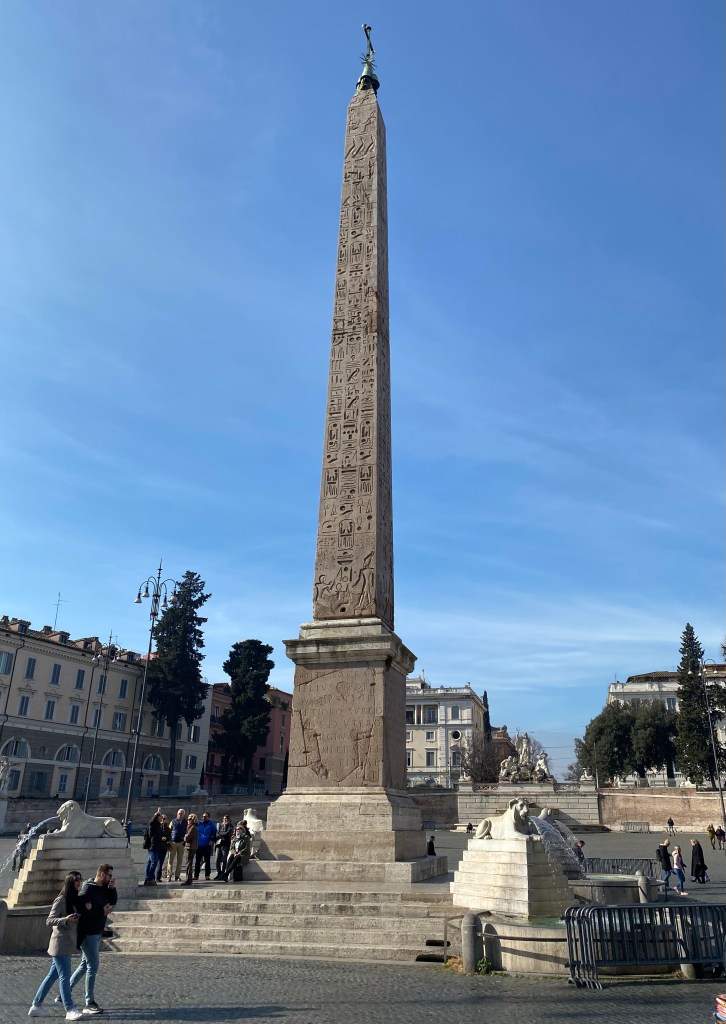
Piazza del Popolo
I have to comment on what I’ve learned (which is really very little and only scratching the surface) about the relationship between the Romans and Egyptians. The result of the Roman occupation of Egypt between 30BC and 640AD was that there are a significant quantity of Egyptian artifacts and natural resources (for example, coloured marble from Egyptian quarries) incorporated into Rome’s architecture and museums. I actually started collecting photos of Egyptian obelisks in Roman piazzas of which this is one example of 13 in total! This is the Flaminio obelisk and was brought to Rome from Heliopolis (Cairo) in 10BC by Augustus. Interestingly, at some point it toppled and broke into 3 pieces but was discovered and re-erected in its current location in the 1500s.
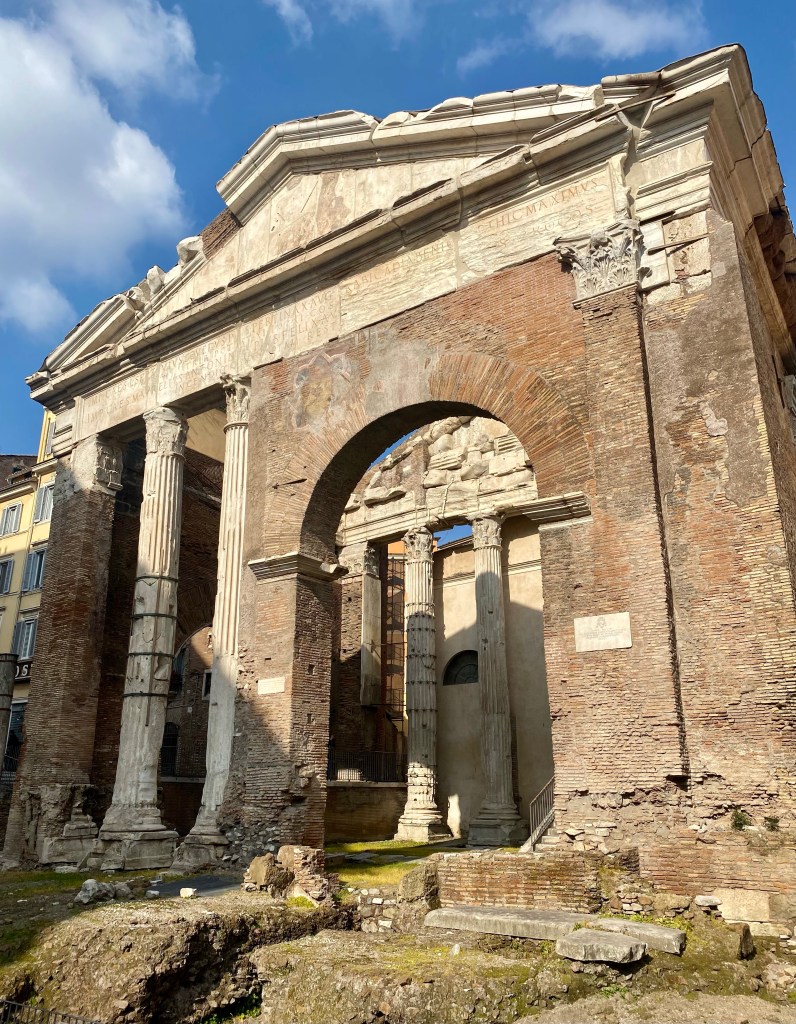
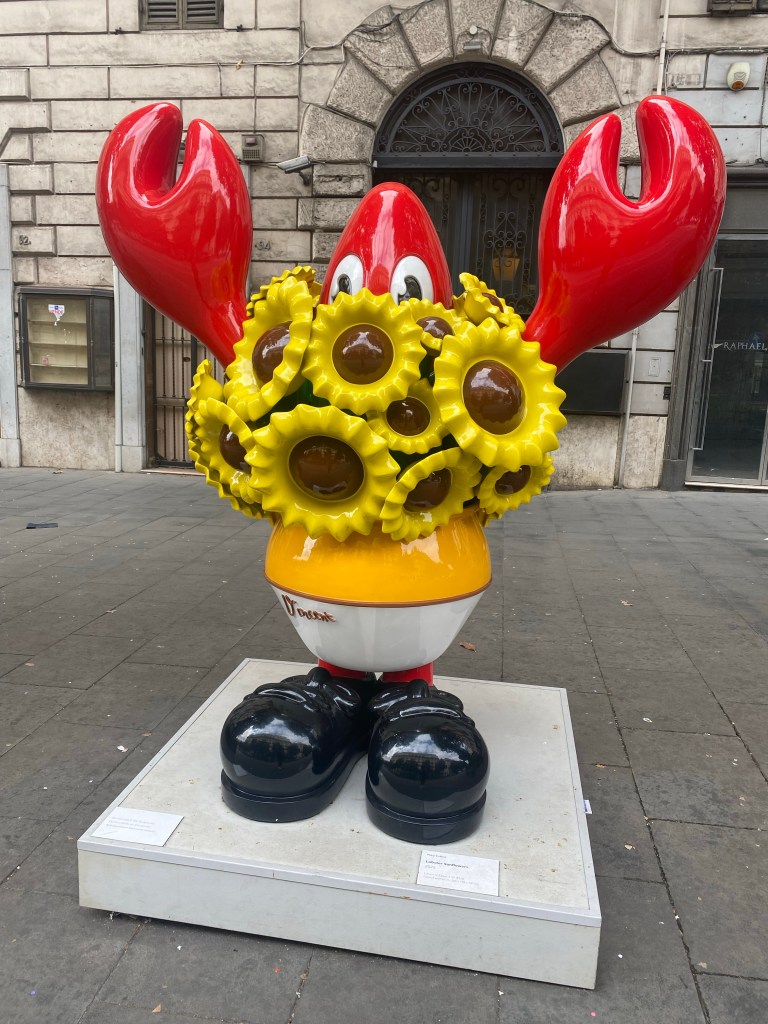
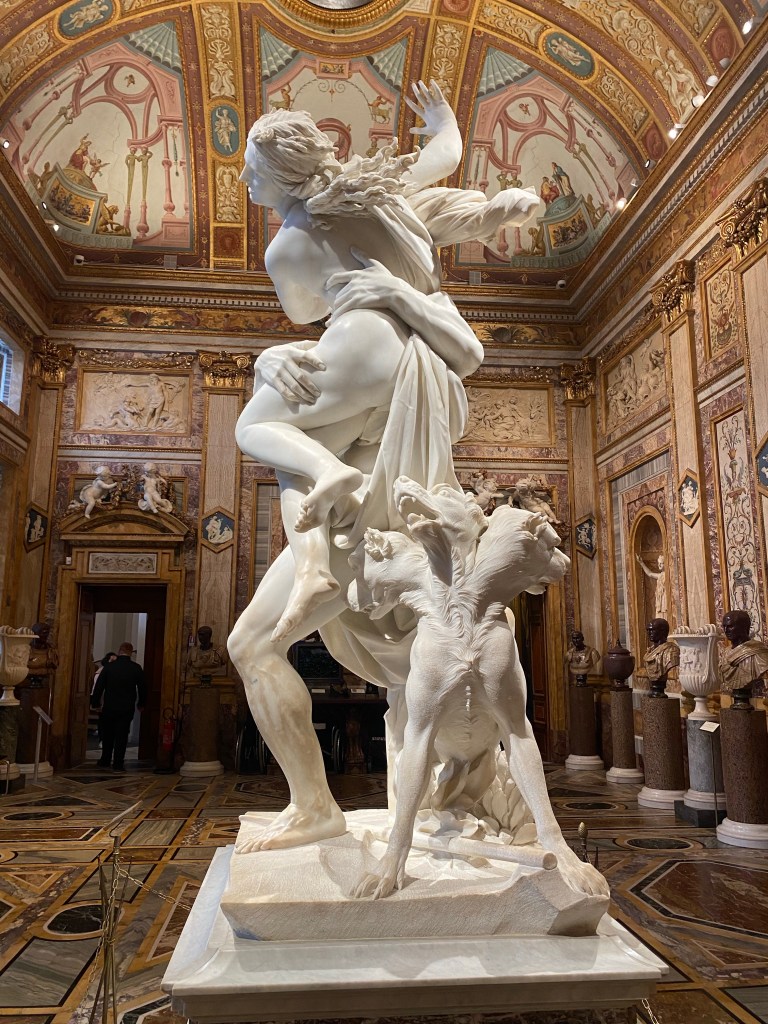
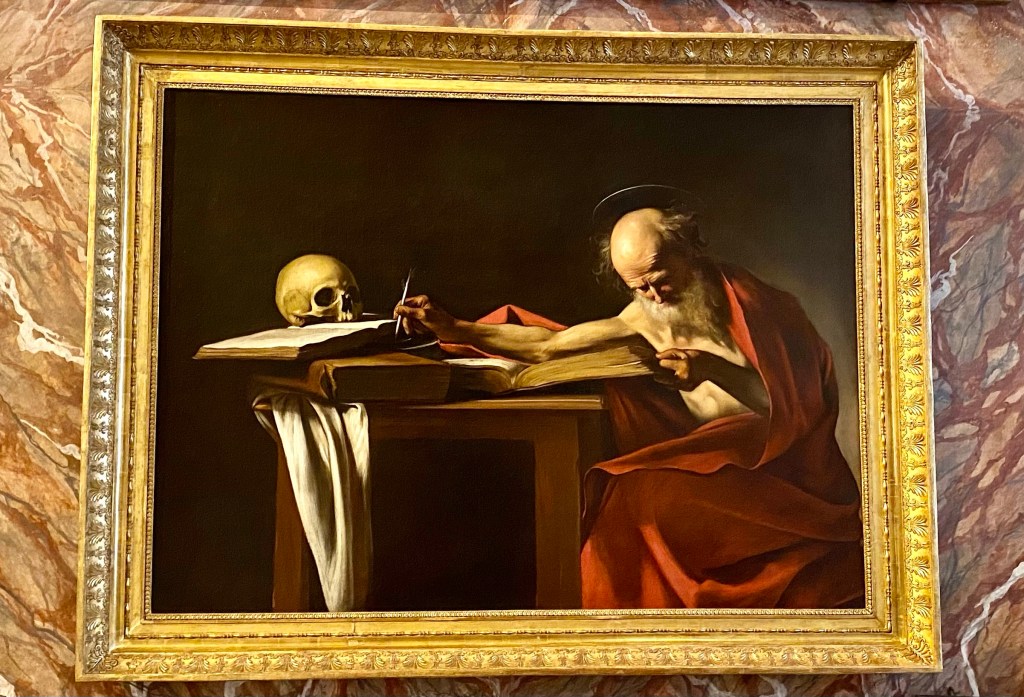
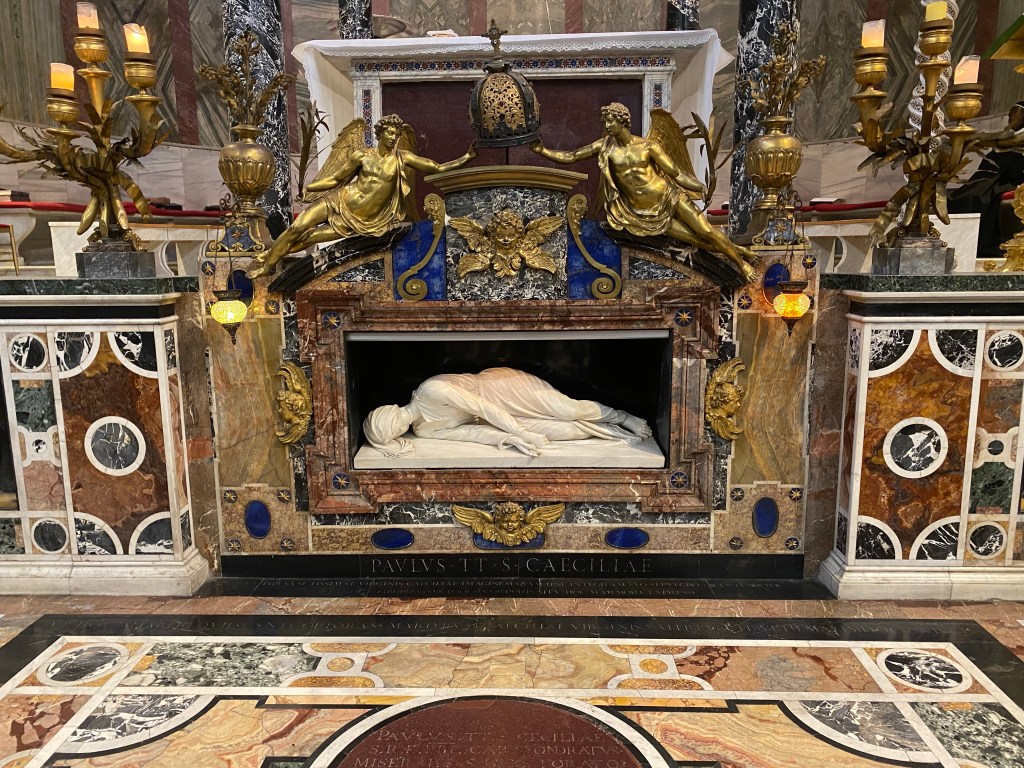
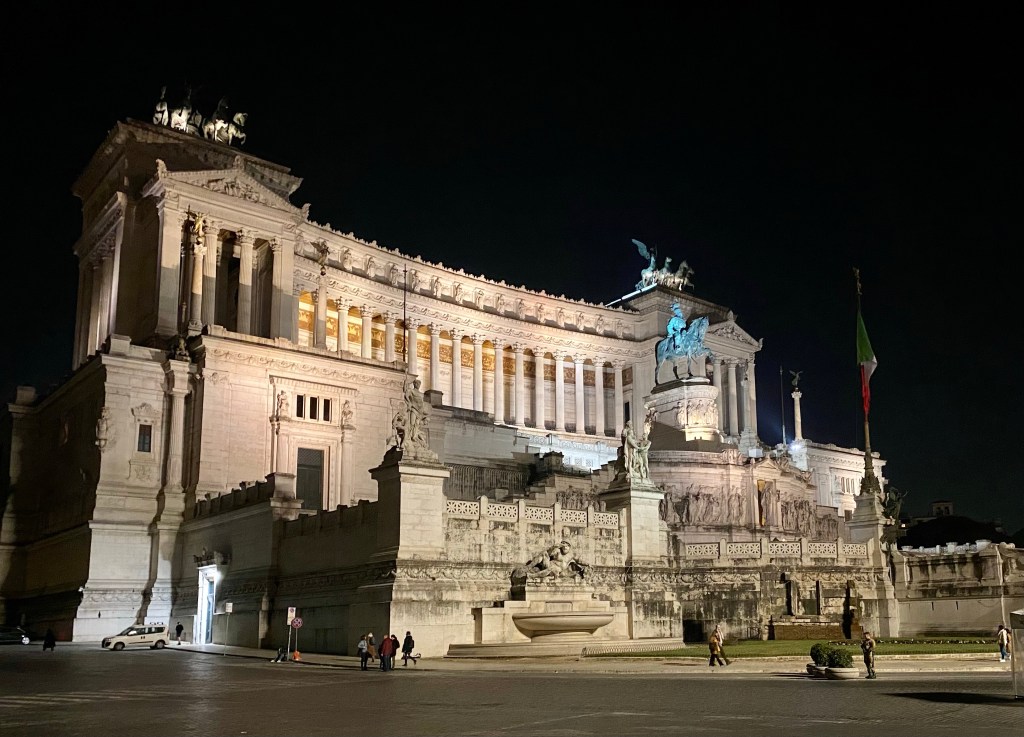
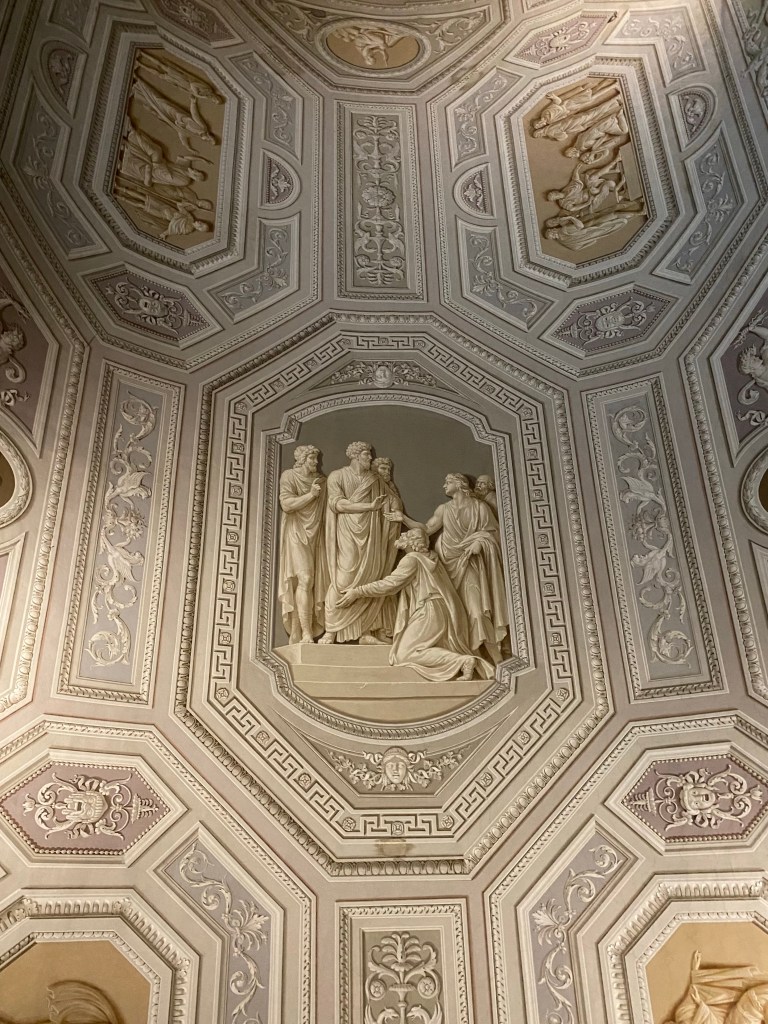
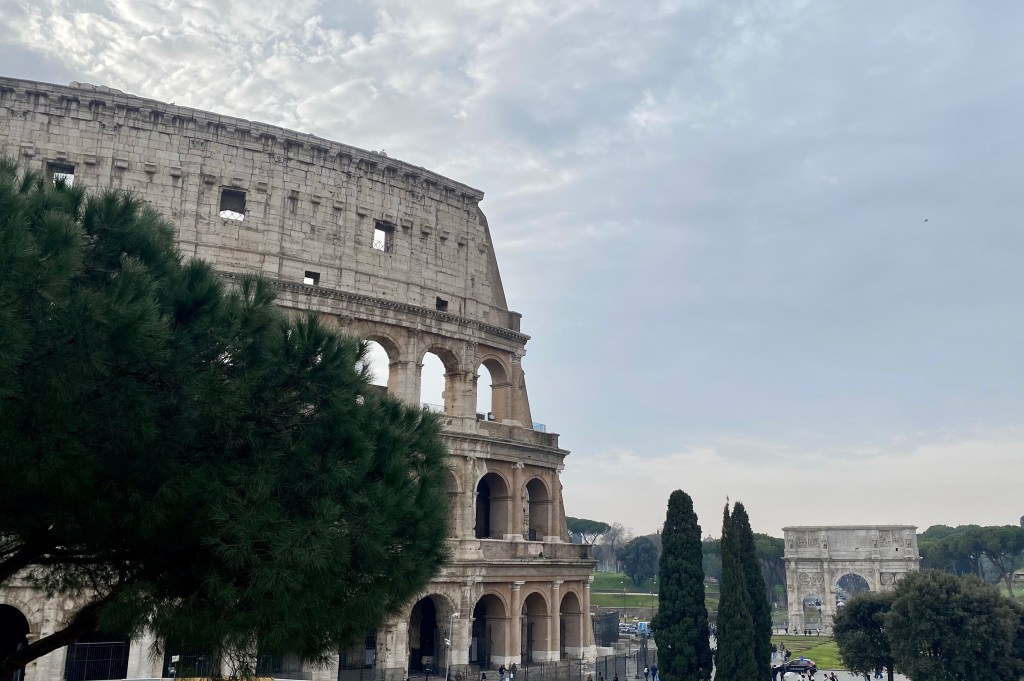
Trevi Fountain – this photo creatively omits the throngs of people I had to navigate to get close enough for a photo. I subsequently walked by quite a few more times and it was always the busiest place in Rome!Remaining columns of the facade of the Temple of Hadrian in the Piazza di Petra – build around 145ADPoetico of Octavia – ruin from about 24AD, partially restored due to 2 fires and significantly modified during the medieval period One of 12 installations on the Via Veneto by British artist Philip Colbert – just around the corner from my bed and breakfast Galleria Borghese Bernini’s ‘The Rape of Proserpina’ – remarkable in terms of his ability to make marble look soft Caravaggio’s ‘Saint Jerome Writing’ – another fascinating work in Galleria BorgheseTomb of Saint Cecilia – marble sculpture created after her body was exhumed in 1600AD (she died in 230AD) miraculously intact Incredible mosaic honouring Saint Cecilia in an underground chapel built in the 1800’s beneath the Basilica originally built in her honour in the 800s ADOldest bridge in Rome (Ponte Fabricio) leading to Tiber Island (ship shaped island in the River Tiber close to Trastavere)Alter of the Fatherland at night Modern sculpture – sphere within a sphere – in the Pigna (Pine Cone) Courtyard at the Vatican Museums Beautiful ceiling fresco in the Vatican – an optical illusion – not a sculpture, just a paintingRaphael’s ‘The School of Athens’ – a fresco in the Raphael rooms of the Apostolic Palace in the Vatican. Painted in the early 1500s, there are depictions of the greatest mathematicians, philosophers and scientists from Ancient Greece (including Aristotle, Plato and Pythagoras) as well as Michelangelo, Leonardo Da Vinci and Raphael himself.Colosseum – the most iconic attraction in Rome
Foodie Exploits
I have to include a brief food component to this post, because the food in Rome is absolutely magnificent. I had a pretty comprehensive list of things and places I wanted to eat (and thanks to my friend Sue Leeson for her recommendations)! I didn’t even come close to completing my list, hence my earlier comment about needing to go back!
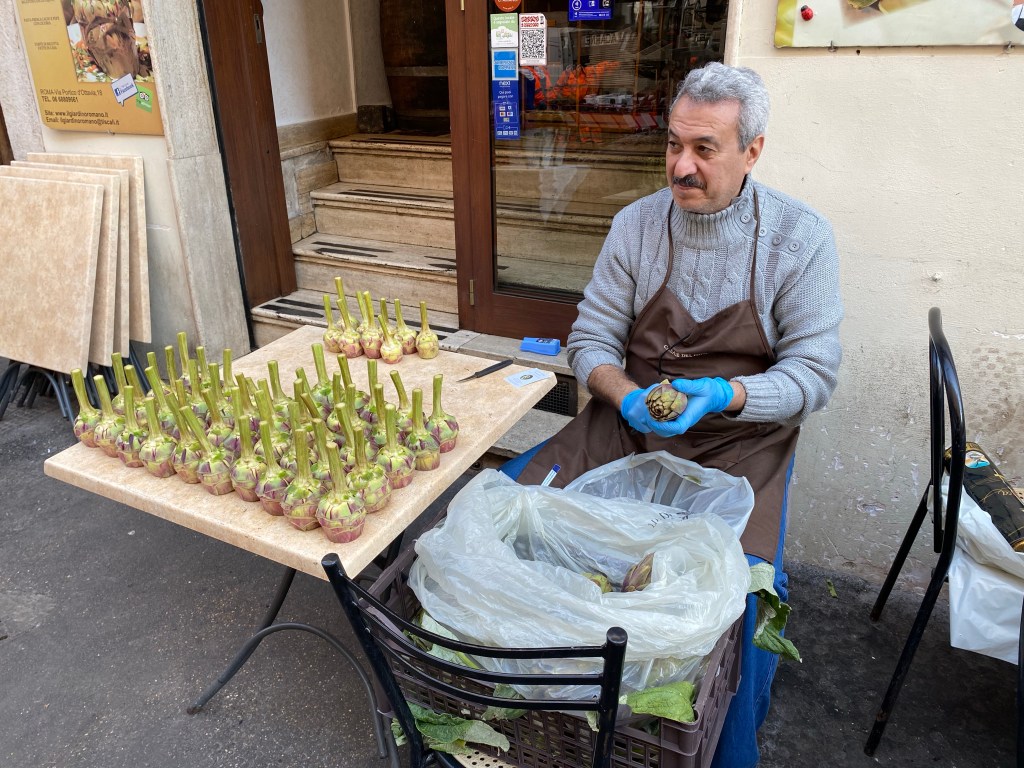
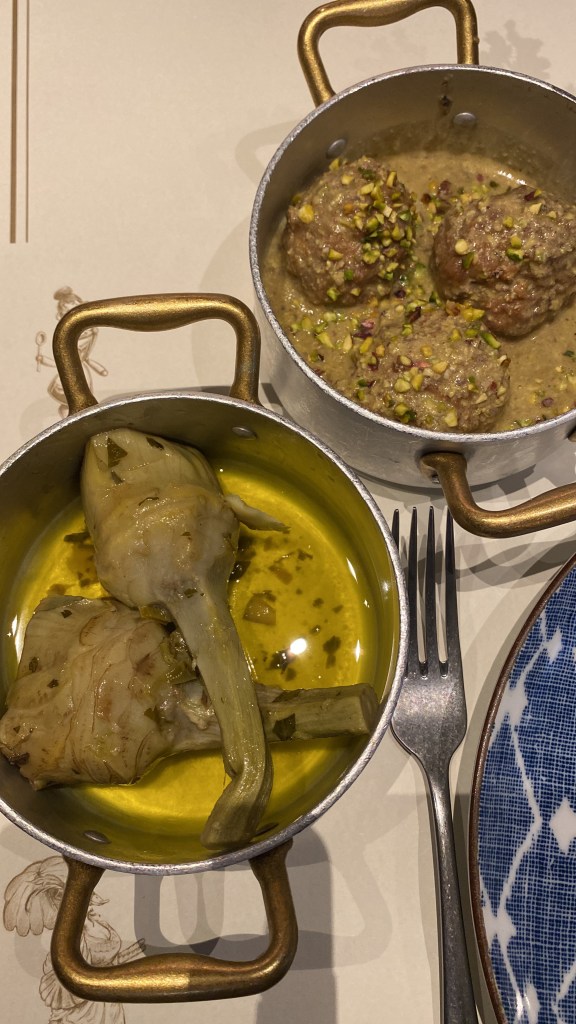
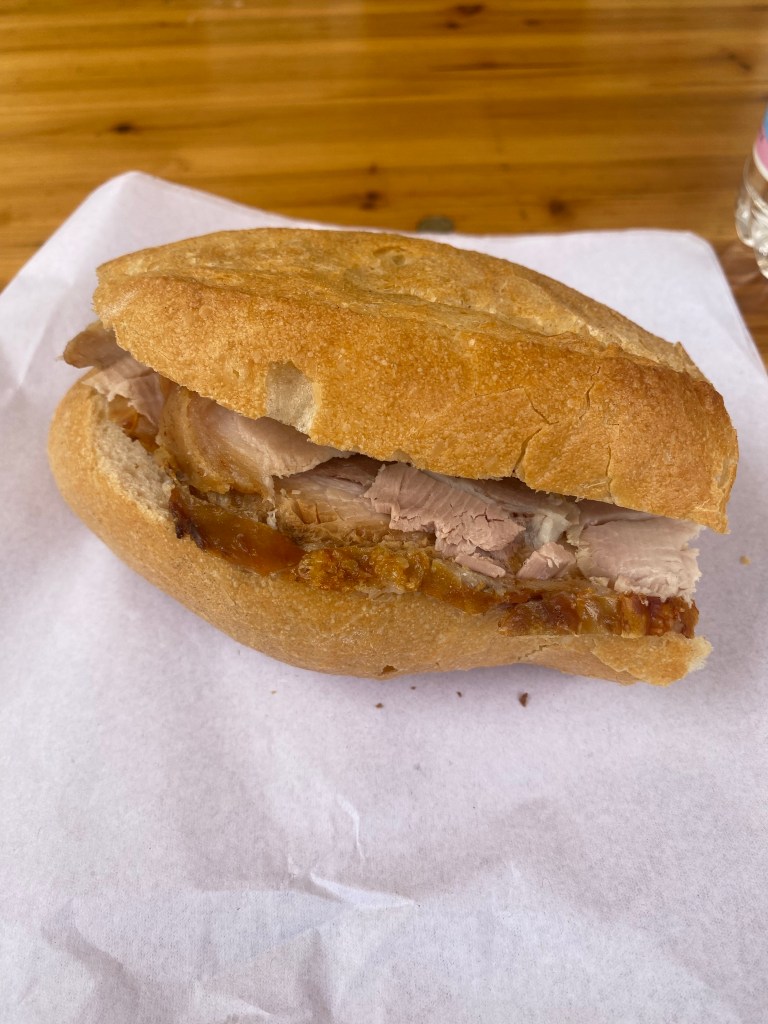
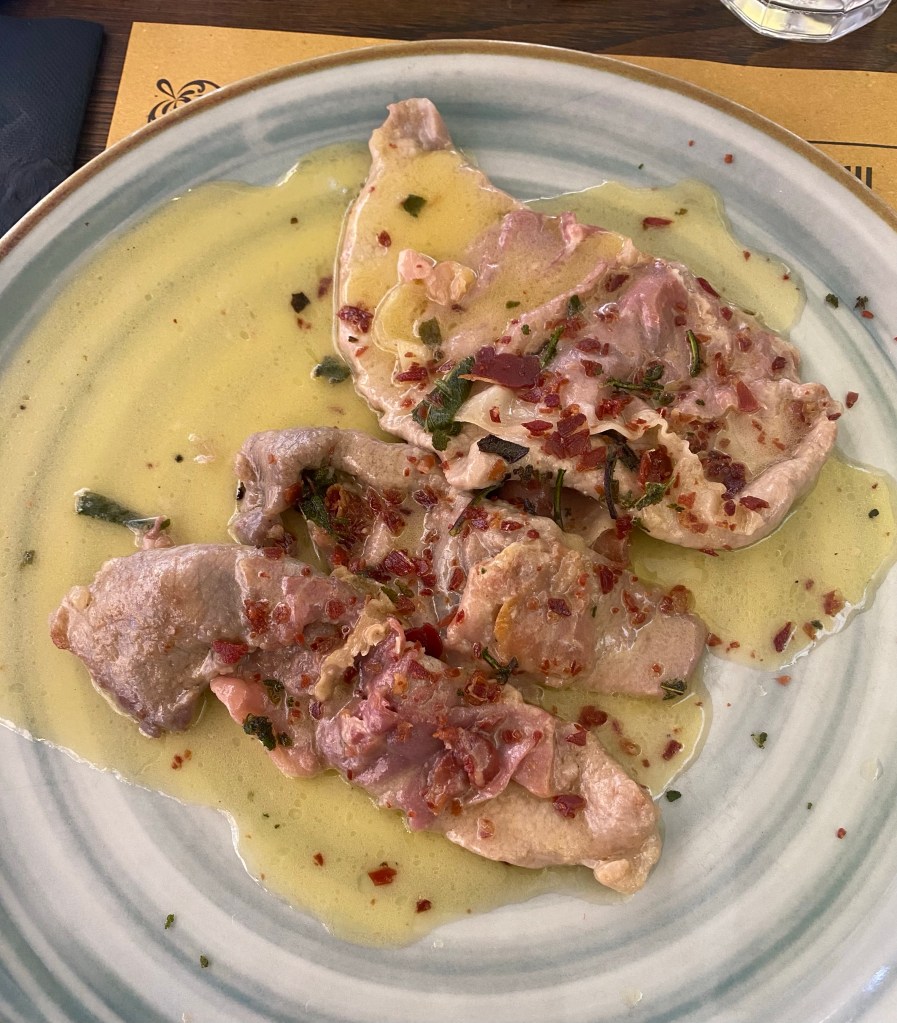
Prepping artichokes Artichokes are huge in Rome and you’re allowed to take a side when it comes to the debate about which cooking style is best – pictured here is the Roman style artichoke – Carciofo alla Roma (braised in water and oil with herbs). Also pictured are the delicious polpette from Dillà Ristorante. (I confess to also having 2 glasses of wine with this meal…)This is Carciofo alla guida – deep fried artichoke that originated with the Jewish community on Rome. Both were delicious but I preferred braised over deep fried This was the most spectacular gelato I’ve ever eaten. Gelaterias are absolutely everywhere in Rome and you have to choose carefully to get ‘real’ ingredients. I ended up at Frigidarium for what was unfortunately my only gelato (I was just too full the rest of the time)Porchetta – I actually ate this twice – it was a bargain at 4.50 euros. Very simple, just traditionally prepared seasoned roast pork and a fresh bun, nothing else! Saltimbocca – another simple but delicious dish – marinated veal with prosciutto and sage. So rich and flavourful!
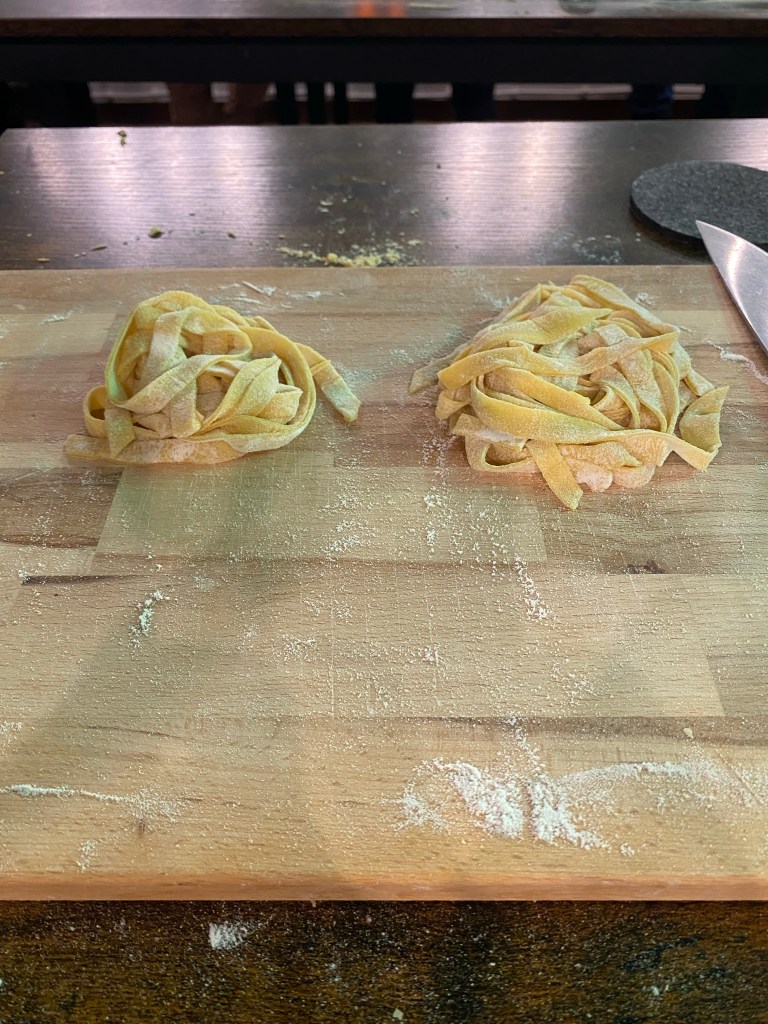
I happened upon an evening activity called ‘Spritz and Spaghetti’ and decided it would be right up my alley. Essentially it involved learning how to make (and drinking) 3 types of spritzes (Aperol spritz, Campari spritz, Limoncello spritz) and a pasta dish from scratch. After going through the surprisingly straightforward process of making tagliatelle (from an egg, pasta flour, a pinch of salt and some ‘elbow grease’) we got to choose if we wanted cacio e pepe (pecorino romano cheese and pepper, vegetarian friendly) or carbonara (same ingredients as the cacio e pepe with the addition of guanciale or pork cheek and egg). I chose the cacio e pepe because I knew I wouldn’t be able to finish all of it and wanted it to be takeaway friendly. The drinks and pasta were all delicious!
Pasta ingredients and Aperol spritz at the ready! Fresh Tagliatelle Cacio e pepe
List of Attractions I Visited
Alter of the Fatherland and Victor Emmanuel II National Moniment
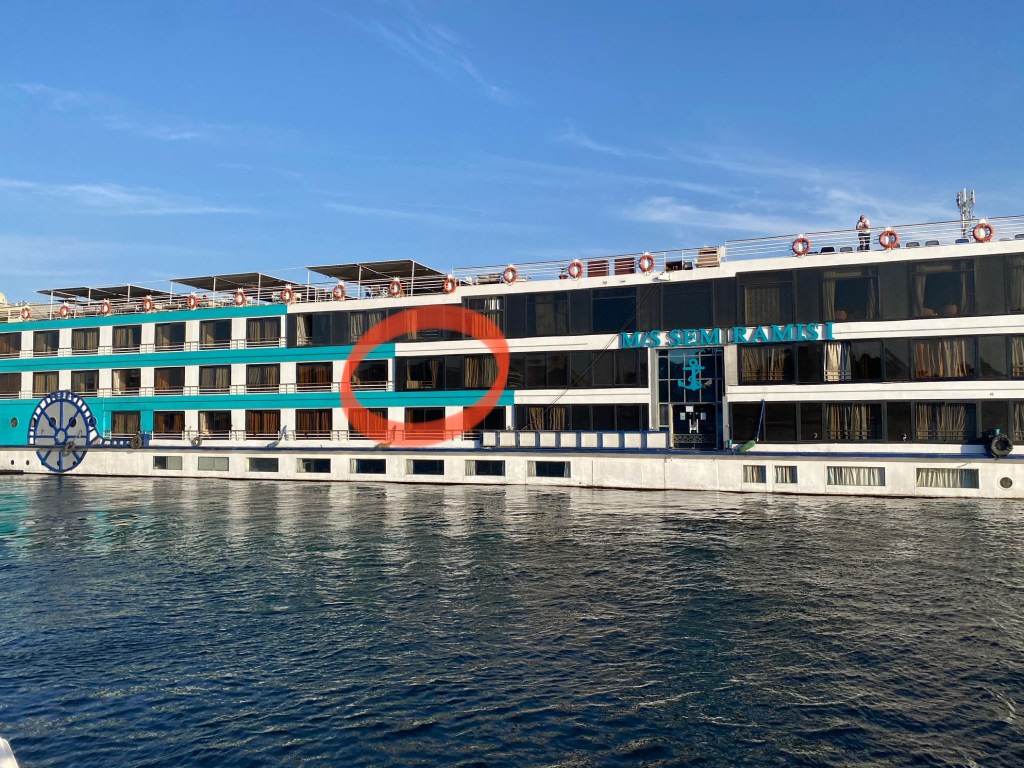
We arrived in Aswan and immediately went to check in to our Nile Cruise. We had a comfortable cabin (see our window circled below) with beautiful views of the river aboard the M/S Semiramis I. Our guide, Mostafa was ready to go but since we hadn’t showered in 52 hours we mutinied and fortunately the ship allowed us early check in. After lunch we took a private boat trip to a Nubian Village. Although interesting to learn a bit about the Nubians (and Mathis got to hold a juvenile crocodile) this is essentially a tourist trap with a huge market full of ‘souvenirs’. I’d recommend skipping if you’re visiting Egypt. Just take the small boat and explore the river instead!
Our boat with out window circled Small boat trip on the Nile
The rest of the afternoon/evening was spent relaxing on the cruise ship. The numbers of these types of boats on the Nile is astonishing! Sometimes we’d be docked 4 or 5 boats deep. The boats just shore up to each other and the guests on the outer boats just walk through all the others to get to shore. We actually only cruised for an afternoon and overnight one night despite staying on the boat for 3 nights. The rest of the time the boat was docked and our jumping off point for tours in Aswan and Luxor.
So on day 2 we woke up still in Aswan, had breakfast on the boat and then headed out with Mostafa to see the Unfinished Obelisk and Philae Temple. The Unfinished Obelisk is notable in that it is the largest known ancient obelisk. It was ordered by Queen Hatshepsut somewhere around 1500 BC but not completed as cracks developed during its construction (obelisks must be one complete piece of solid granite). The site gives valuable clues as to the workers’ techniques when constructing and moving these colossal stones. It would have been almost 42m (137ft) high if completed and erected.
The Unfinished Obelisk
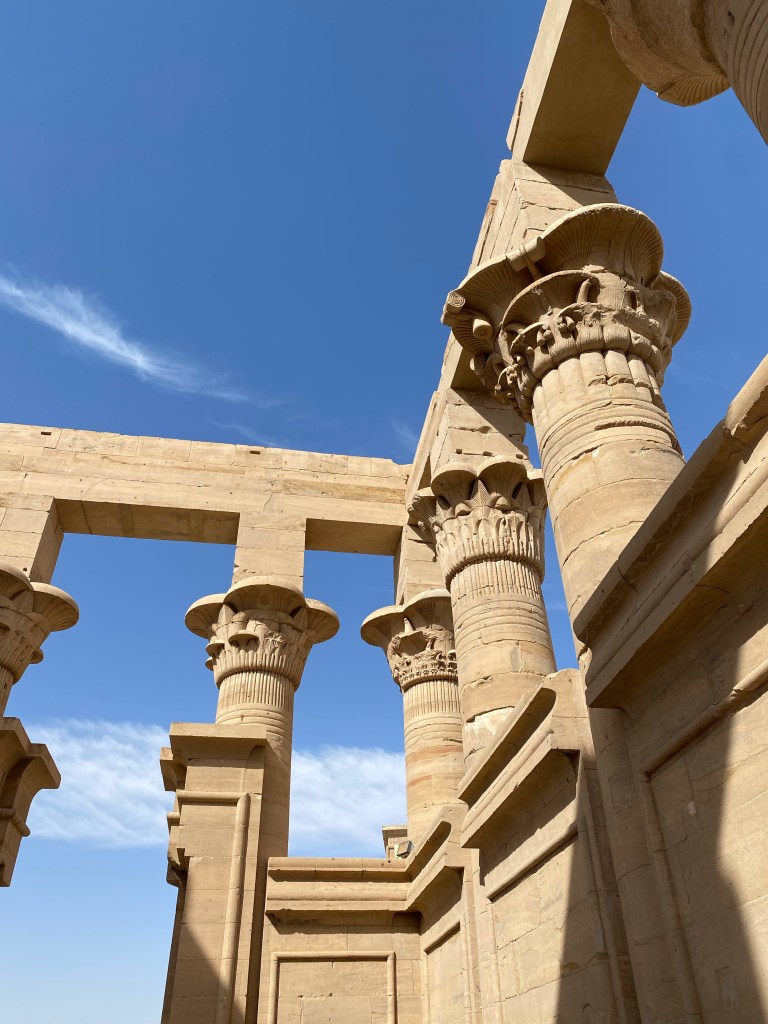
Another UNESCO world heritage site, the temple of ISIS formerly from Philae but relocated to Agilkia island before the Aswan High Dam was completed (it had been intermittently flooded since the completion of the low dam in 1902) was our second stop. It’s amazing to stand in this complex and understand that the entire thing was moved stone by stone and reconstructed! Another interesting feature is the way in which the Christians who invaded Egypt desecrated these temples by scratching out portions of the hieroglyphs and adding grafiti.
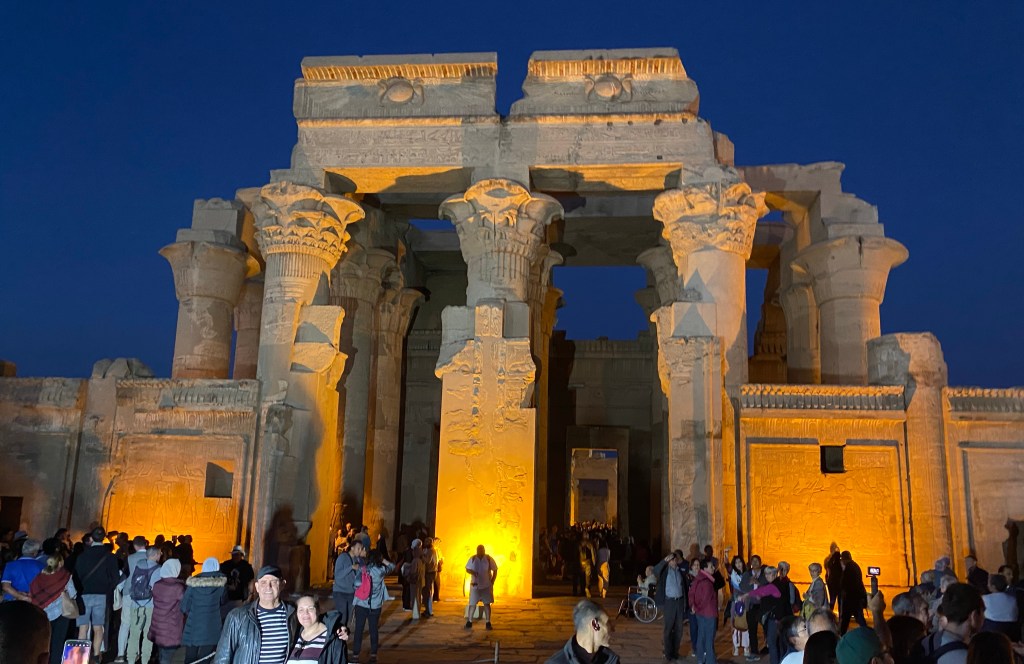
Our boat sailed at 2:30 and our only stop before reaching Luxor would be the temple of Kom Ombo. This was another amazing temple complex but an interesting visit. We reached it after dark along with numerous (likely around 50) other Nile cruise boats. So many people converging on the area at once! The photo of the entrance below says it all.
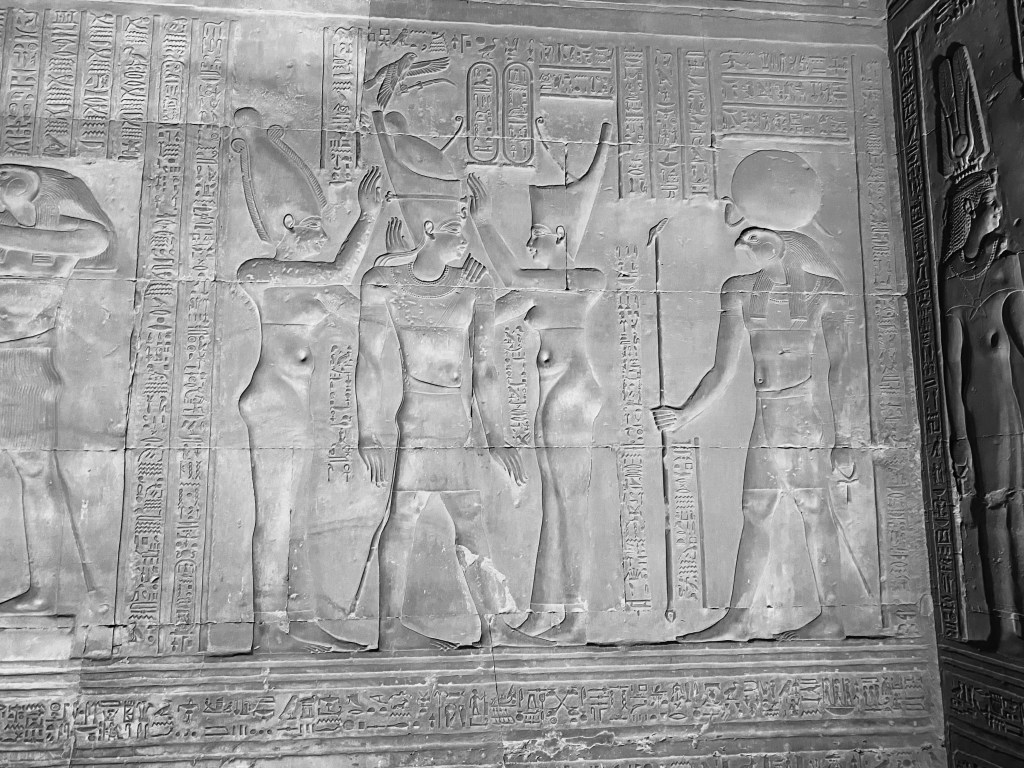
Kom Ombo is a double temple (dedicated to two different deities, Sobek and Horus) constructed during 180-47 BC.
Detailed hieroglyphs – Horus the falcon headed god on the right Hieroglyphs depicting surgical tools 😳The last part of the visit is a display of mummified crocodiles
Back to the boat to continue cruising overnight to Luxor. We met Mostafa at 2pm for our visits to Karnak Temple and Luxor Temple.
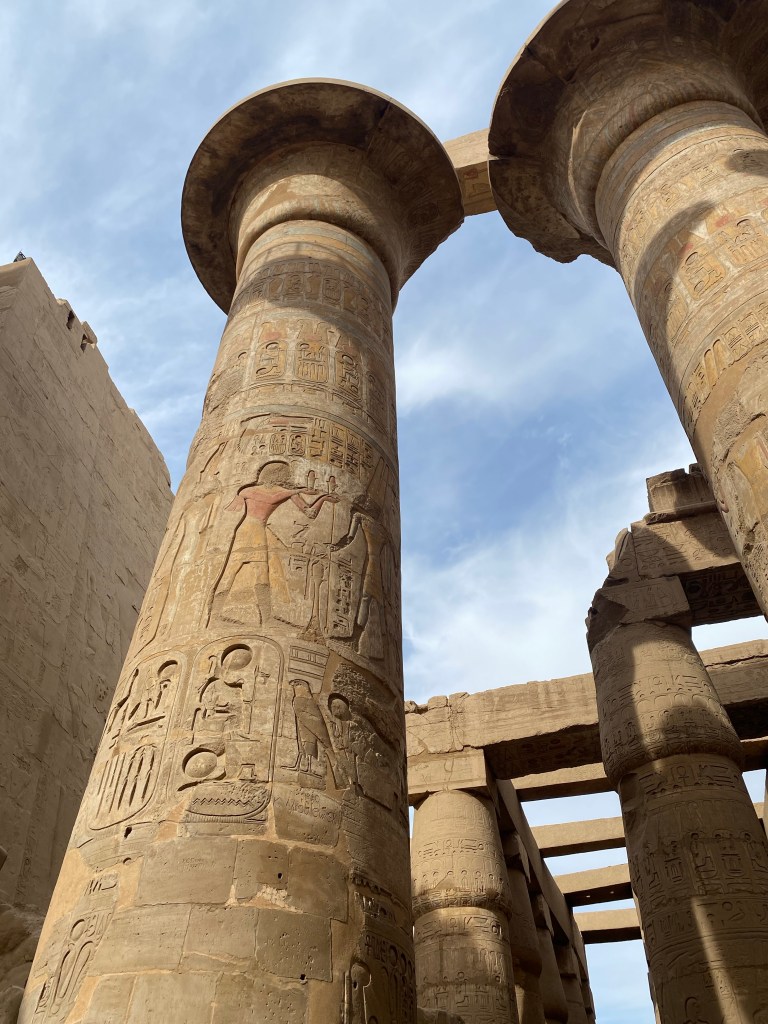
Karnak Temple has a number of beautiful columns (134 arranged in 16 rows in the Great Hypostyle Hall) with the original color still preserved. The temple complex (not all open to the public) is the second most visited historical site in Egypt (you can guess which is the first). It is believed to have been built/worked on by approximately 30 pharaohs!
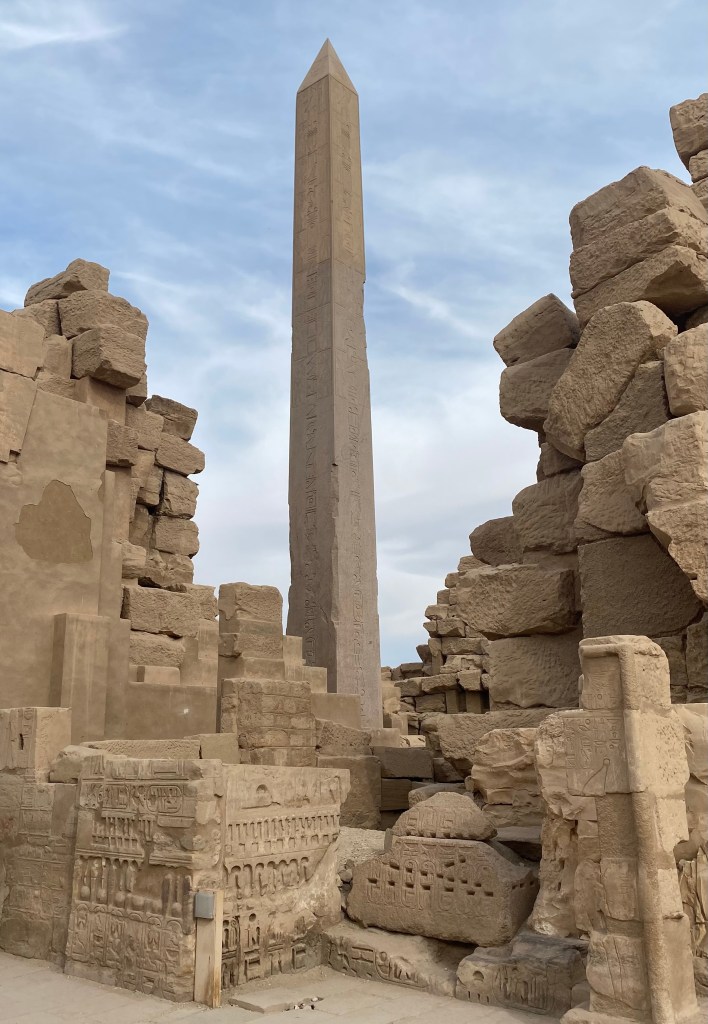
Queen Hatshepsut’s successfully completed Obelisk at Karnak temple (tallest in Egypt at 99ft). Interestingly, the tallest obelisk in the world stands in Rome, Italy and was moved there from Karnak via Alexandria
Luxor temple was the first thing we saw as we climbed the concrete steps from the boat.
Dating back to 1392 BCE, the temple was built on the east bank of the Nile River and is dedicated to the deities Mut, Khonsu, and Amun. Its construction was begun by Pharaoh Amenhotep III and was completed by Pharaoh Tutankhamun (the infamous King Tut whose tomb is in the Valley of the Kings and tomb contents are the biggest draw to the Egyptian Museum in Cairo). Containing ten sections, Luxor Temple is massive.
Luxor Temple
Following Luxor temple it was back to the boat for dinner and to sleep. The next day we would check out of the cruise and see the Valley of the Kings and Queen Hatshepsut’s temple before lunch and then head out on the 4+ hour drive to Hurghada in the afternoon.
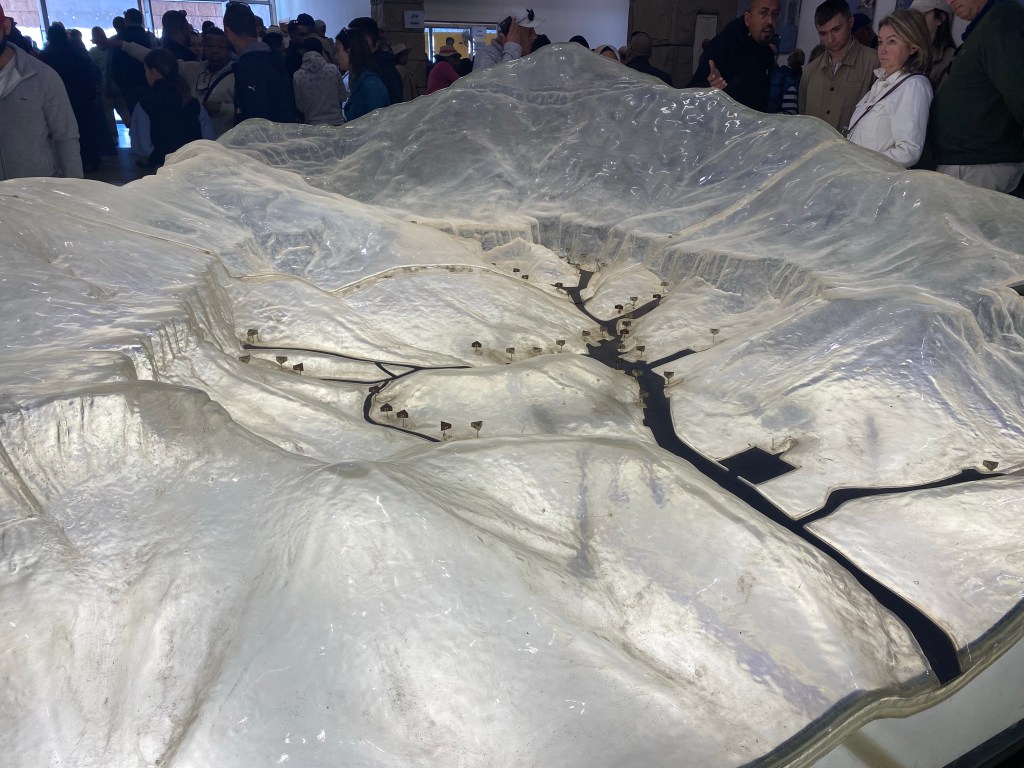
I feel like I have to include the pictures of the topographical maps from the visitor centre to fully illustrate the Valley of the Kings. The first is a photo of the ‘above ground’ portion of the map and the second is the ‘below ground’ illustration. The Valley of the Kings was used by the pharaohs for about 500 years (16th to 11th century BC) for their burial tombs.
Location of tomb entrances above ground Tap and zoom in to see all the tomb structures below ground
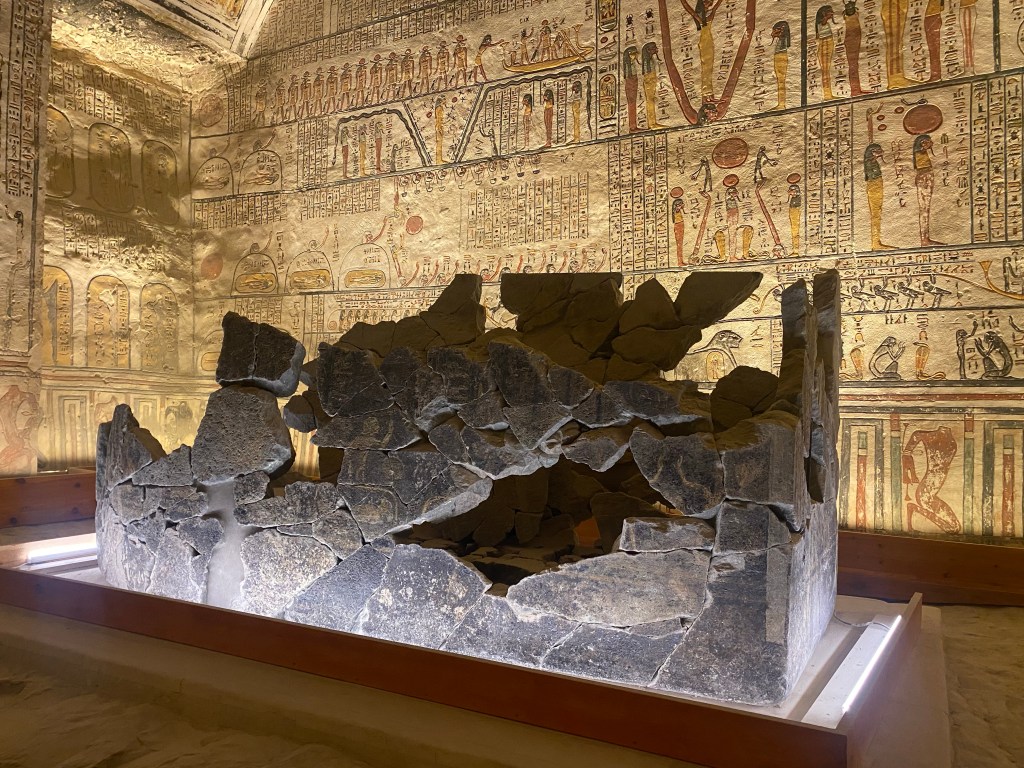
We visited 4 of the tombs in total. Generally they’re quite similar with an opening that leads gradually downward underground through ornately decorated and quite spacious tunnels to the vault at the end. The history here is extensive and I won’t bore you with it. But we saw the tombs of Merenptah, Ramses V and VI (one tomb together), Ramses III and Ramses IX.
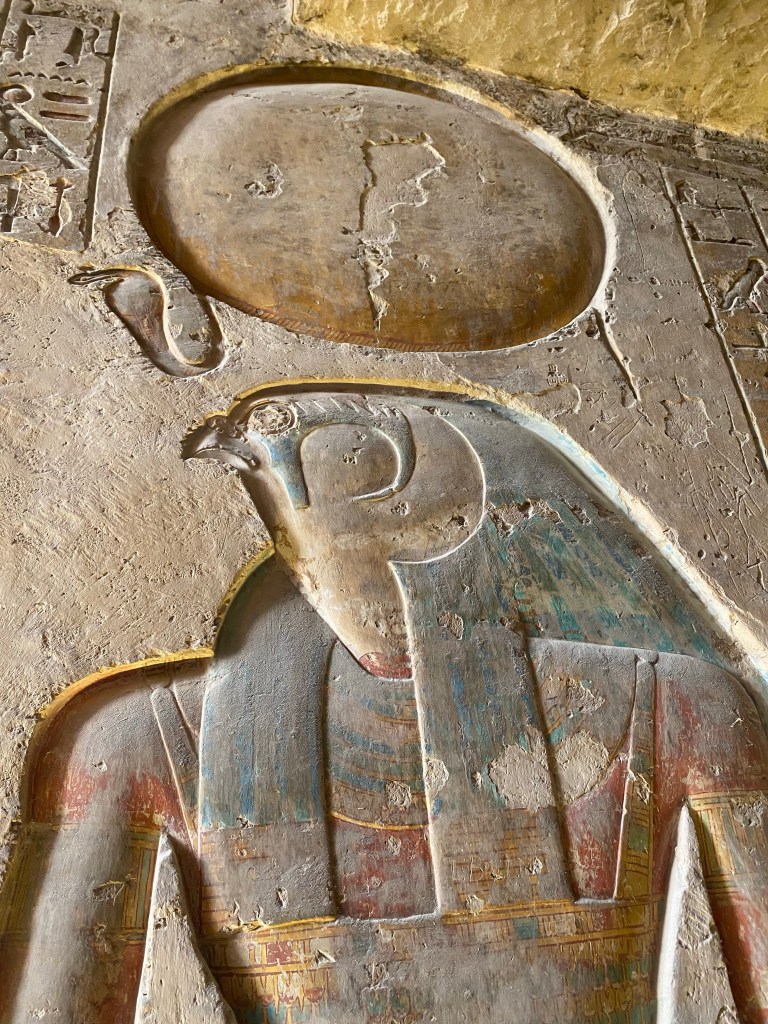
Corridor in KV9 (tomb of Ramses V and VI)Partially reconstructed sarcophagus in the burial chamber Horus – god of sun and god of kings
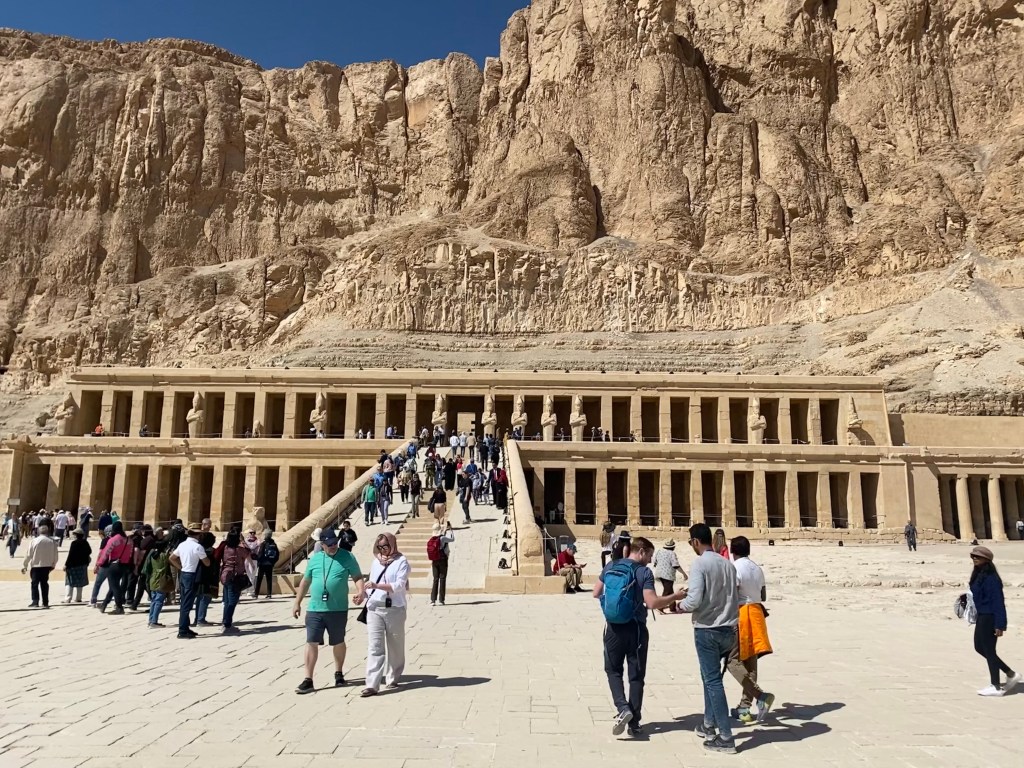
The final historical site we visited in Egypt was Queen Hatshepsut’s temple. A stunning architectural wonder, it’s beautifully restored but poorly preserved due to the extensive destruction of many of its references to her rule by her own stepson Thutmose III during his reign. Regardless , there are still some interesting features and beautiful views of the river valley and the East Bank of Luxor.
The tomb built into the soaring cliffs Statues of Queen Hatshepsut
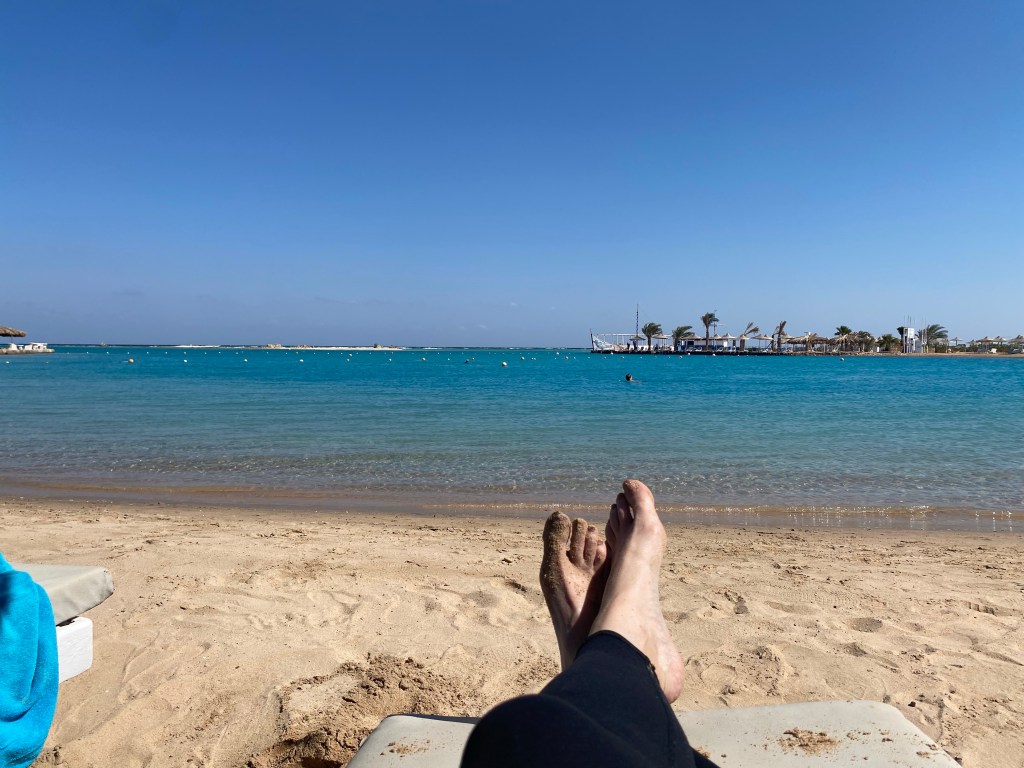
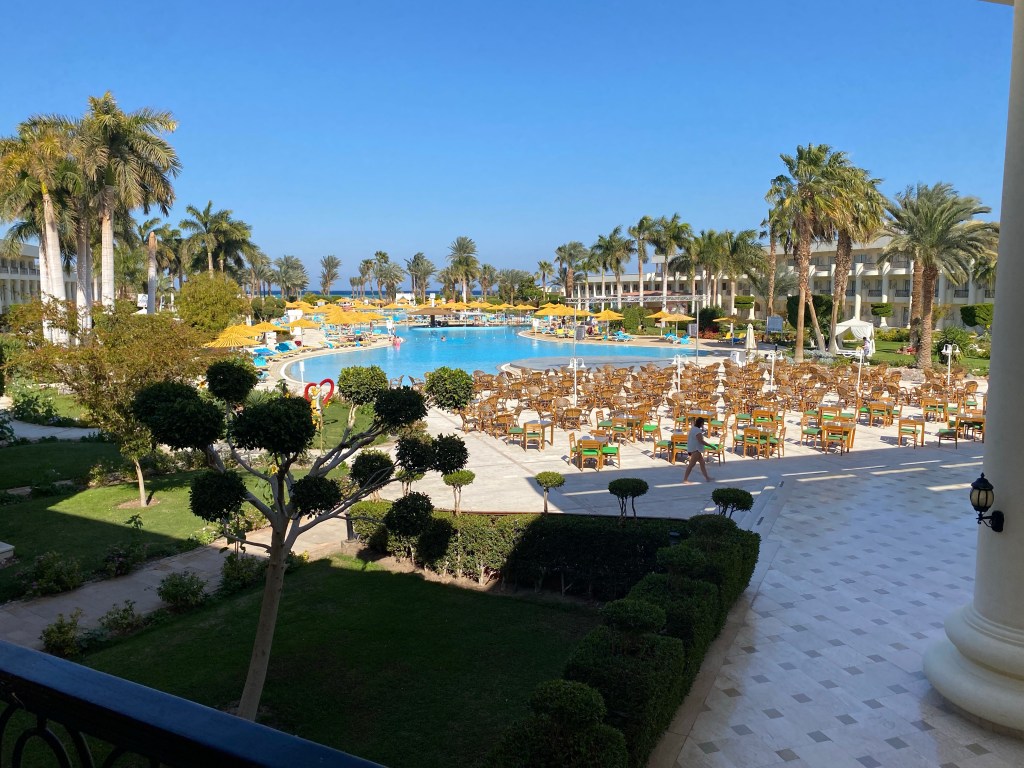
The final leg of our trip took us to Hurghada for 3 days on the beach at an all-inclusive. I have to be honest and those of you who know me will know – I’m too restless and too much of a foodie for the all-inclusive approach to travel. But I powered through, endured the 6 hour drive back to Cairo (not at all sure why we didn’t fly for $80 each but that was what was organized by the tour) and got some sun, fresh air and dipped (too cold to swim) in the Red Sea for the second time in my life. And that’s a wrap on Egypt!!! The highlight was definitely getting to spend time with Malorie and Mathis! Followed closely by getting to see another of the seven wonders of the world!
Our third day was spent seeing the sights in Cairo. We moved up to more recent history for sure!
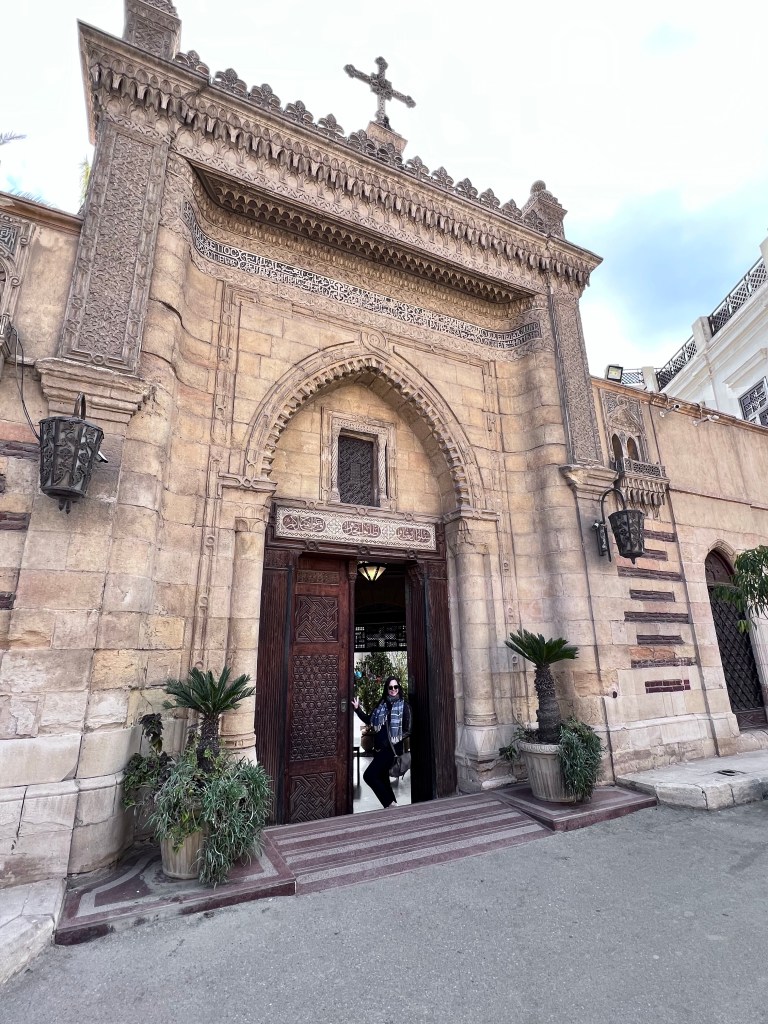
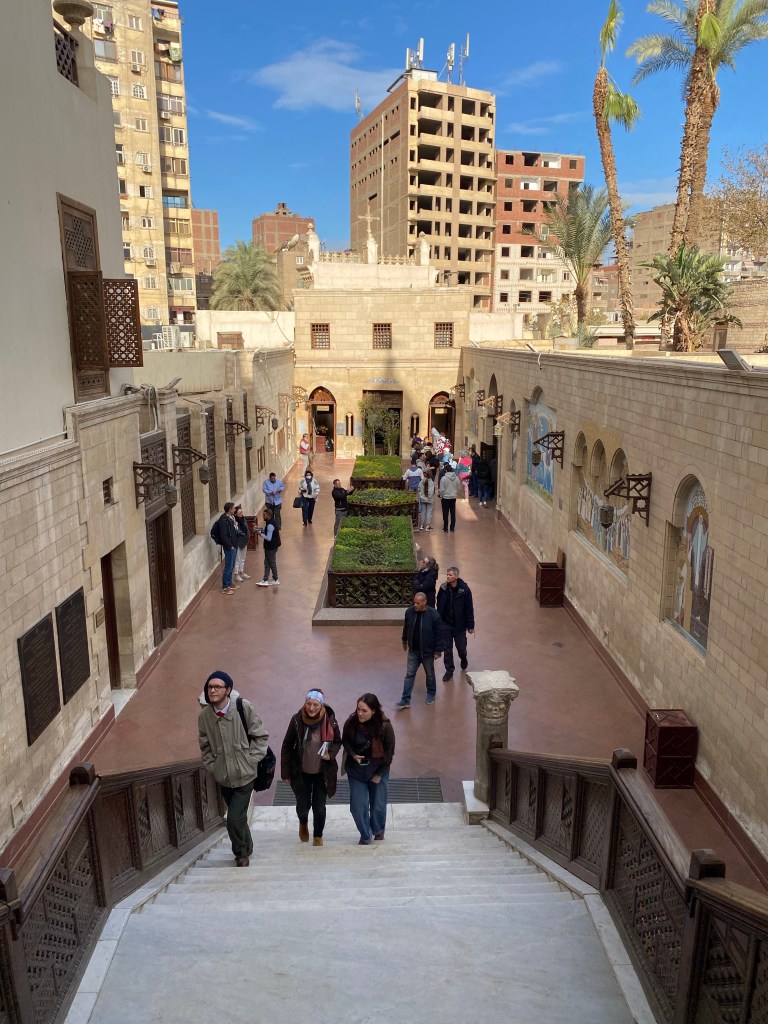
False entrance to the Hanging Church
Our first stop in Old Cairo was the area known as Coptic Cairo. I’d never heard the term ‘Coptic’ before and I hope I’m explaining it correctly – the Copts are an ethno-religious group who believe themselves not to be of Arabic origin but of ancient Egyptian origin (of Pharoahnic descent) and represent the Christian minority in Egypt (around 10% of the population).
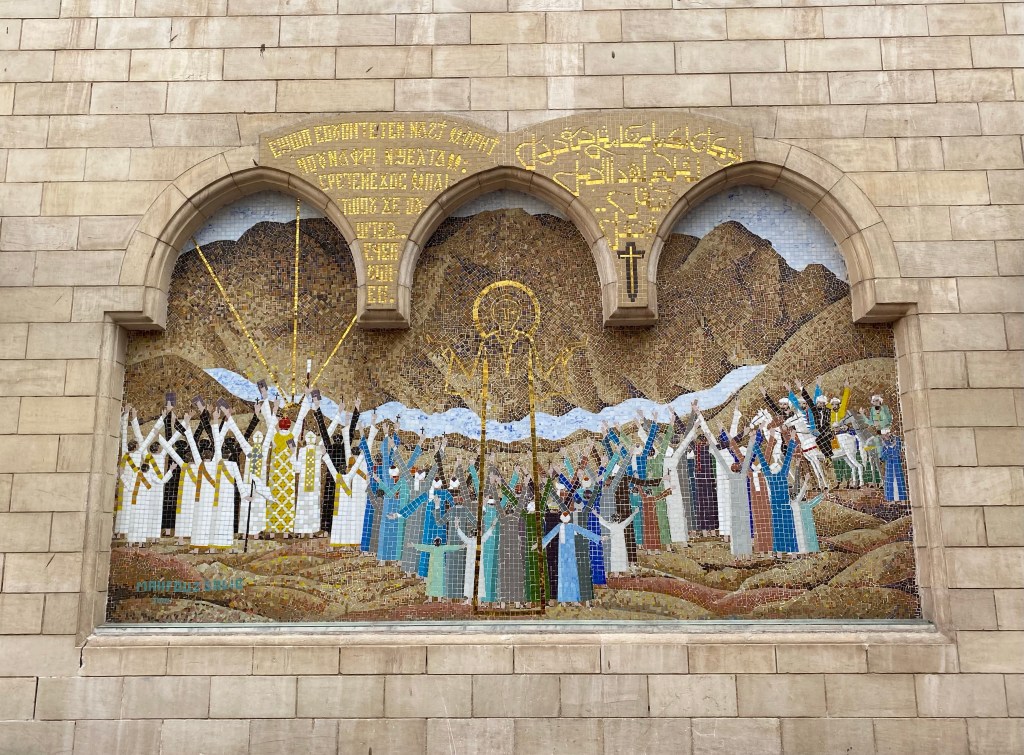
One of the intricate mosaic murals in the courtyard of the hanging churchCourtyard of Coptic Hanging Church
The hanging church is notable as it was built on the gate of an old Roman Fortress. ‘Ground level’ often shifts significantly in many of these areas due to flooding and blowing sand so underneath the church are partially excavated Roman ruins from around 30BC and the church itself dates back to the 3rd century AD. It’s so difficult to wrap your head around the activity of humans over hundreds of years so long ago!
Our next stop was the Mosque of Ibn Tulun – one of the oldest mosques (884 AD) in all of Africa and the largest in terms of total area of the site. We spent quite a bit of time here exploring as there were magnificent views to be had both from the roof and from the top of the minaret. Minarets are towers at the mosques that can be seen in the skyline all over Egypt and other Muslim countries (see second photo below). Their purpose is to identify the mosque and for announcing the call to prayer.
Entrance courtyard of Mosque of Ibn Tulun with puppies and mama sleeping peacefully in the sunshineView of Old Cairo from the minaret of the mosqueView from the interior of the mosque to the courtyard and ablution fountain
Directly next to the mosque is the Gayer-Anderson museum, named for Major RG Gayer-Anderson Pasha, a British dignitary who lived in the house from 1935 to 1942. It’s actually 2 houses in one – the main residence and a guest house both equally as large with many ornately decorated rooms. It was built in the 17th century.
Rooftop terrace of Gayer-Anderson house overlooking the mosqueRooms for women to use post-partum – very bright, cheery and luxurious
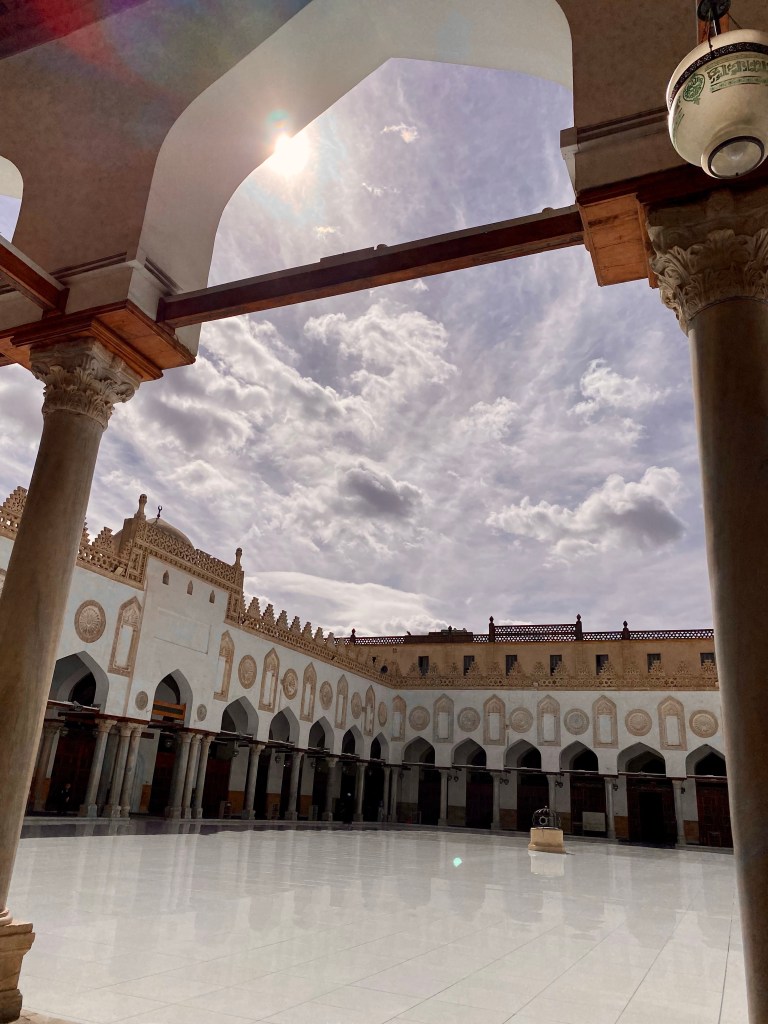
We also visited the Al-Azhar Mosque – which is likened to Vatican City as a centre of Muslim religion. It was a beautiful spot and we were there during prayers so very ethereal!
Sparkling white courtyard Old Cairo street view – this guy had astonishing skills!Tangerine Mirinda and Koshari
Food was unfortunately not a focus for this trip. We ate at a lot of buffets and a couple of tourist restaurants when we couldn’t convince our guides to take us for falafel or shawarma at the very least. Our favourite sweet drink (from a very limited number of choices where we ended up eating) was Mirinda (orange, tangerine or apple flavoured pop). And this was probably our best food day of the trip – we got to eat street food – falafel and koshari on the Shariah al mu’izz il-din allah – Main Street old Cairo. Egyptian Koshari is comfort food at its best – pasta, rice, chickpeas, lentils, tomato sauce and fried onions!
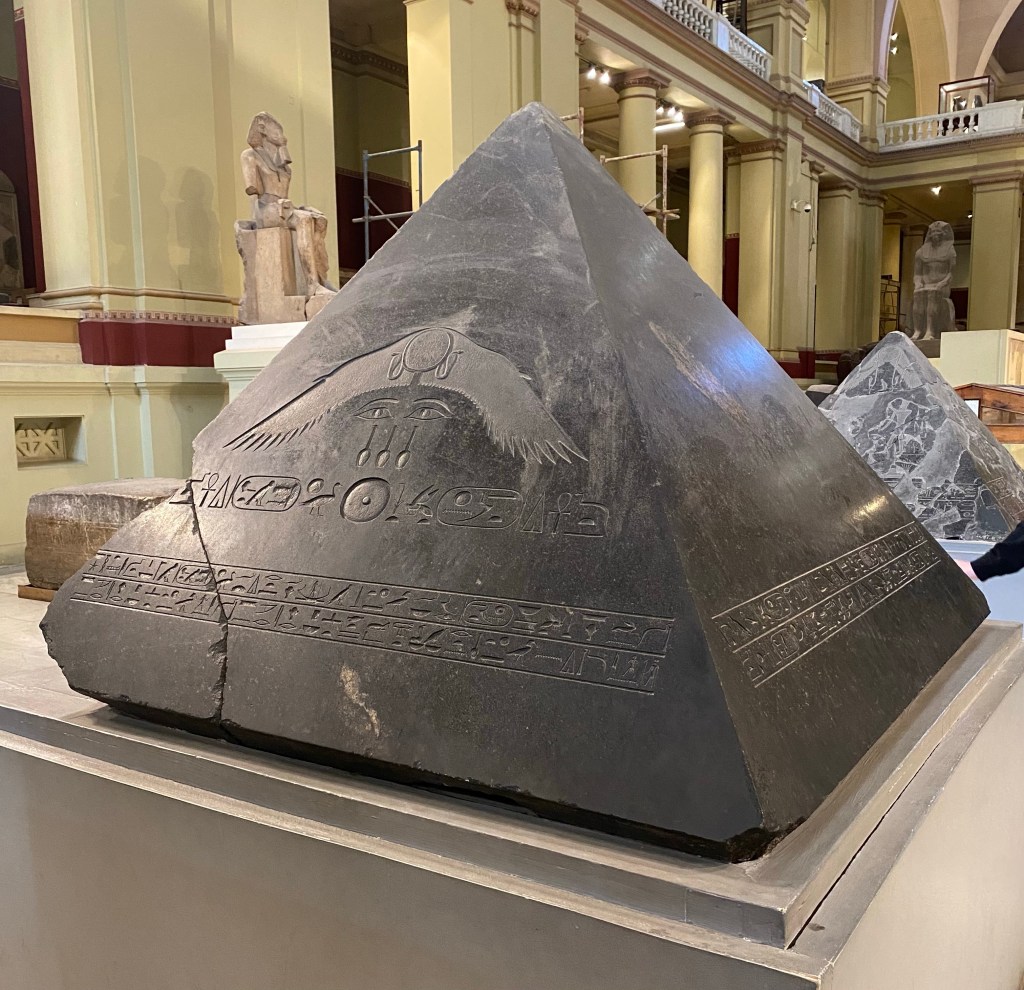
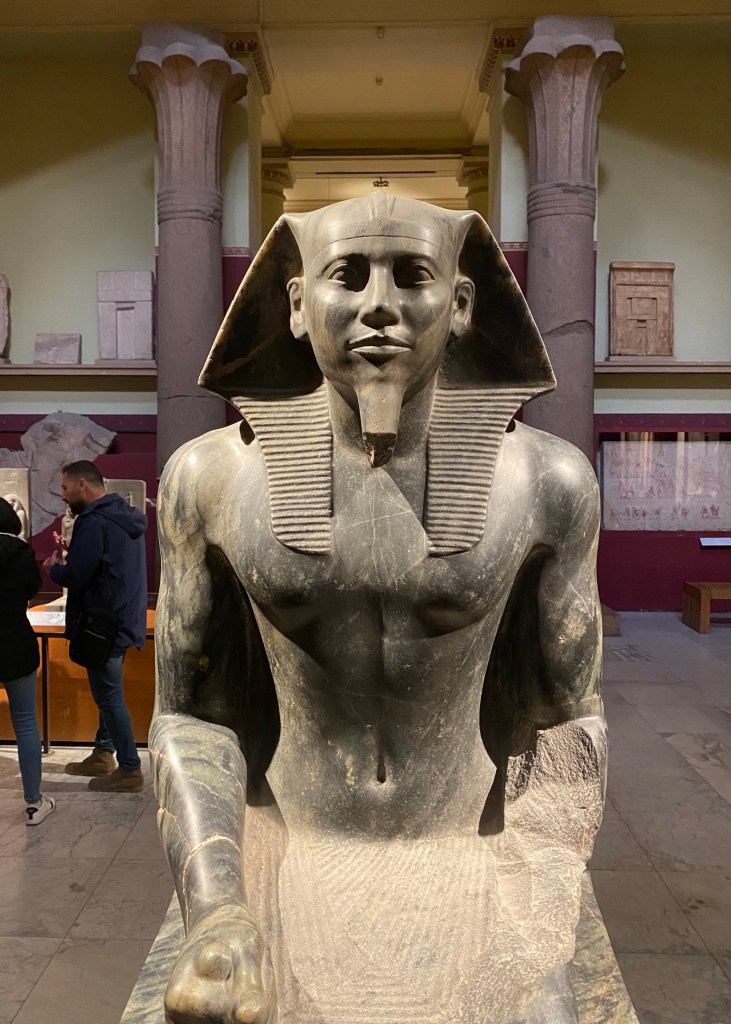
After our (very late) lunch, our last stop was the The Egyptian Museum. Ideally it would be good to have an entire morning to spend here. As it was, our guide took us to the highlights of this huge collection!! I was originally disappointed that the Grand Egyptian Museum in Giza wouldn’t be open yet for our visit but this was so spectacular in its own right! I’ve read before that many of the artifacts aren’t labelled and this is true, but the sheer number of them is amazing! And the key attractions are adequately explained – Tutankhamen’s tomb contents, the hall of the tomb of Yuyu and Thuya (including their very well preserved mummies on display), mummified animals and countless sarcophagi, statues and hieroglyphs.
Pyramid capPharaoh Khafre (builder of the second largest pyramid at Giza)Wooden sarcophagus and tomb contents
The next day we checked out of our hotel and hit the highway headed west to the Black Desert and the White Desert. Our 4X4 was well used and adorned with the horns of a ram….. and with 6 people crammed in (the 3 of us, the driver, our guide and the driver’s son along to help) plus luggage and camping gear it made for an uncomfortable ride overall. Add to that the fact we were driving for nearly 8 hours and that the suspension was super loose (not sure if on purpose or not) and I was more than maxed out on ‘ass time’ for the day!
Also, I just don’t get driving in Egypt (or India for that matter). First, the concept of ‘stay right (or left when in India) except to pass’ simply doesn’t exist. And literally 80% of the time people drive in more than one lane at a time – in traffic or when there’s no one else on the road! And this trip to the desert was notable in that they’re building a 6 lane highway but it’s in various stages of completion. So drivers just pick which side they want to travel on. I tried to take a photo – we’re in what should be one half of a six lane freeway but vehicles are going in both directions. And 2 transport trucks are taking up all 3 lanes!!! My (mostly) rule (and logic) following nature doesn’t allow for these concepts 😆 and I literally had to stop looking!
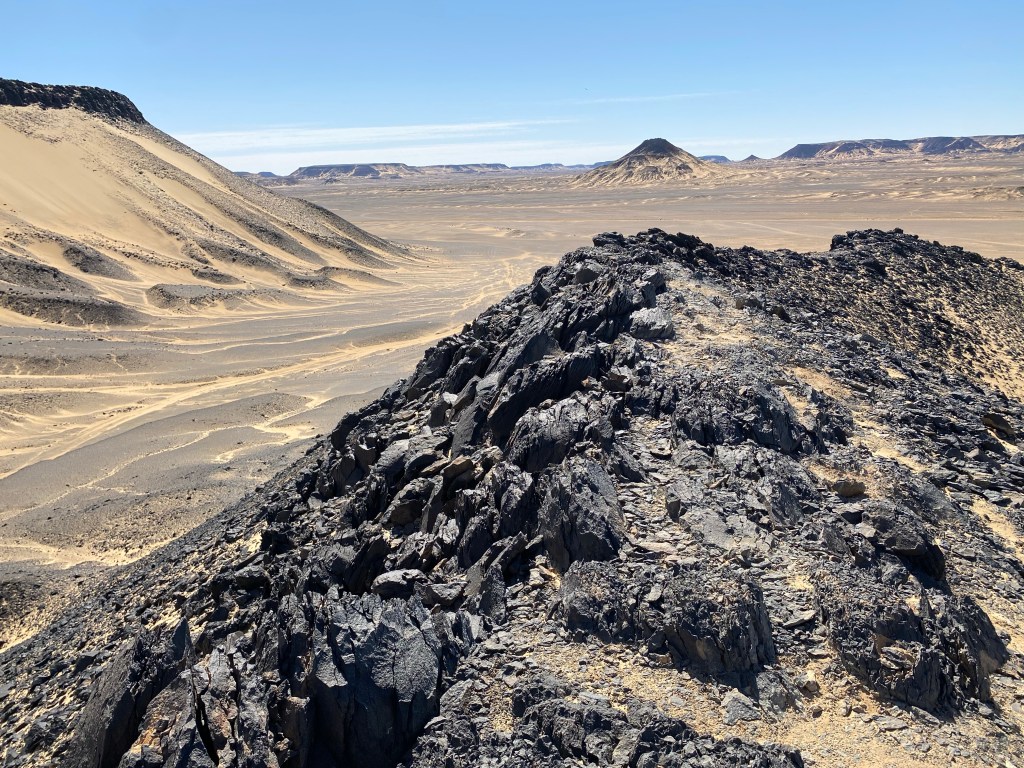
Our first stop was almost 4 hours in at the Black desert. It was dead calm and the temperature was a perfect 20C or so. And sooo quiet after the din of the city – it was wonderful! We spent 20 minutes or so wandering and climbing to the top of one of the hills of basalt lava deposits. It was stunning and would have been a great place for a picnic. Instead we stopped at a sketchy roadside cafe about an hour later. Surprisingly, it turned out to be one of the best meals in Egypt! We didn’t have a choice, we ate what we were brought, but it was a selection of dishes including shakshuka, beans and a delicious tomato salad!
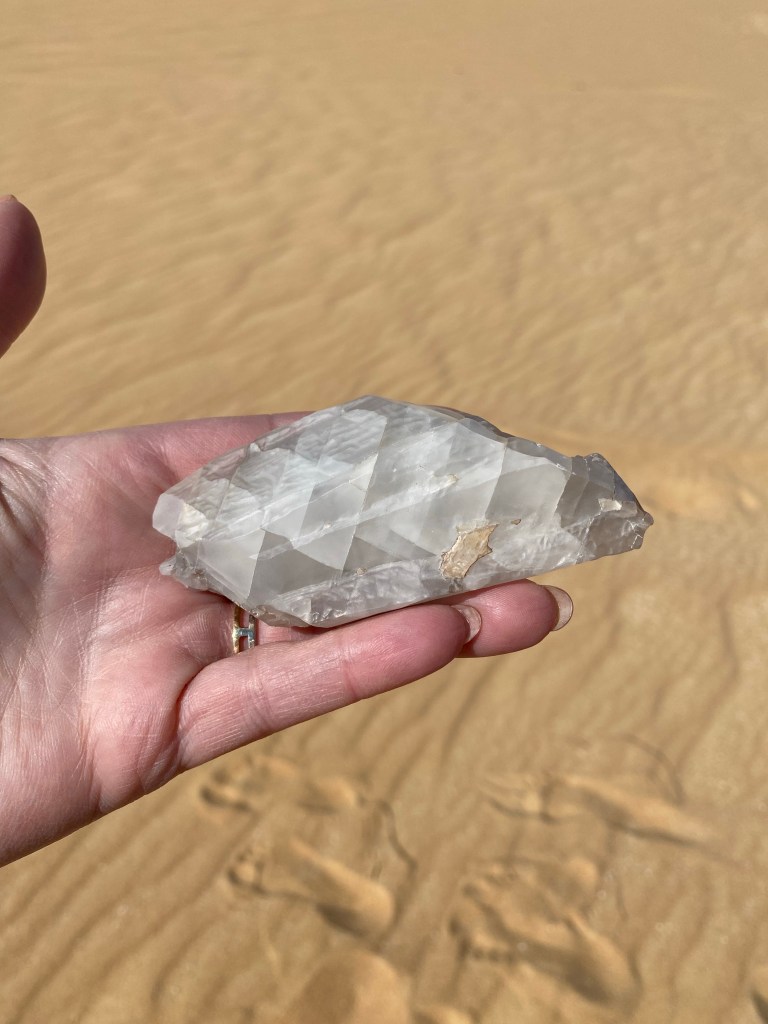
After lunch we stopped at Crystal Mountain at the beginning of the White Desert. We were told that the crystals were formed after a meteorite strike in the area. Hilariously, we had some mechanical problems as we were leaving Crystal Mountain. We were the only ones out there in the middle of the desert and were definitely contemplating what it was going to look like if they couldn’t get the vehicle started again!! Fortunately our driver had 20+ years of experience and knew his vehicle well and we were up and running with no further glitches in about 15 minutes!
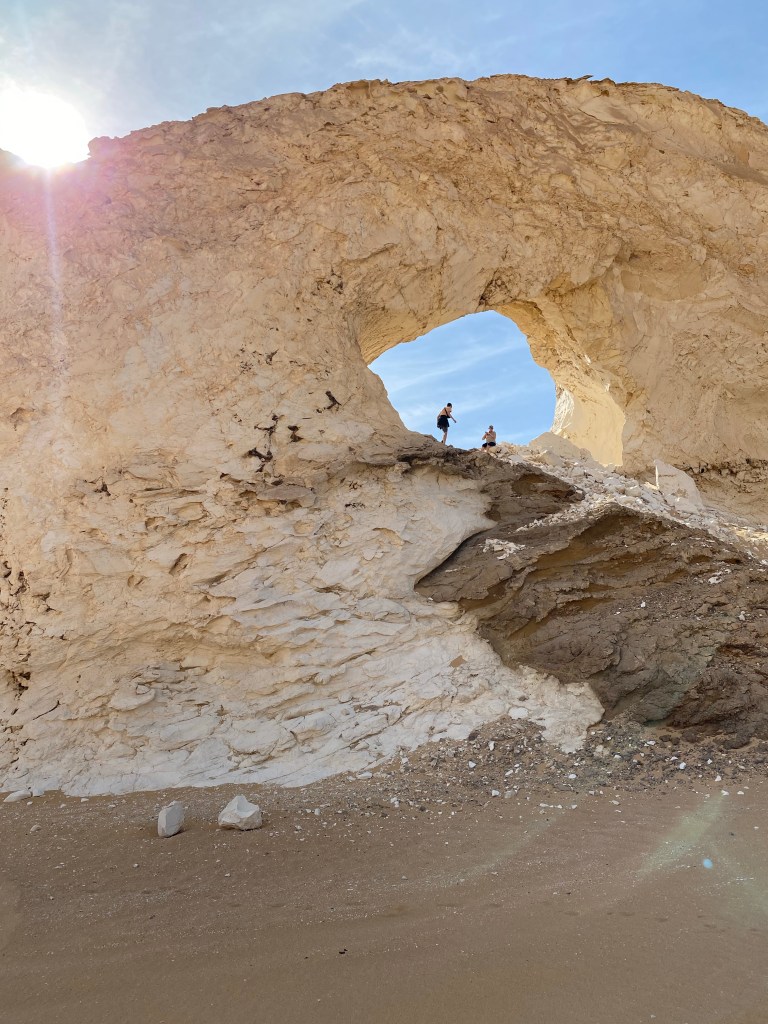
Finally we arrived at the White Desert in the early afternoon and spent a couple of hours 4x4ing through the sand looking at different formations. The landscape is truly stunning!
Mathis and Malorie framed by the rock 2 attempts with a fully loaded vehicle up the sand hill didn’t work, so we unloaded 4 people and success!
The other major down side of our desert visit was that we weren’t informed til our lunch stop that it would be our last actual bathroom for 24 hours. Likely TMI, but toileting in the desert isn’t my idea of fun – I need time to prepare, to wrap my head around it! Also, it was sooo cold and we were told there’d be blankets – and there weren’t – just woefully inadequate sleeping bags (with sand in them). There were good things about the camping ⛺️ too – sunset, stars, sunrise and a delicious dinner prepared over hot coals.
Sunrise in the White Desert
The next day we reluctantly piled back into the 4X4 and headed to the Wadi Al-Hitan – Valley of the Whales. Literally hundreds of whale skeletons have been found in the stage of evolution where they are transitioning from land to ocean animals and still have vestiges of their hind limbs! This is a UNESCO world heritage site with a newly opened museum that is super well done! We had no idea where we were going when we set off across the desert (turns out there’s a road, but the short cut is about 45 minutes through the open desert)!
Our final stop before arriving back in Cairo at the train station for our overnight train to Aswan was the Magic Lake (named as such because it changes color several times a day). People swim and sand board here (we didn’t) and there’s also some great 4X4ing terrain. Malorie took the initiative to ask if we could drive (so many kudos to her cuz I was dying to but too chicken to ask). She took the wheel first through some of the deeper sand and then it was my turn. I was super surprised when the driver let me head out on to the road so I got to take us up to full speed and practice using my horn to pass. Got some stares when people went by – it’s not common to see women driving. It was a blast!
Magic LakeTaking the wheel in the desert!
See you in Aswan!! (note: the wait for the overnight train was cold and uncomfortable at the station outdoors for almost 3 hours. But the train itself had surprisingly comfortable beds!)
I hit the ground running in Egypt. Fastest time through an airport ever thanks to my eVisa and carry on luggage – I think I was off the plane, through immigration and out the door in less than 10 minutes. Cairo’s airport is quite far from Giza where our hotel was so it was a bit of a trip to meet up with Malorie and Mathis to start our morning at the pyramids. I met Malorie through Leighton – they used to work together and he frequently reminds me that she was his friend first and Mathis is the eldest of her 3 sons. Mathis chose Egypt as his first overseas destination and this trip was supposed to happen in March of 2020.
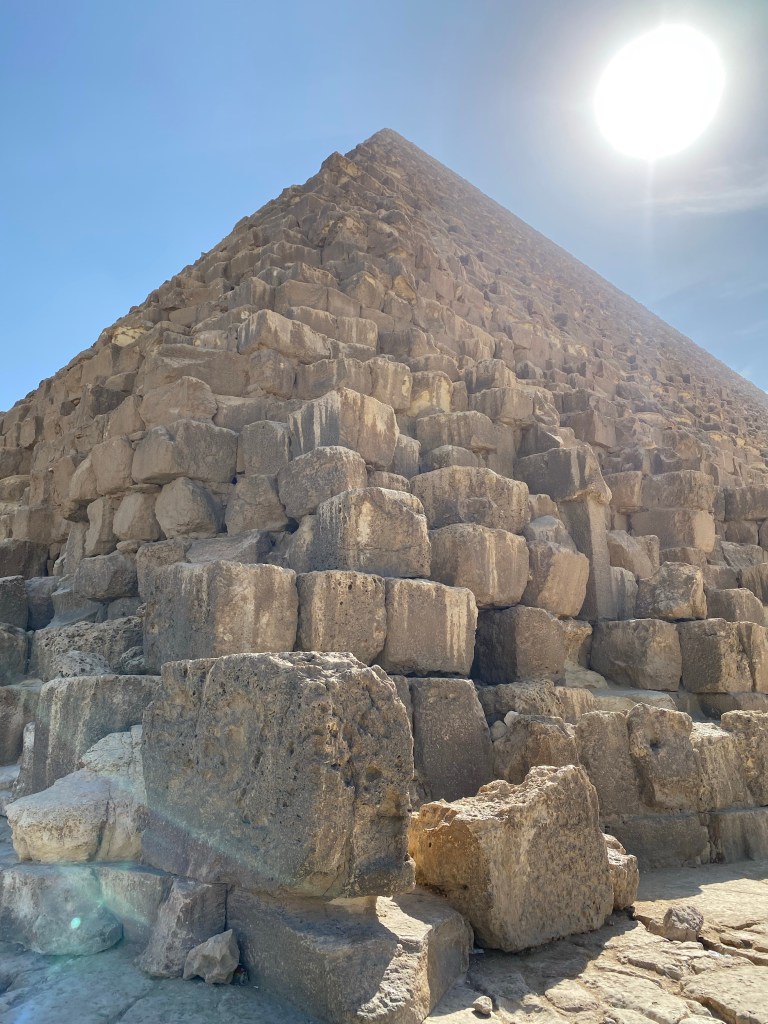
Great Pyramid of Khufu up close
There are actually 9 pyramids at the Giza site. The largest is the Great Pyramid of Khufu (or Cheops) is around 4600 years old and covers 13 acres at its base. The pyramid closest to it, the pyramid of Khafre is smaller but appears larger at certain angles because of its higher elevation. The Great Pyramid was designated as one of the seven wonders of the ancient world and is the only one remaining.
Sphinx and Pyramid of Khafre
After viewing the pyramids from all angles (except the one that yields the perfect photo of all 9 pyramids but requires a $22 camel ride – and if I never sit on a camel again it will be too soon), we proceeded downhill slightly to where the Sphinx stands guard. This iconic monument with the head of a man (presumably the pharaoh Khafre) and the body of a lion is thought to have been built in approximately 2558–2532 BC. There are numerous interesting theories about the destruction of its nose and extensive restoration and excavation has taken place multiple times throughout history.
I feel like I should qualify my statement about camels. They’re lovely animals from far. Up close, they smell awful and are generally grumbly unfriendly creatures. And riding them is uncomfortable. But all those things aside, they make me sad. Generally they don’t appear to be well cared for and the ones we saw at the pyramids were scarred and even had open wounds. And I just can’t see that standing around waiting for someone to agree to go for a ride all day, every day is any way for a creature to live.
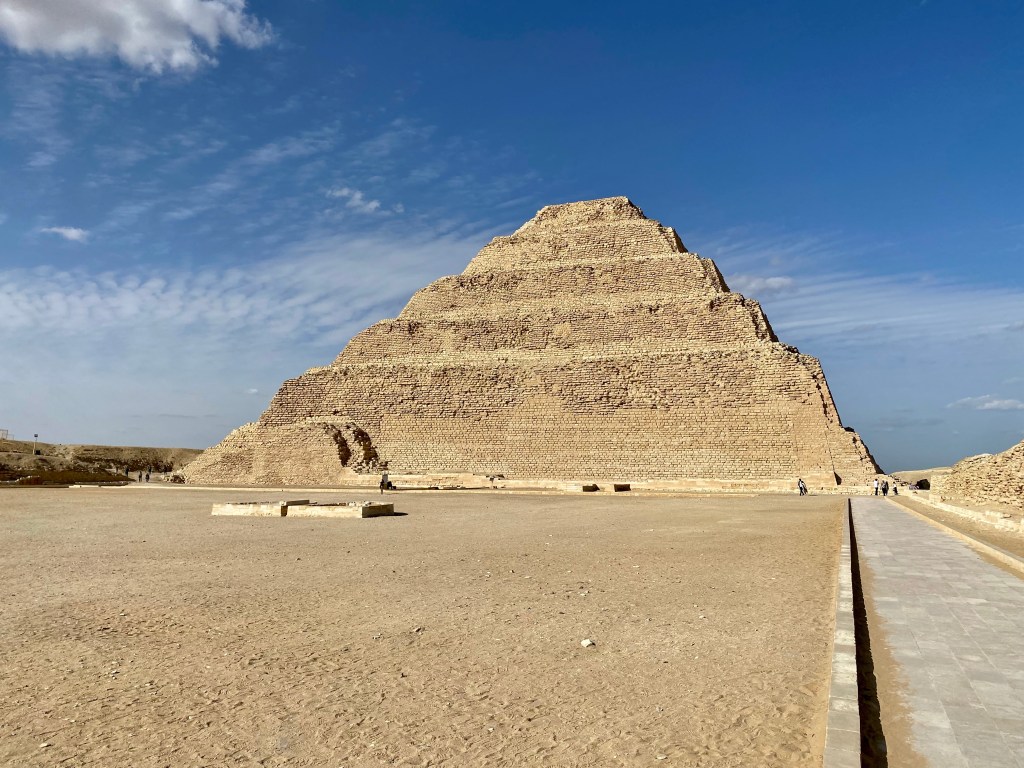
The next archeological site we visited was Saqqara. I now realize that I didn’t fully appreciate Saqqara while I was there – I absolutely plunged down a google rabbit hole a couple of days later and found out what a gold mine of archeological finds it was and currently is! As recently as January, tombs with literally hundreds of mummies and loads of antiquities were discovered! And just a few days ago it was announced that an intact papyrus scroll 16m long was retrieved from the site. 
King Djoser’s step pyramid from the 27th century BC (earliest colossal stone structure in Egypt – older than the pyramids of Giza)Replica of ‘ka’ statue of King Djoser looking toward the stars of north sky (representing eternal life). We saw the original in the Egyptian Museum in Cairo
Day 2 – Alexandria
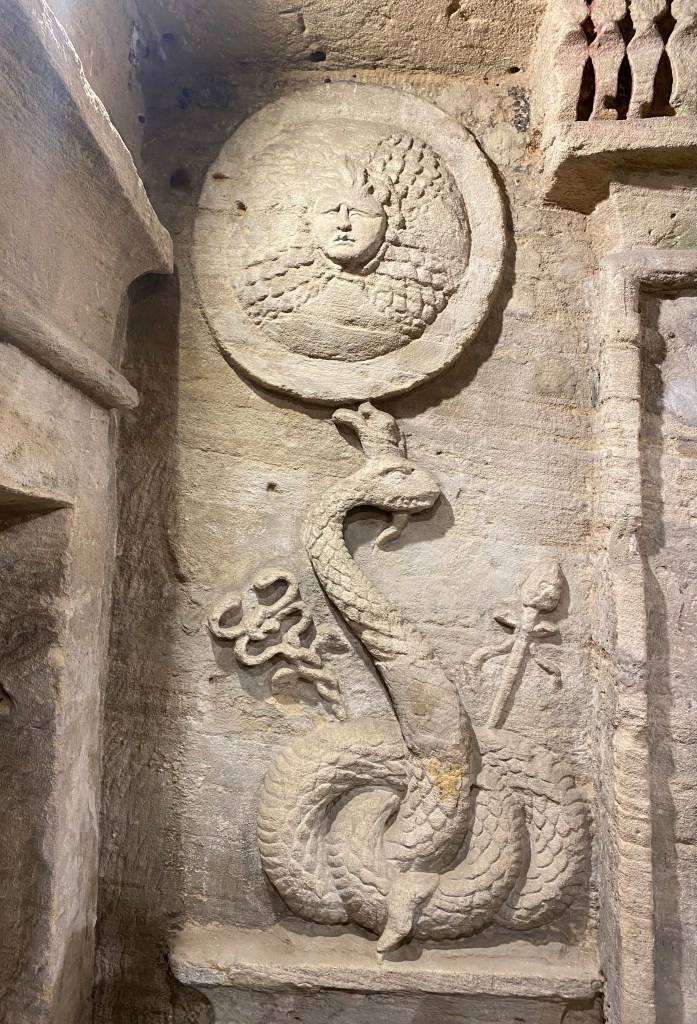
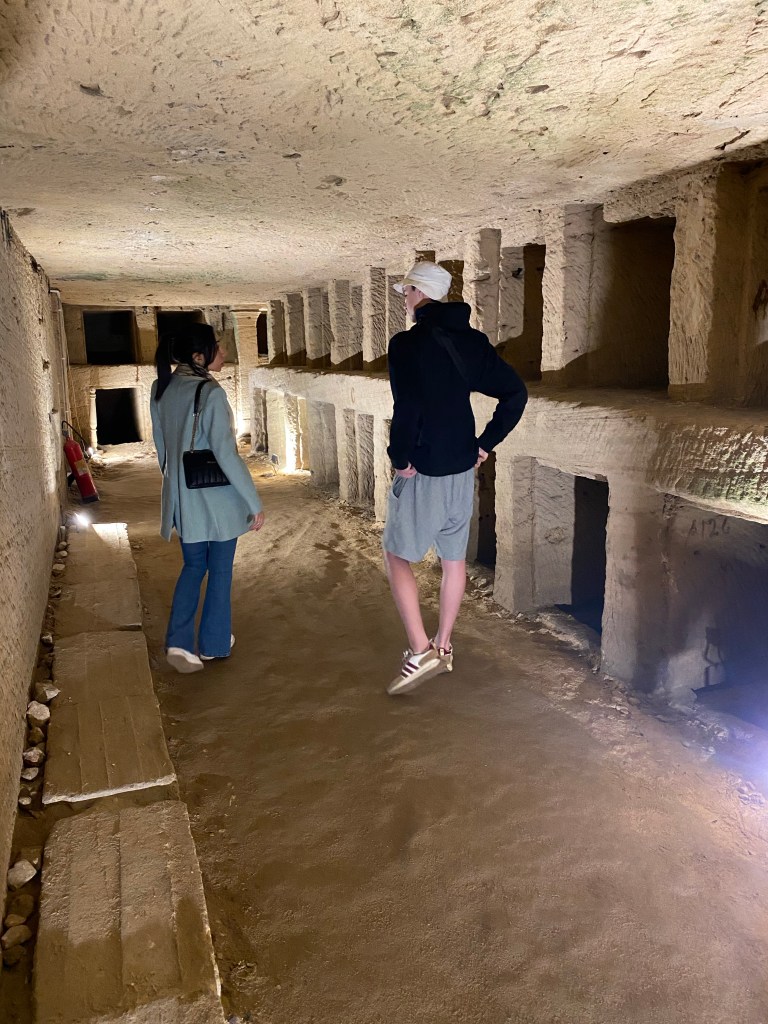
We headed north to the city of Alexandria to explore the sites there. It was an unusually rainy, windy and miserable day but we powered through, starting with the Catacombs of Kom el Shoqafa. In short, these are burial tombs originally created for one family in the 2nd century AD, but for unknown reasons, expanded to store numerous other bodies of both humans and animals.
Symbolic protectors of the bodies and burial goods within Rows of tombs for lower class citizens
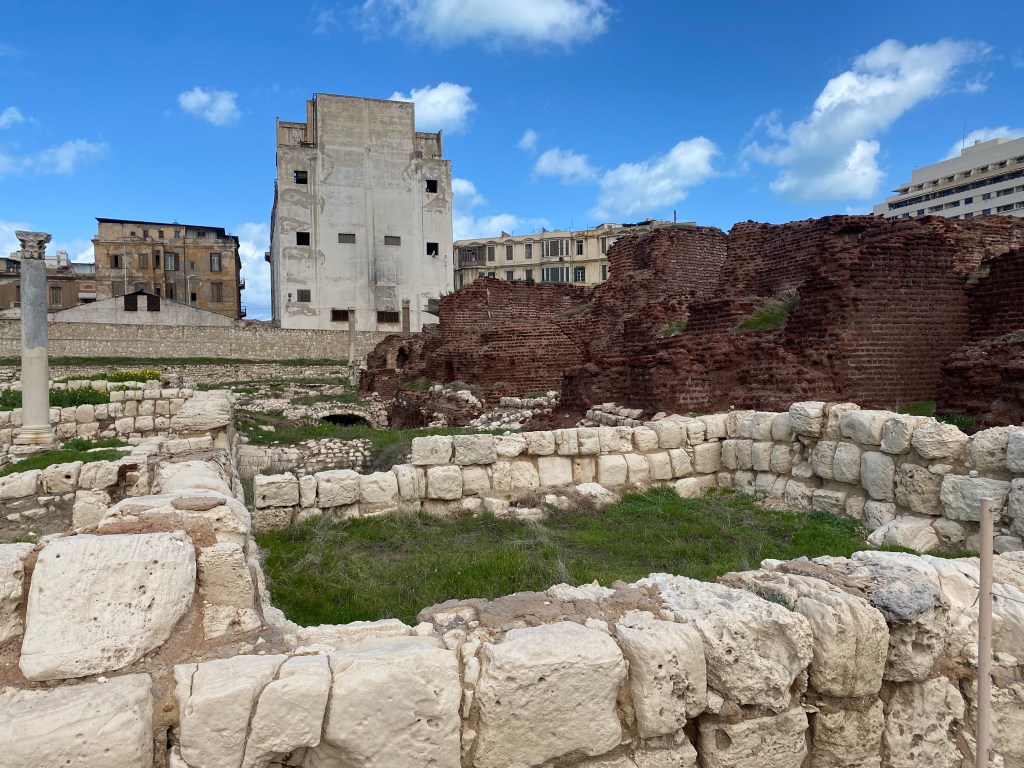
Our next stop was the Roman amphitheater and Roman baths.
Roman baths – light coloured limestone for cold and dark coloured sandstone bricks for hot
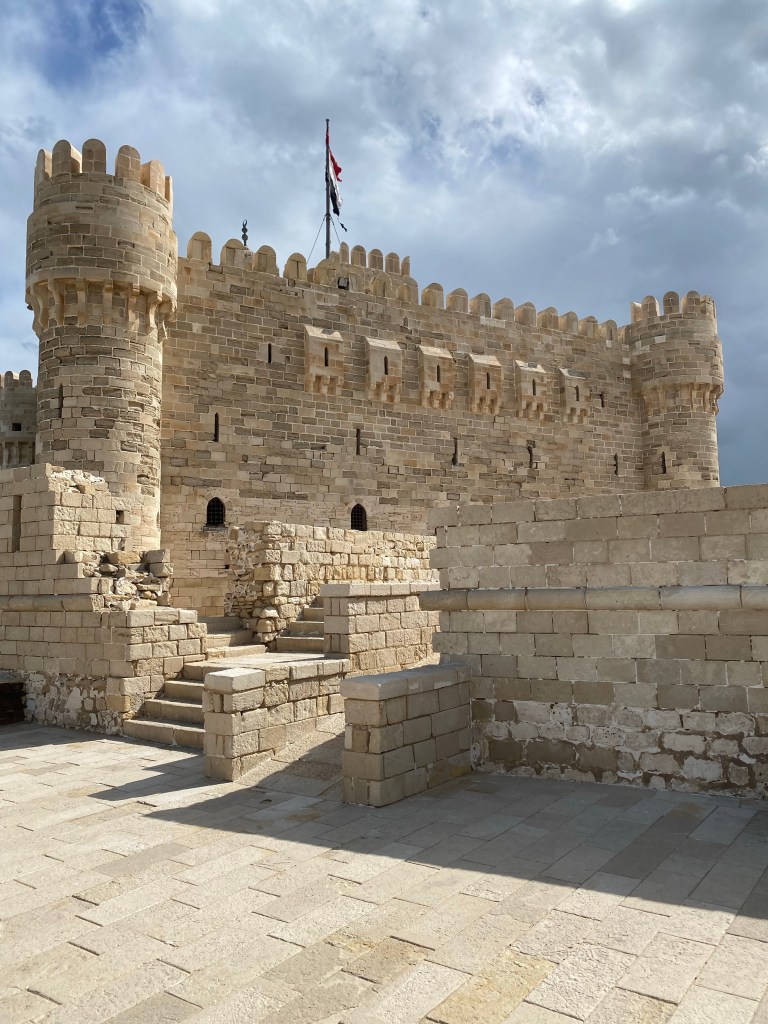
The Citadel of Qaitbay (fort built in the 15th century and restored in the 1980’s) was our next stop. Perched right on the Mediterranean Sea, it was a windy spot but afforded great views of the surrounding city and the sea.
Citadel of QaitbayQuick visit to Abu al-Abbas al-Mursi Mosque where we were able to enter and view the interior architecture and shrine to its namesake
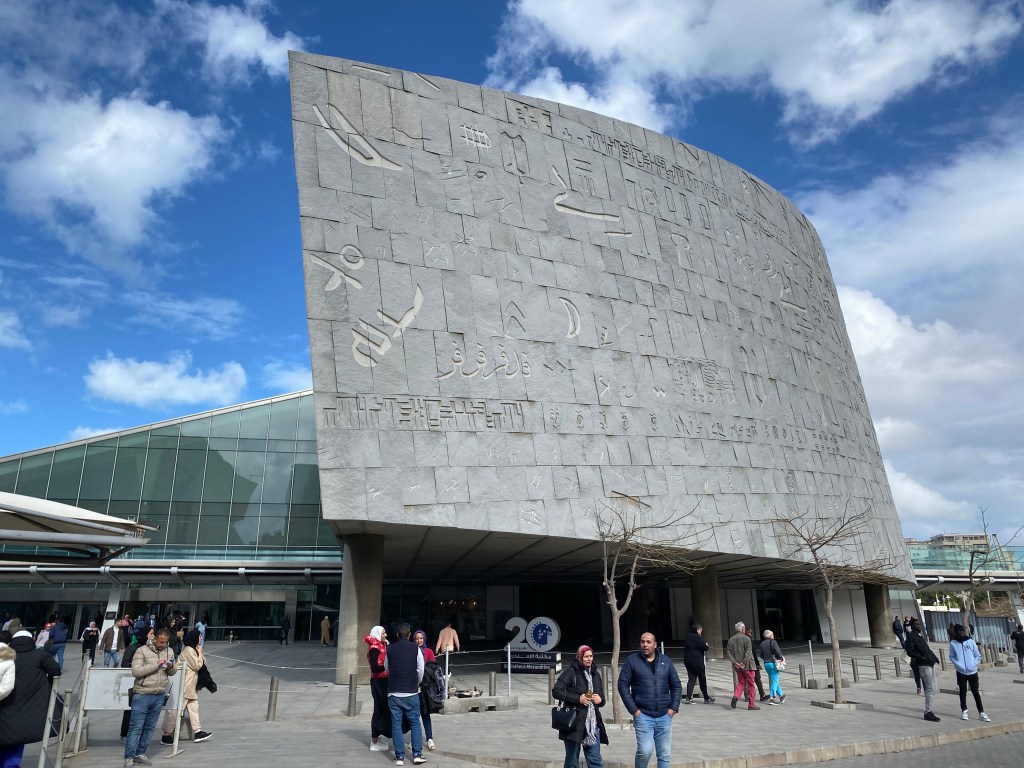
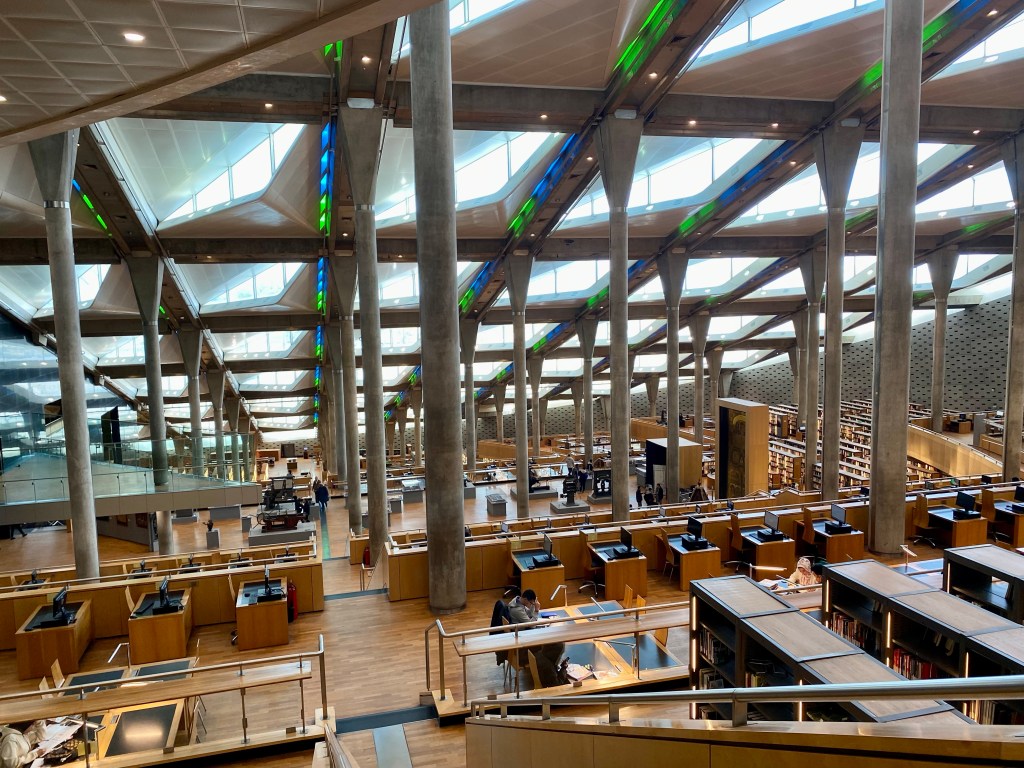
Probably the highlight of the day was the modern Bibliotheca Alexandrina. I could have spent hours here exploring the collection of books, art and antiquities! And the 11 story building itself is just stunning! It commemorates the Library of Alexandria, once the largest in the world. Unfortunately the original library’s collections were lost in a series of accidental and purposeful events disputed through history but likely completed in around 600-700 AD.
Front entrance and facade The multiple levels of the interiorThe ‘rear’ of the building that faces the ocean and the planetarium science centre in the same library complex
Disappointingly we concluded our day in Alexandria with lunch at a somewhat dingy tourist restaurant on the ocean. The servers were very nice and super attentive though and the fish was surprisingly good!
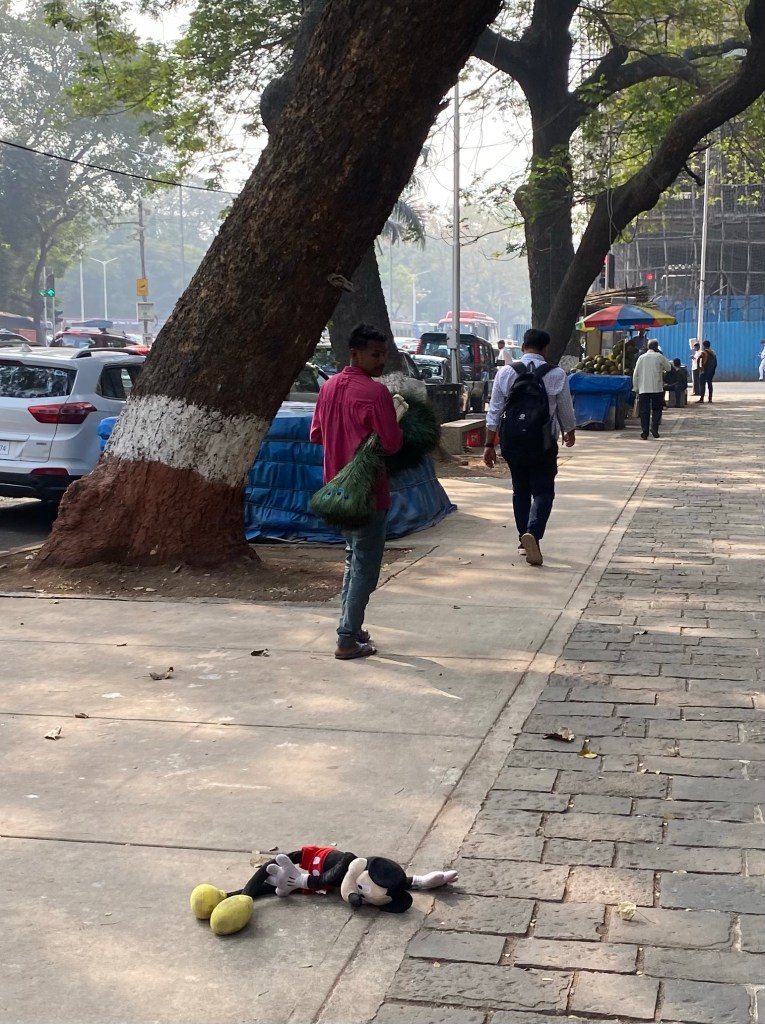
Thankfully Mickey and I aren’t in the same condition!
I expected it to be harder….
I expected it to be stressful, super challenging, maybe overwhelmingly heart wrenching. It wasn’t. And maybe that was mostly due to my Intrepid Travel tour and absolutely exceptional guide, Saurabh and the 4 other women who I had the privilege of spending the last 2 weeks with.
And maybe it’s because India gets an undeserved bad rap back home…. There are definitely not so nice aspects of travelling here but the food, culture, history and architecture more than make up for them! So here are a few of my general impressions:
The not so good:
The tourist scams – try as I might not to get ‘sucked in’ I still did. It started with the taxi ride from the airport and a poor choice of kiosks (even though my homestay host had clearly laid out which kiosks were good and how much it should cost). I was tired, stressed about the series of nonfunctional or dysfunctional ATMs I’d had to deal with to get my 10,000 rupees, and I just took the offer from the second kiosk I checked at. So I paid roughly double what I should have for my taxi ($30 versus $15). In the grand scheme of things, not a huge deal. I also told the story earlier about the other taxi ride runaround in Delhi (fortunately that one only ended up costing me about $2.50 and an hour and a half of my time more than it should have). And I lost 10 rupees (16 cents) to a religious figure on the street who had a yarn bracelet tied on my wrist before I even knew what has happened – so I paid him to get away.
There are countless other scams, touts and pickpockets when you’re out on the street too. But mostly if you keep your wits about you and learn not to make eye contact with or acknowledge the people constantly begging and cajoling, it’s ok. It feels awful though to ignore a small child or a young mother cradling her baby asking for money, but I had to learn to look away. Giving money only fuels the problem – children and babies are most often ‘tools’ for begging and supporting it only encourages more of the same.
Also disconcerting is the staring – a tall, white female in a male dominated South Asian country draws some attention. And that spills over into this odd phenomenon where everyone wants to take a photo with you – ‘just one photo’. I was literally mobbed at Qutab Minar to the point where I had trouble leaving. And it’s everyone – young men and women, children, mothers and fathers! Again, the polite Canadian in me wants to do one thing but knows that being ‘rude’ might be the only reasonable response!
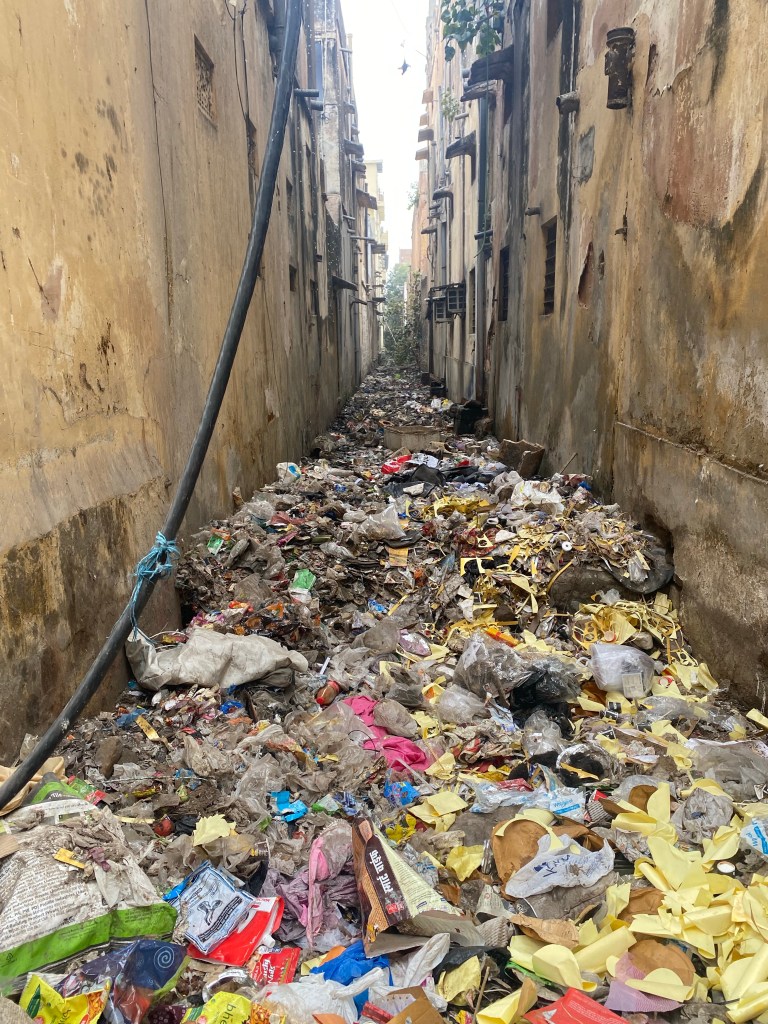
The garbage problem is real. It was explained that culturally, civic responsibility isn’t strong here. People see the garbage as ‘not their responsibility’ so personal residences and yards are mostly tidy but common spaces are often a plastic strewn horror. I’m still struggling with understanding this one.
An alley in Jaipur
The pollution is choking. Like everywhere we went! City or countryside, it doesn’t matter. I assumed Delhi and Mumbai would be bad, but was surprised when literally everywhere was a foggy/smoggy haze! The most shocking illustration of the pollution for me (aside from the black color when I blow my nose 😆) is that Apple Fitness notified me 12 days in that my average respiratory rate had increased from 13.7 breaths per minute to 15.4 breaths per minute. I literally have to breath more here to get enough oxygen!
Taken from the train to Agra in the countryside
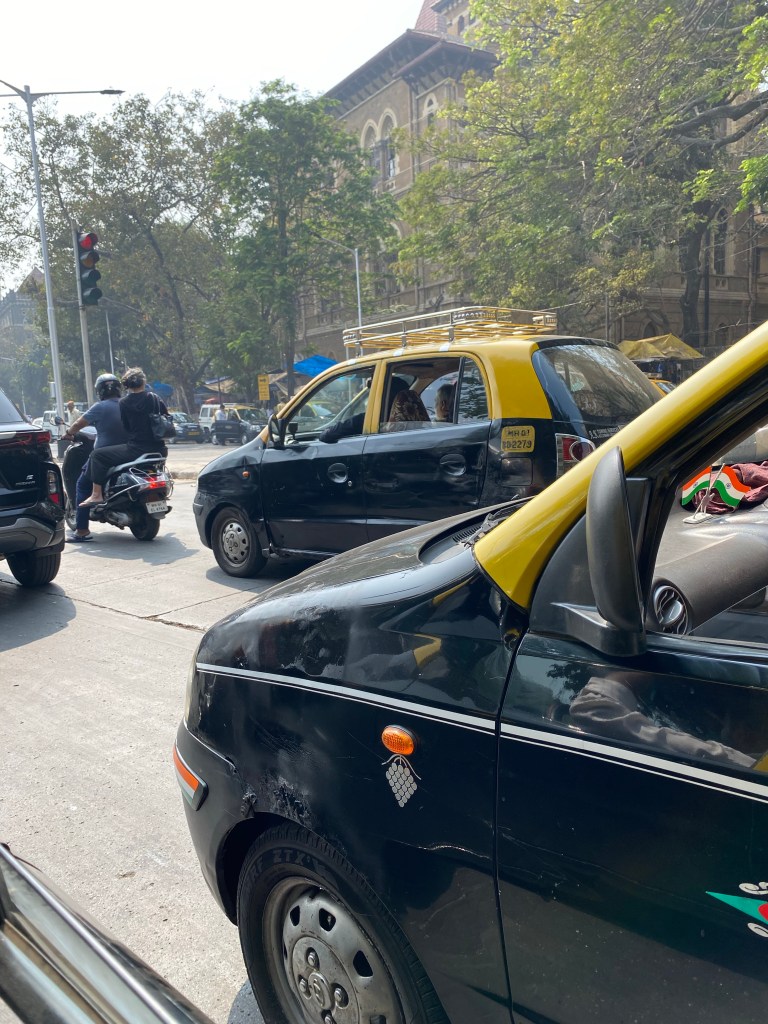
The traffic is mind boggling. So many motorcycles, scooters, rickshaws, trucks and cars! And lane markers, traffic lights and stop signs are merely suggestions! Saurabh explained that because there are so many people, culturally everyone is conditioned to ‘fill in the spaces’. And so they do – a 2 lane road is likely to have 5 vehicles across it, honking and maneuvering between and around – very close at all times. And almost every single vehicle is dented or scratched (not surprisingly).
‘Scarred’ taxis in Mumbai
Being a pedestrian is life threatening! Pedestrians have zero right of way – anywhere – even in a crosswalk. And it’s different than Asia – there they will go around you if you just walk at a steady pace. Here they will drive over you if you don’t stay/get out of the way. I had to play ‘Frogger’ (an old video game reference from the 80’s for those of you who don’t know) on a 6 lane street in Delhi on my way to Qutab Minar even though there was clearly a pedestrian crosswalk!
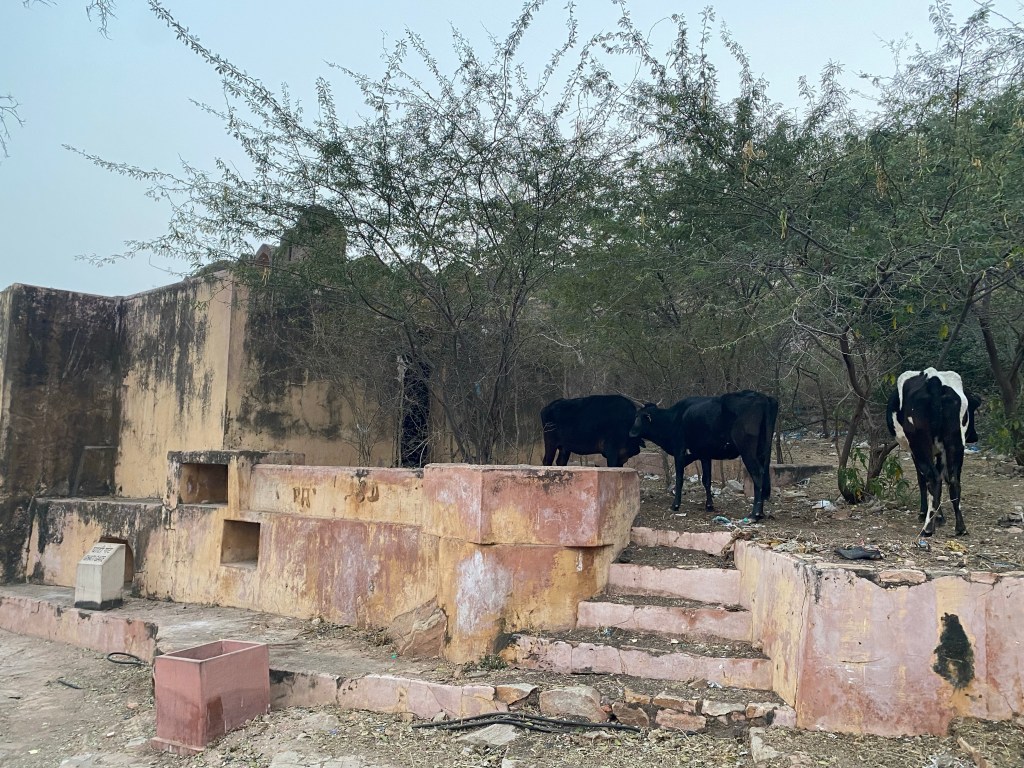
The street wildlife is unnerving. Cattle are holy and everywhere! Stray dogs are absolutely everywhere. And cats were more present in Mumbai. And the goats roamed freely through places like the market in Udaipur! I know from experience that animals are unpredictable and I was just waiting for a spooked cow to run me down or a stray dog to lash out as I walked by! Ok – maybe that’s slightly exaggerated since most of these animals are surprisingly docile and most of the time completely ignoring the chaos around them while they snooze or just wander.
It’s definitely disturbing as many of the cats and dogs aren’t in the best physical condition. I want to rescue them all!! The cows and goats, however are well taken care of!
Cows at a historic Fort in Jaipur Mumbai cat collection
The so very, very good!
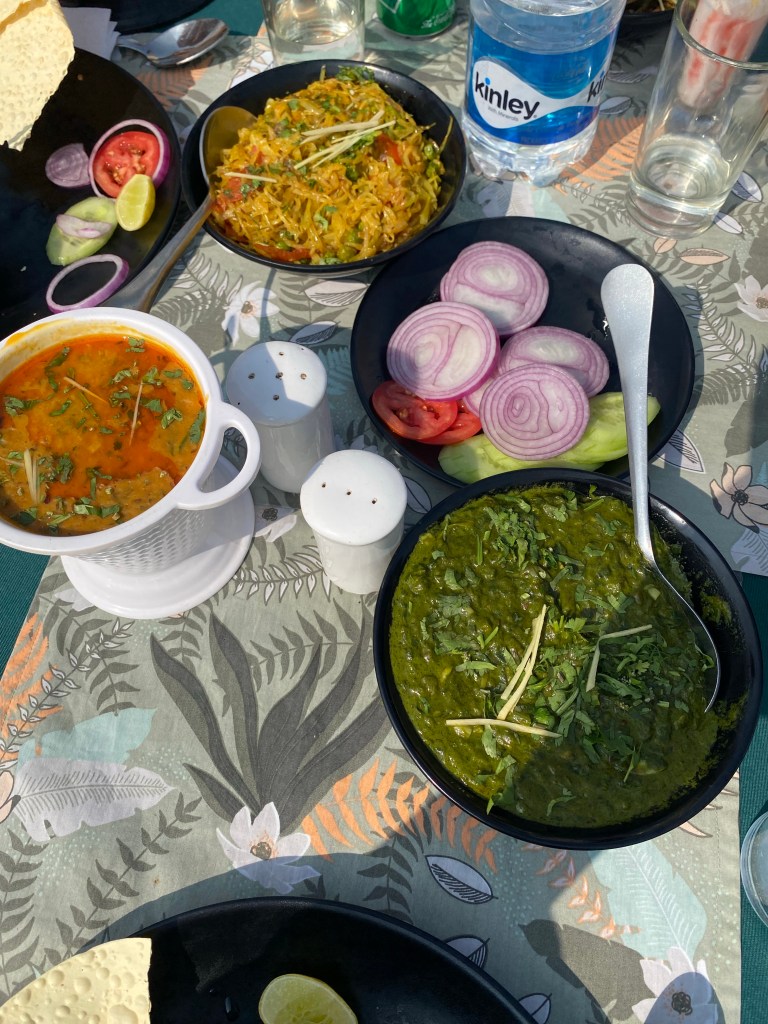
The chai!!!! Specifically masala chai loosely translated to ‘mixed spice tea’. Brewing good chai is an art and we were lucky enough to have a chai connoisseur as our guide – the Chai King! Saurabh was all about introducing us to his personal obsession and we all jumped right on board! There are lots of variations but the best ones have cardamom and ginger steeped with fresh milk, Asam tea and a healthy dose of sugar (1 tsp per cup of milk). The mixture is brought to a boil and cooled 3-4 times until the desired colour is achieved. It’s a perfectly safe street food if you get it fresh made since it’s been boiled for so long. There’s so much more to tell you about chai, but I don’t have the time or space to get into it here.
If you’ve read the rest of my blogs you should have a pretty good feel for my opinion of the food. I’m truly obsessed – the spices and the flavours are perfection! And it was fantastic to be able to learn so many cooking techniques! I’m so excited to go home and go shopping for spices and cooking tools! I seriously think I will need to cook this food on a regular basis or suffer from withdrawal! Also, I can’t say enough good about being unbelievably lucky enough to have a true foodie as our guide – thank you so much Saurabh 🙏. And it was such a privilege to be able to safely partake of the street food! Yes, I got sick but I honestly think it was due to my own error in ordering a snack that was of western origin instead of local. If only I’d just stuck to the local food…. And, I’m happy to say I’m the only one in our group who didn’t come down with a cold, so that’s something at least!
I can’t go without mentioning the lime soda and lassi. A good lime soda here is made with fresh lime juice, soda and sugar. Many of the locals might disagree and enjoy the addition of rock salt and other spices. In my opinion, rock salt is death – it smells and tastes like sulphur – aka 💩 – haha. And I can’t get on board with the salty drinks, but then I’ve never been a Gatorade fan back home either! So – you can order your lassi (yogurt based drink) salty, sweet or fruit flavoured. And you can order your lime soda plain, sweet, salty or mixed sweet and salty! The choices! I’ll take a sweet plain lassi and a sweet lime soda any time!!!
Also evident from my other posts – the historical beauty and culture that permeates the entire country. Admittedly I need to do some more reading to fully wrap my head around the history but so many representations and relics of that history that I saw were absolutely jaw dropping.
I’m going to sign off here for now, but I’m sure there are going to be alterations to this blog as things come to mind over the coming weeks.
The final 2 destinations in India were so markedly different! My first late afternoon and evening in Mumbai were spent recovering from my mild bout of GI illness. I missed out on a walk to a nearby beach, Girgaon Chowpatty where the colourful street food market yielded a delicious dinner complete with many rave reviews of the ice cream. The thought of food still didn’t appeal to me and I didn’t trust my gut not to mutiny so the FOMO (fear of missing out) was real! It was worth it though as a good sleep and some rehydration meant that I woke the next morning ready for my day in Mumbai!
Local transportation – legendary trains (video creds to Sophia cuz my train vid was a fail!)
Our first destination was the largest open air laundry in Mumbai (called a Dhobi Ghat) that’s been operating since 1890. Laundry comes from all over the city and a combination of basic hand washing and modern mechanized washing is used. Workers here earn a good living.
We boarded the train again and made our way to the Colaba area of Mumbai for a historic walking tour. The British colonial architecture dominating the skyline was a bit disorienting – like stepping into a different country.
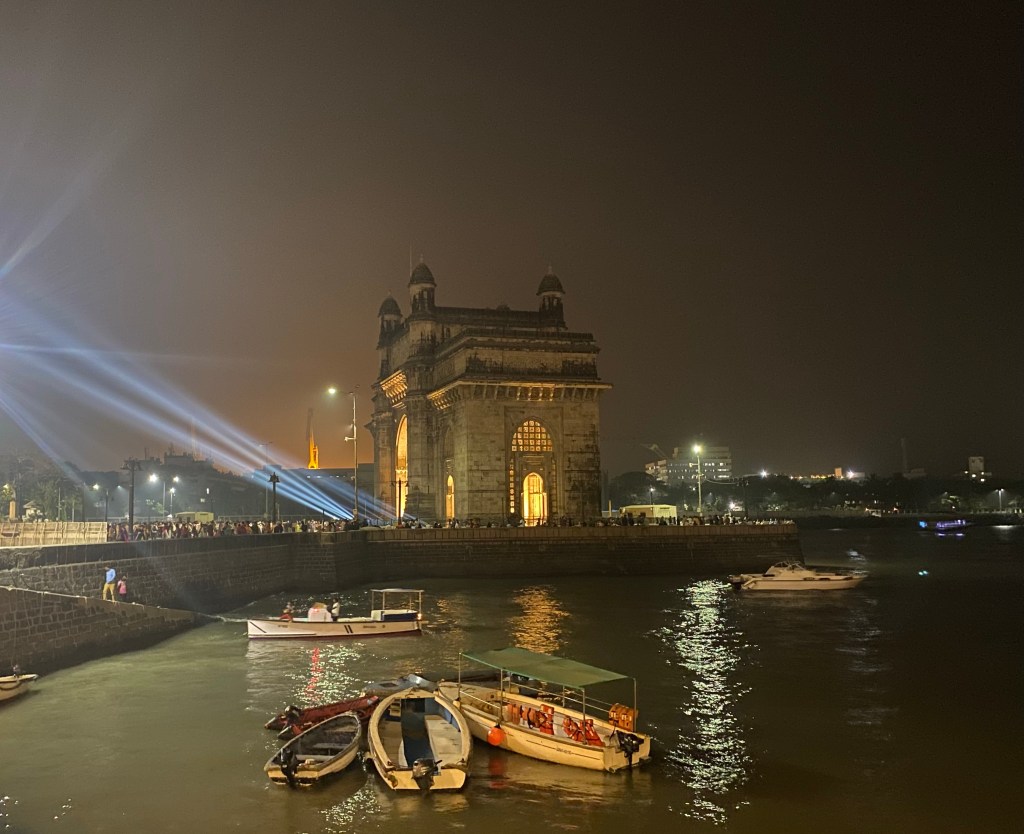
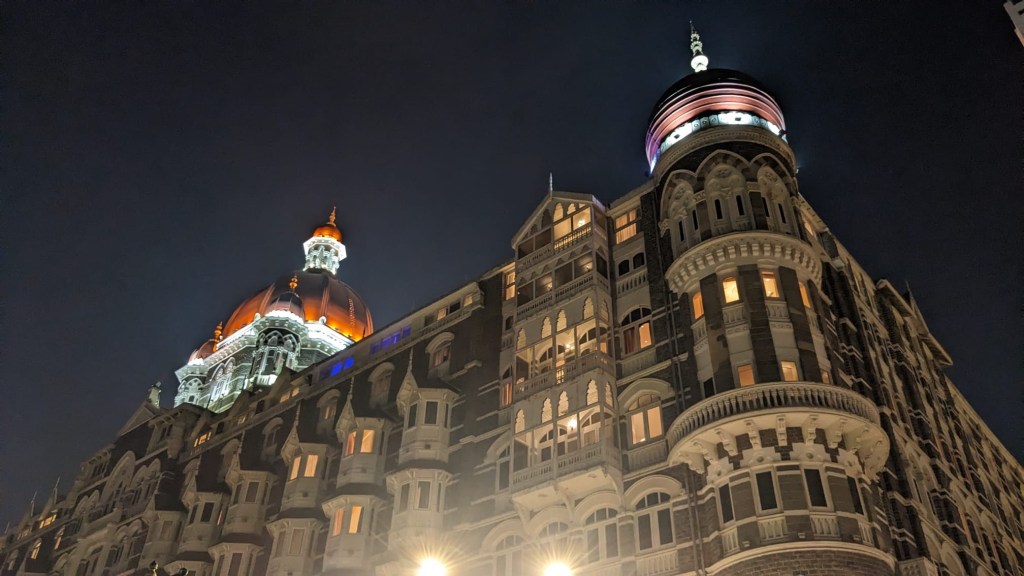
We wandered the streets for a few hours and stopped for photo ops at the Gateway of India (built from 1911-1924 in honour of a visit from King George V) and the Taj Mahal Palace Hotel (made world famous by the tragic terrorist bombings in 2008).
Gateway of India (taken from the side entry to Taj Mahal Palace Hotel)Taj Mahal Palace Hotel
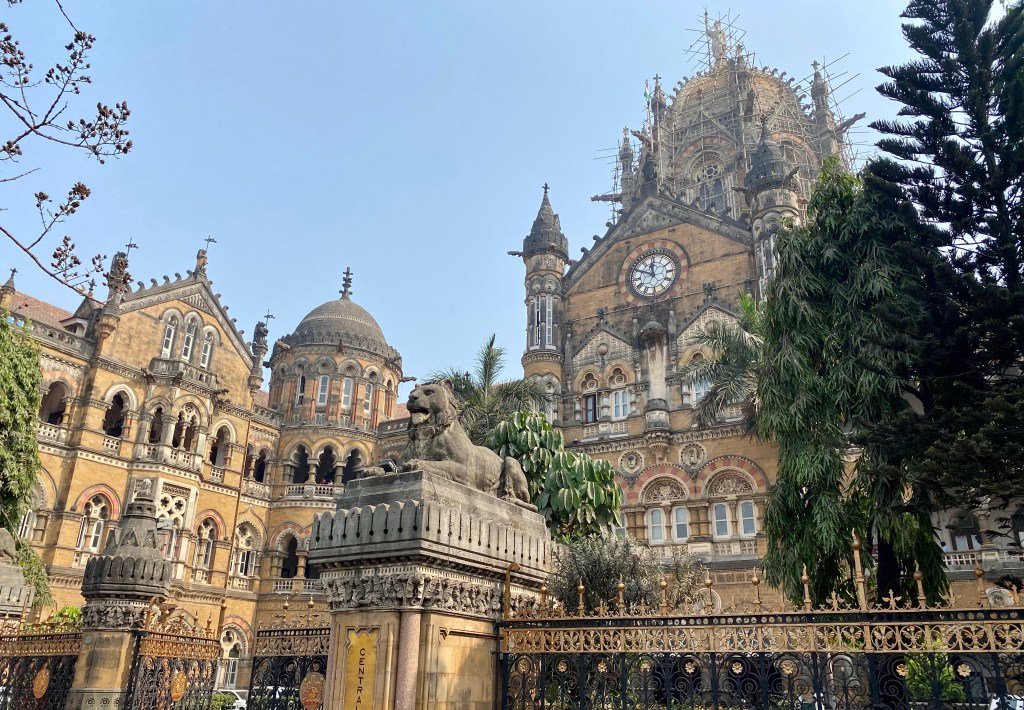
Also notable is the historic train station in Mumbai, Chhatrapati Shivaji Maharaj Terminus, a UNESCO world heritage site. Possessing beautiful, ornate architectural details and servicing over 1000 trains per day, this was an awe inspiring Mumbai attraction!
Main foyer with ticket counters
Our tour ended with a delicious lunch at a Parsee restaurant where I got to rehydrate with fresh watermelon juice with actual watermelon chunks (everyone who knows me is aware of my watermelon obsession)!
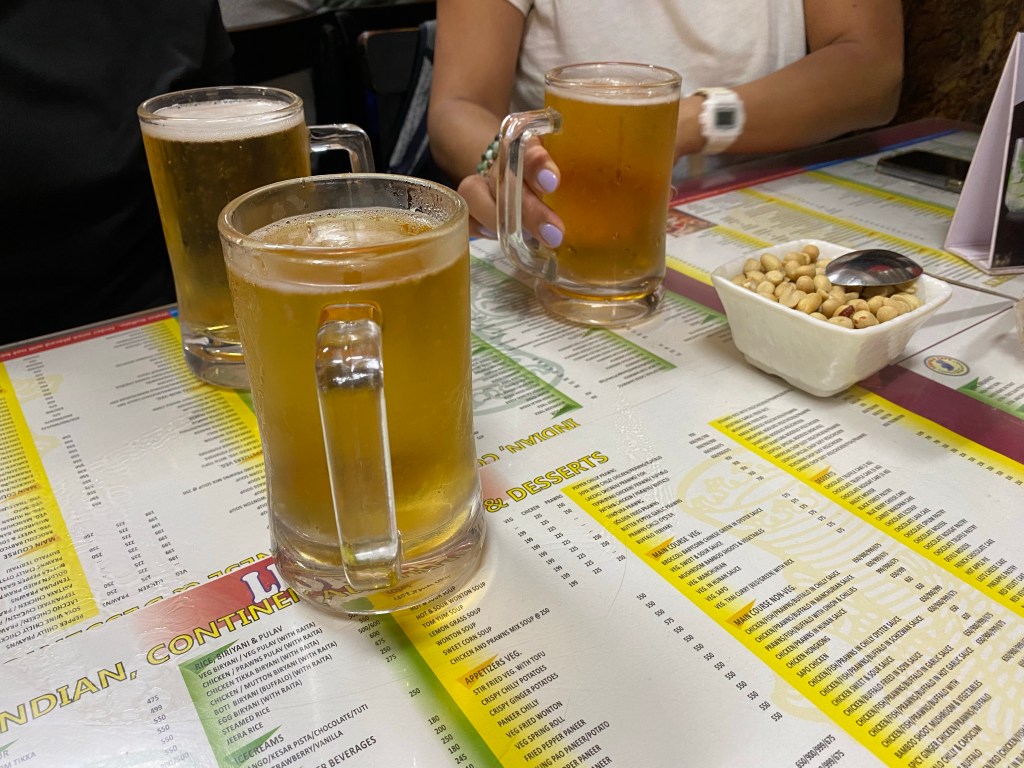
The 30C heat and humidity of Mumbai were stifling after the cooler weather on the rest of the trip so after lunch we headed to the famous Leopold Cafe (read ‘Shantaram’ for more) and I had my first alcoholic drink of the trip. Alcohol is heavily taxed in this state (Maharashtra) and my pint came to 465 rupees or roughly $7.60. It was still gratifyingly refreshing!!!
Kingfisher draught
The group split in two (shoppers and non-shoppers 😆) and Sophia and I headed off to explore the opulence inside of the Taj Hotel. I can honestly say I’ve never felt so underdressed. So many colourful, bejewelled women and men! The Taj is open to everyone, but it really is best to show up in your finest!
The heat and the lack of calories over the previous couple of days was starting to get to me so we went back to the hotel for a bit of a rest before dinner. Saurabh hit yet another home run with his suggestion for us and he, I and Sophia hopped in a cab and headed back down to Colaba to Bademiya for more mouthwatering Mughlai food. After dinner we walked back to the Taj to grab some night shots.
Gateway of India Taj Hotel (photo creds to Sophia, another photo fail for me)
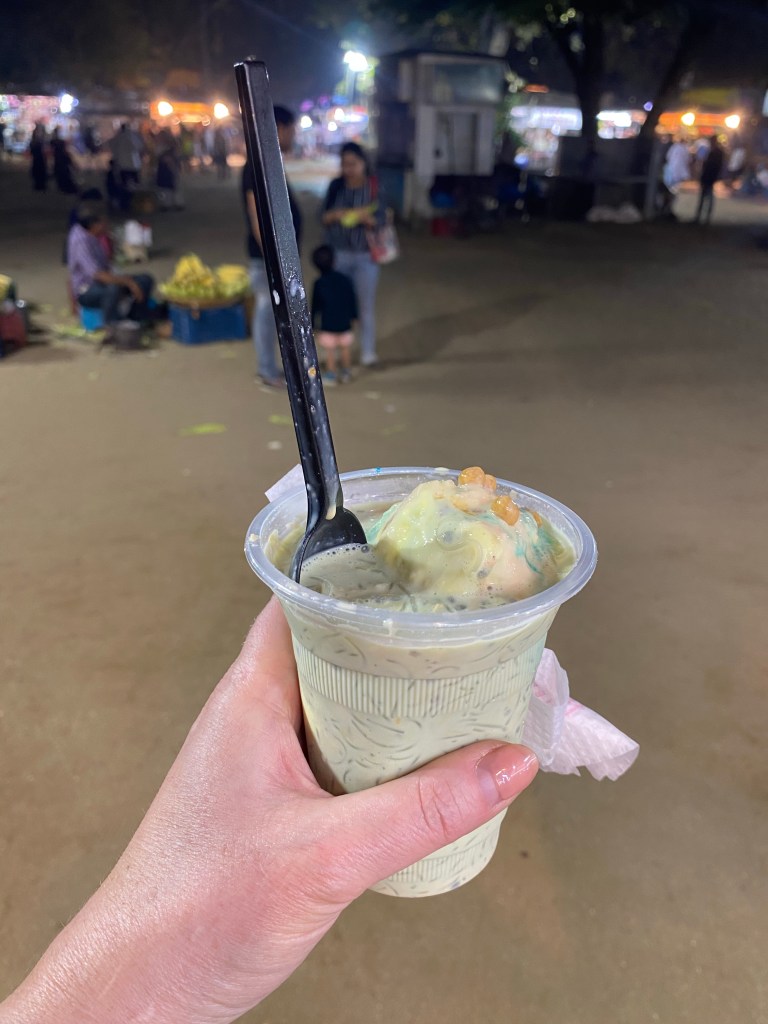
Finally we ended the night with a harrowing taxi ride back to Chowpatty beach for dessert and a walk. Hilariously, Saurabh attempted to tell the driver to slow down ‘nicely’ by commenting that we’d ‘just had a very big dinner‘. It didn’t work, so he told us to just keep looking out the side windows and not to look ahead 😆. We were thankful to be close enough to walk back to our hotel from the beach!
But not before enjoy a yummy butterscotch falooda – obsessed!!!
Our next morning started early with a trip to the airport for our 10am flight to Goa. Our flight departed an hour late because of some technical issues but was otherwise uneventful and our driver and van were waiting immediately upon our arrival to take us directly to our first stop – lunch and a tour at a spice plantation.
For some reason, I still wasn’t feeling completely healthy and was finding the heat draining. It also killed my appetite so I didn’t optimally appreciate my lunch – which was actually exceptionally good for a buffet. And I’d been on a spice tour in Sri Lanka before so recognized many of the plants we were shown. So overall not the most exciting attraction on my visit to India, but pleasant. And also not the most notable photos….
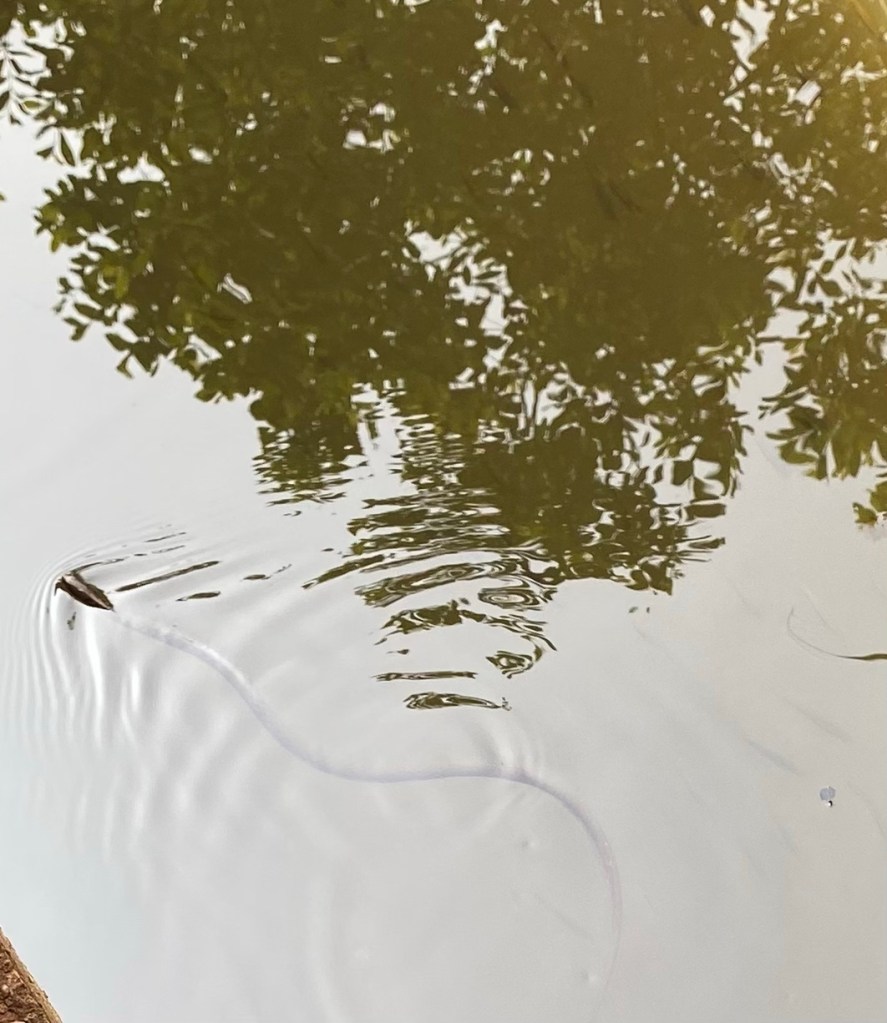
Poser Budweiser bottles water too.. hmmJust a little water snake swimming beside us 😬
Our next stop was the Basilica of Bom Jesus where (most of) St. Francis Xavier’s remains are interred. Really, parts of him are spread all over the world and I find it hard to comprehend this practice of dismembering and displaying the body parts of religious figures randomly in different locations. The church itself is an impressive piece of red sandstone architecture built in the late 1500’s.
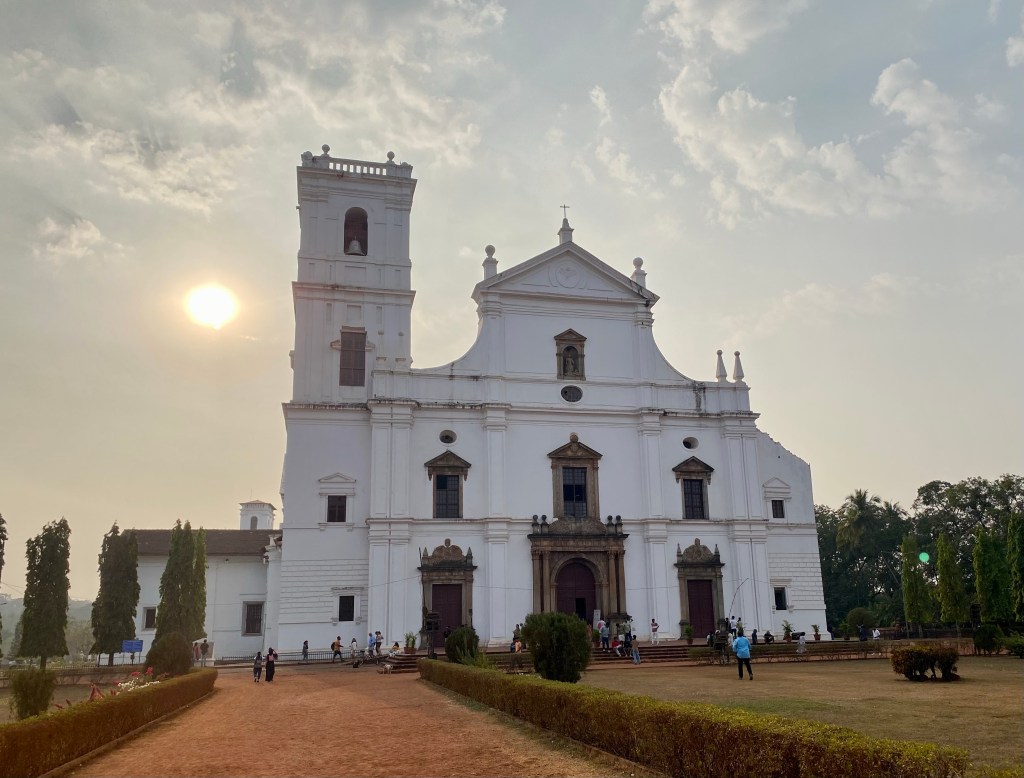
Close by is the Sé Cathedral of Santa Catarina, of Portuguese origin, it’s one of the largest Catholic Churches in Asia and another UNESCO world heritage site.
Saurabh in front of our brightly coloured van – christened the ‘Scooby Doo Van’ (better known as the Mystery Van) for obvious reasons.
After a busy day including a flight, driving winding roads and seeing the sights, I still wasn’t feeling 100%. Ugh – I sound so whiny!!! Believe me, it physically hurt me to miss out on another evening meal but my throbbing tension headache wasn’t going to make for a fun evening out so I stayed in again and skipped dinner. The rest of the group was sweet to let me know that I hadn’t missed out – the beach culture in Goa calls for deafening pounding techno music and overpriced restaurants. So everyone else was back within an hour and a half.
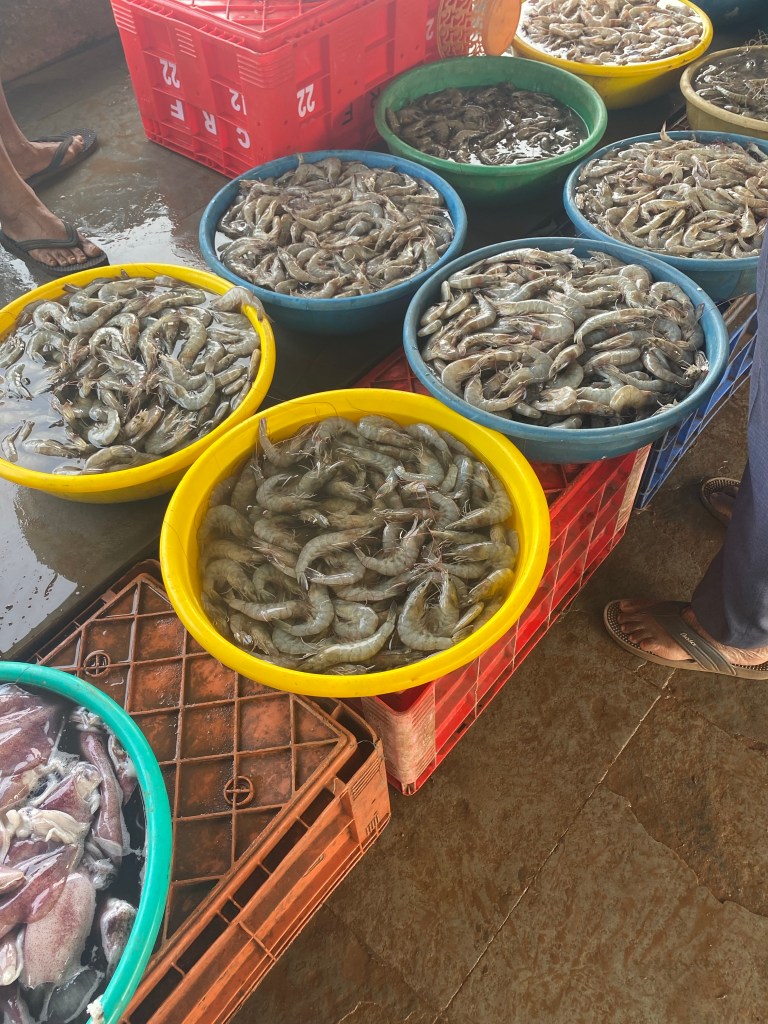
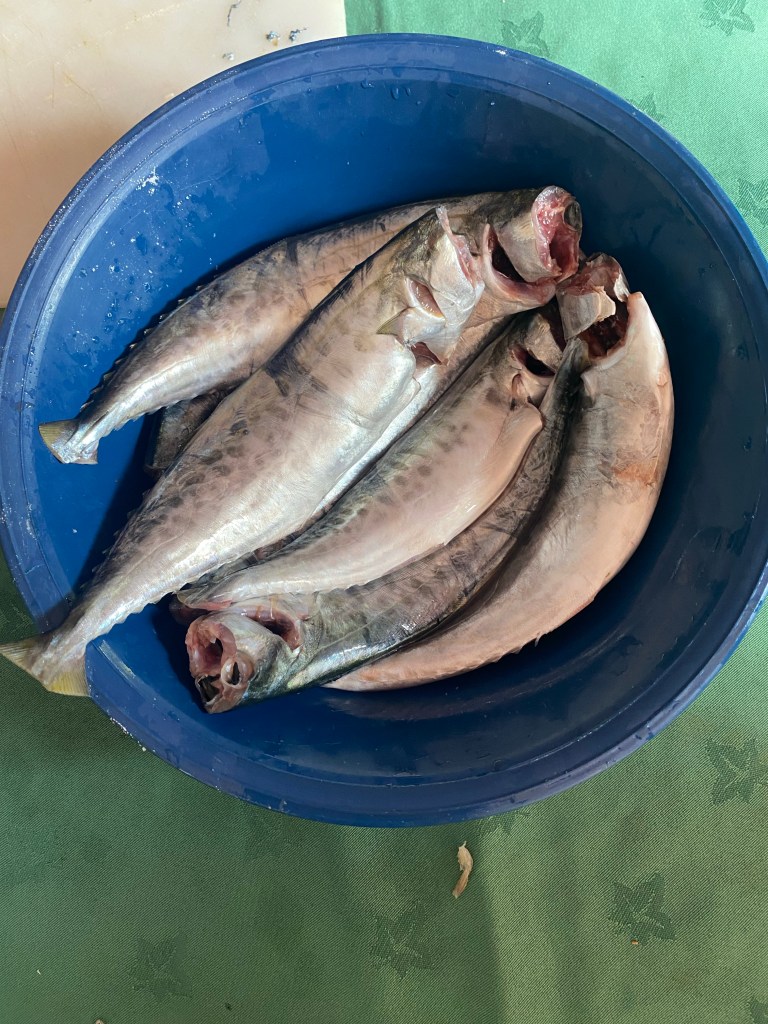
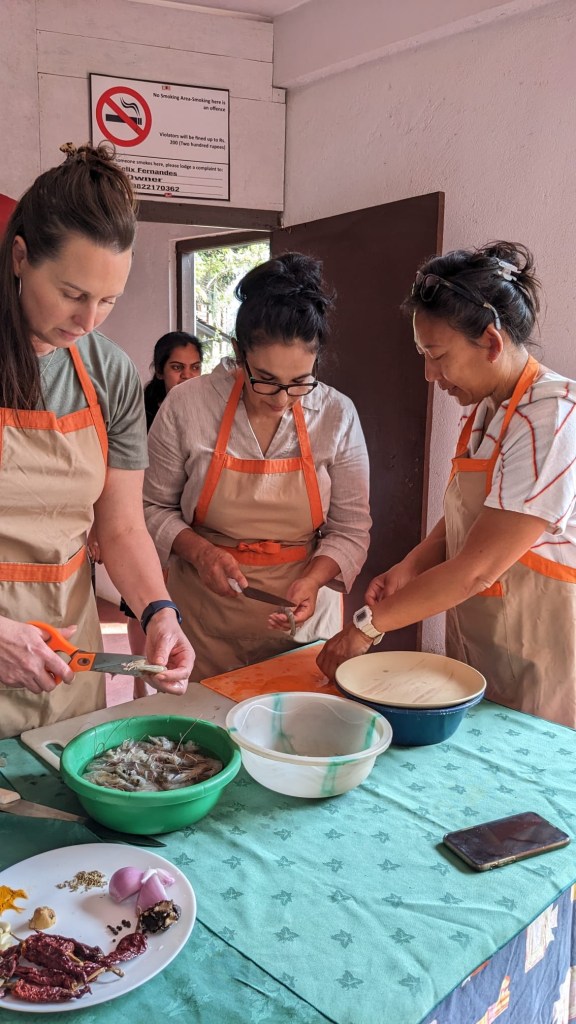
Goa day 2 started with a trip to the fish market and another cooking class. At this one the highlight was the stuffed Kingfish with the addition of a standout ingredient – Goan vinegar (made from sap extracted from Goan coconut trees) – delicious! And I finally learned how to clean prawns and open a coconut properly!!!
Prawns, prawns, prawns (and some squid)Our lunch fish This is how it’s done!Scary coconut cracking device!The prawn prepping crew – myself, Nadine and Meghan (photo creds to Sophia)A free afternoon for some R and R on the beach – yes I’m wearing leggings – see below
The beach in Goa was crowded – but predominantly with local men. Women dress very conservatively in India, even on the beach. So I always just felt more comfortable the more covered up I was. A tunic and leggings was fine since I wasn’t going in the water anyhow.
Truth – I’m not super charmed by Goa. It reminds me of Patong Beach in Phuket, Thailand. Too much focus on partying and commercialism destroys any illusion of ‘nature’. Lots and lots and lots of kitschy stores, the ever present garbage problem (a walk on the sand near the water means dodging plastic bags and bottles, lost shoes and tobacco spit). And the nightlife is dominated by that pounding techno music I mentioned earlier – like head splitting, eardrum exploding loud music! And it’s coming from every beach restaurant so if you choose one to sit down at that isn’t playing music you just get this cacophony coming at you from all sides.
However, Saurabh brilliantly found us a wonderful restaurant for our final meal together as a group on a beach further south from where we were staying. It was a great evening sitting at our table overlooking the water and enjoying the sound of the ocean, the evening breeze and fantastic conversation!
This beer was about $1.60 – big difference from Mumbai, but we’re in a different state now!
Our drive from Jaipur to Udaipur was about 7 hours, broken up by a chai stop and a rooftop dinner in Bhilwara that I later learned was the highlight meal of the trip in our guide, Saurabh’s, opinion. The service was impeccable and the dishes were delicious but what stood out was the variety of breads that kept appearing!!
Rooftop dinner in the sunshine!
I haven’t talked about the breads here yet. It seems there are endless creative ways to mix flours and liquids and assorted other simple ingredients to form yummy vehicles for curry consumption! Most of them are unleavened and vary only in the type of flour used and cooking method. I ended up googling to find some kind of list and to be able to remember some of the names and there are actually illustrated guides!
These are just a few of the approximately 30 types of breads commonly found in India. Of these, I think I’ve tried 7 but I’ve probably had at least the same number again that don’t appear in this picture!
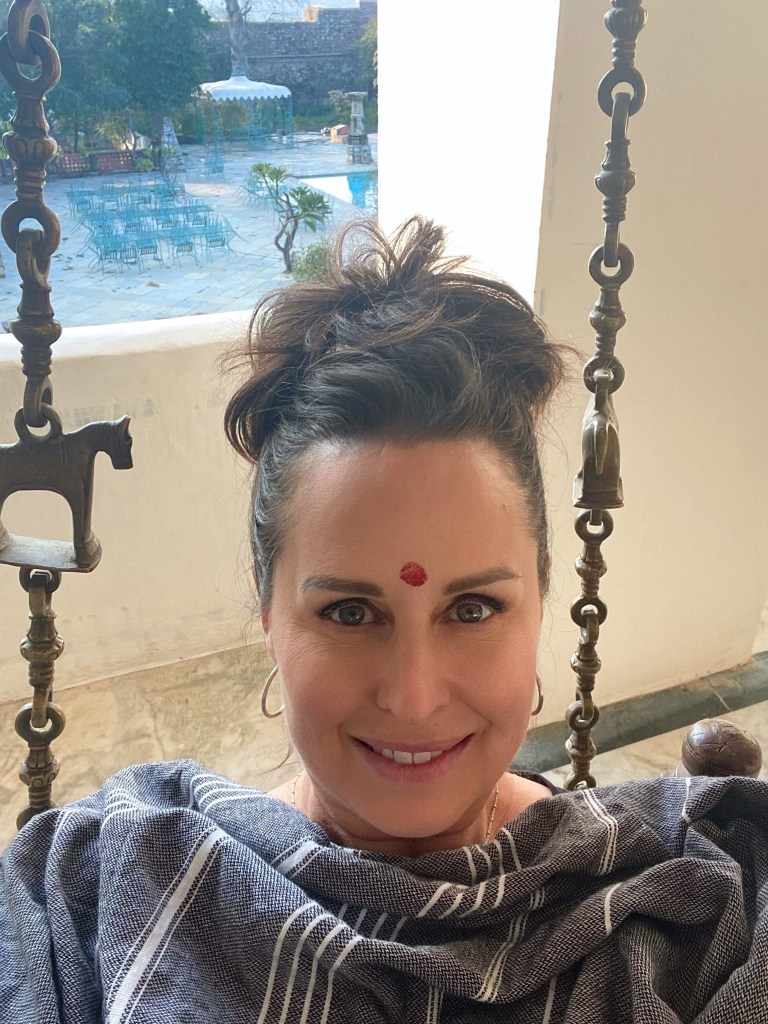
Our arrival at Castle Bidaipur in the countryside near a village of the same name was marked by a presentation of a marigold garland (marigolds represent the sun and symbolize brightness and positive energy) and the application of a bindi on my forehead (the bindi is said to retain energy and strengthen concentration and also represents the third eye).
Joeline receiving her marigold garland and bindi
The castle was a lovely retreat away from the noise of the cities and we slept like rocks in the spacious historic rooms. Evenings were spent around a fire in the courtyard with hot masala chai and crispy papadam chips before dinner.
On the day after our arrival we set out in the back of a jeep (always safety first here…😬) for a tour of the area with some beautiful views and a little information on the agriculture. Saw some wheat, chickpeas, garlic, onions, beans and lots of mustard but the most fascinating were the opium poppies – highly regulated, revered and holy (we couldn’t step into the field) and in full bloom!
Opium poppies
Still fighting the smog, our views from a local lookout were less spectacular than they could potentially be but we saw 2 vultures and got an idea of the fields below.
Lunch was spent at a local resort (Pangarh Lake Retreat) with a cooking demonstration. We also sampled their versions of the common local drinks while we waited for the mutton (goat) curry to simmer – lime soda (sweet or salty), lassi (sweet or salty) and more of the addictive masala chai! Saurabh shared his knowledge of local history, the history of chai and the caste system and some hilarious stories about his experiences in the UK in university. All in all, a relaxing morning and early afternoon by the lake!
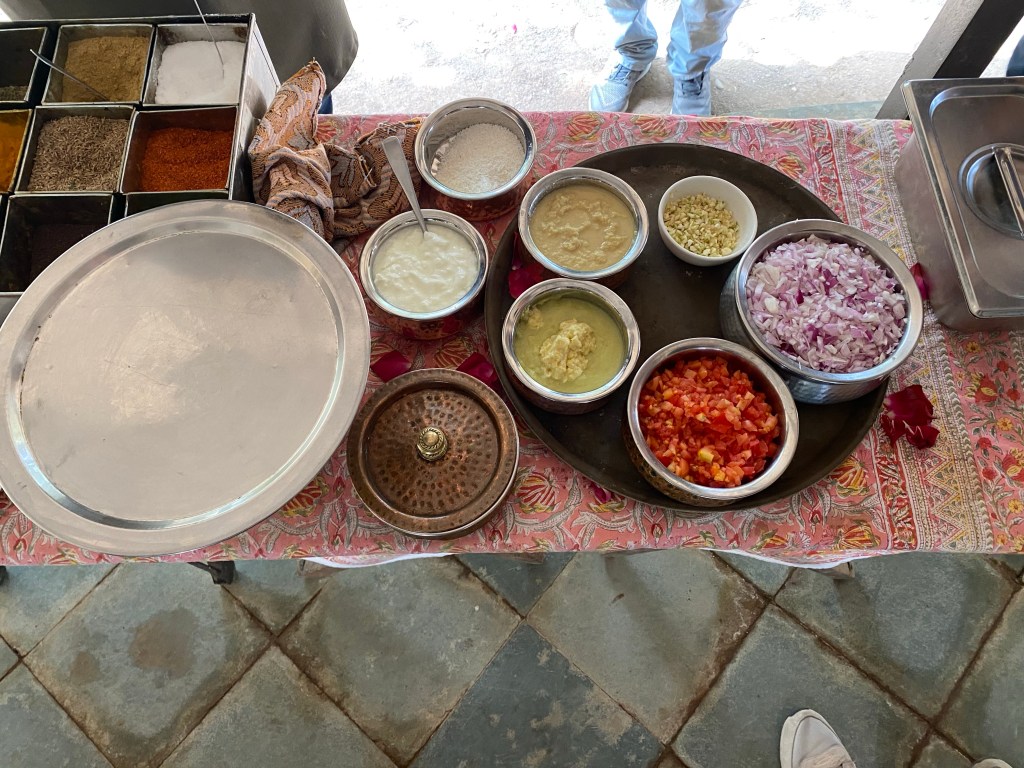
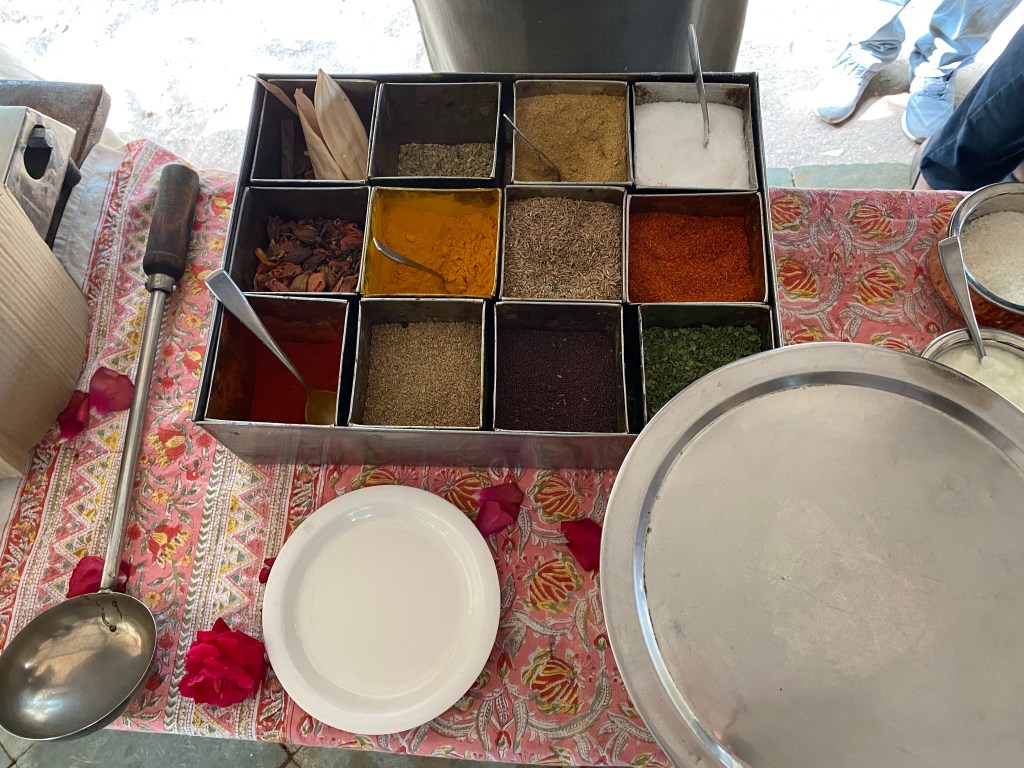
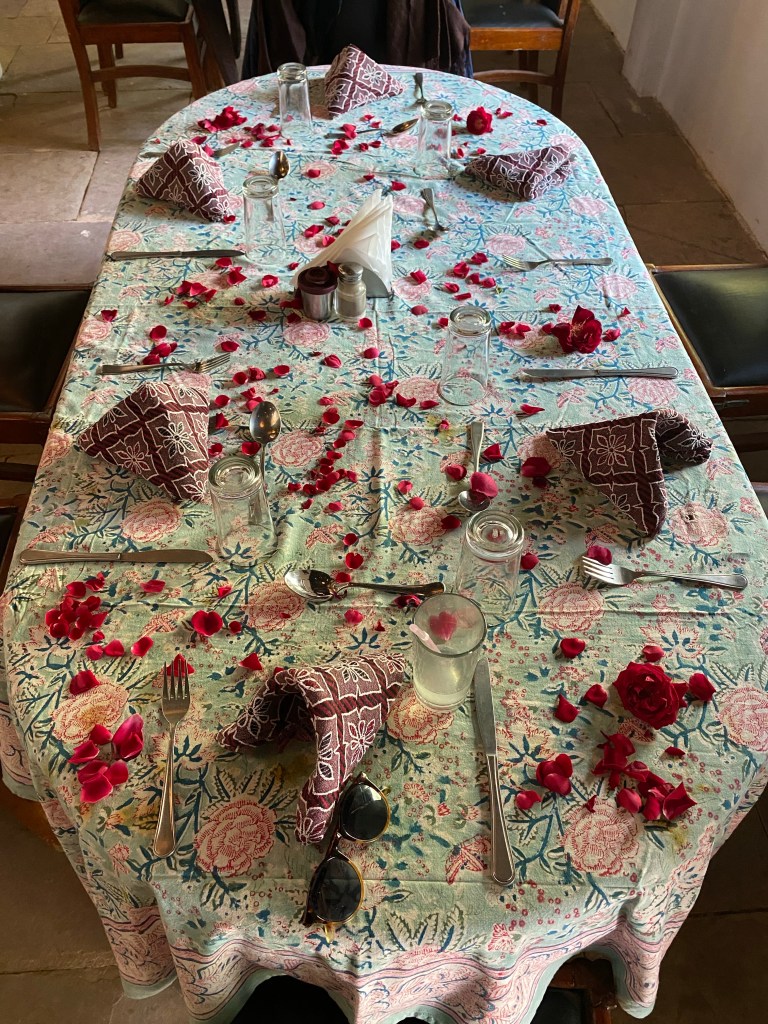
Ingredients (goat meat is in the closed tin on the right)Mouthwatering Indian spices Oil, spices, garlic and onion – the base for most curries Our pretty lunch table Bon appetit! (note another new bread – baati – on the right side – cooked over an open flame)
The following day started with another 3 hour trip from Bijaipur to Udaipur. Saurabh pointed out Chittorgarh (a 7th century Fort visible from the highway en route) and then gave us a brief history lesson and a fascinating overview of the 9 reincarnations of the Hindu god of preservation, Vishnu.
We checked in to our hotel in Udaipur and headed directly to lunch in Old Udaipur at the Rainbow Cafe – a rooftop restaurant overlooking lake Pichola and a favourite of Saurabh’s. After lunch we went on a bit of a walking tour and stopped at a tailor to have a some stitching done – I had a skirt and blouse made but unfortunately don’t have a good photo to include yet. That maxed out my tolerance for shopping so it was back to the Rainbow cafe for chai until our sunset boat ride.
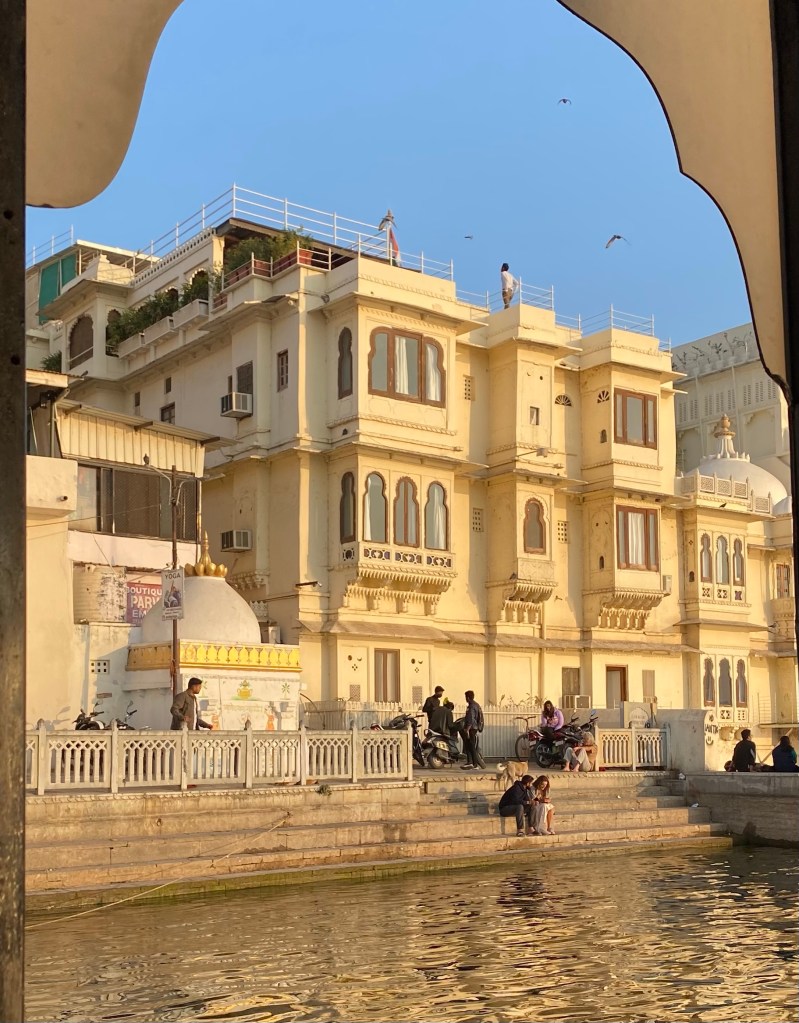
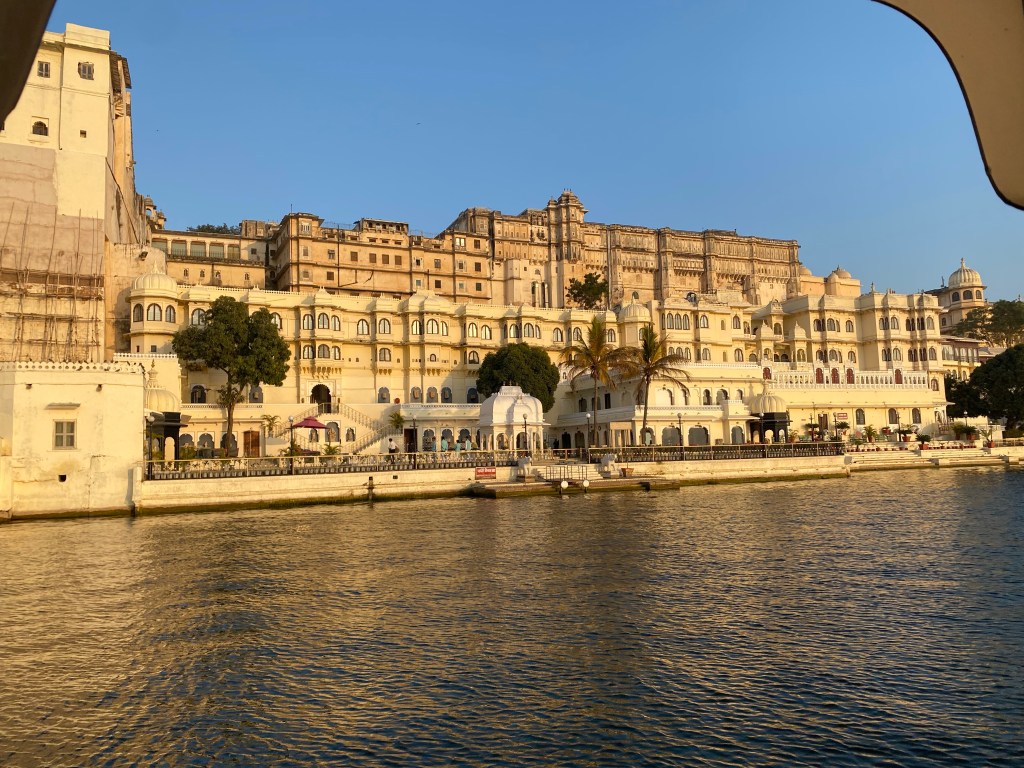
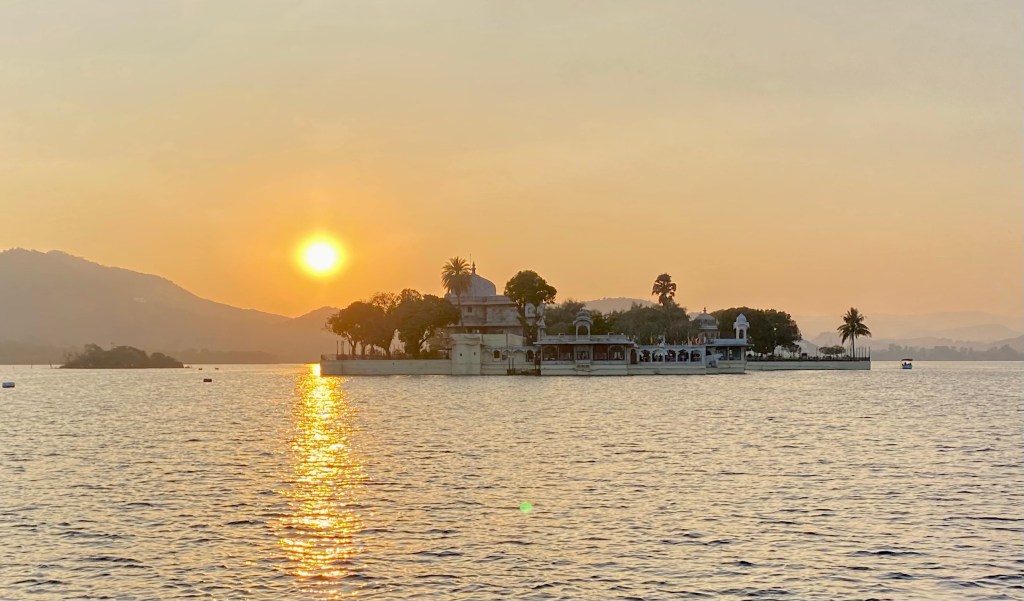
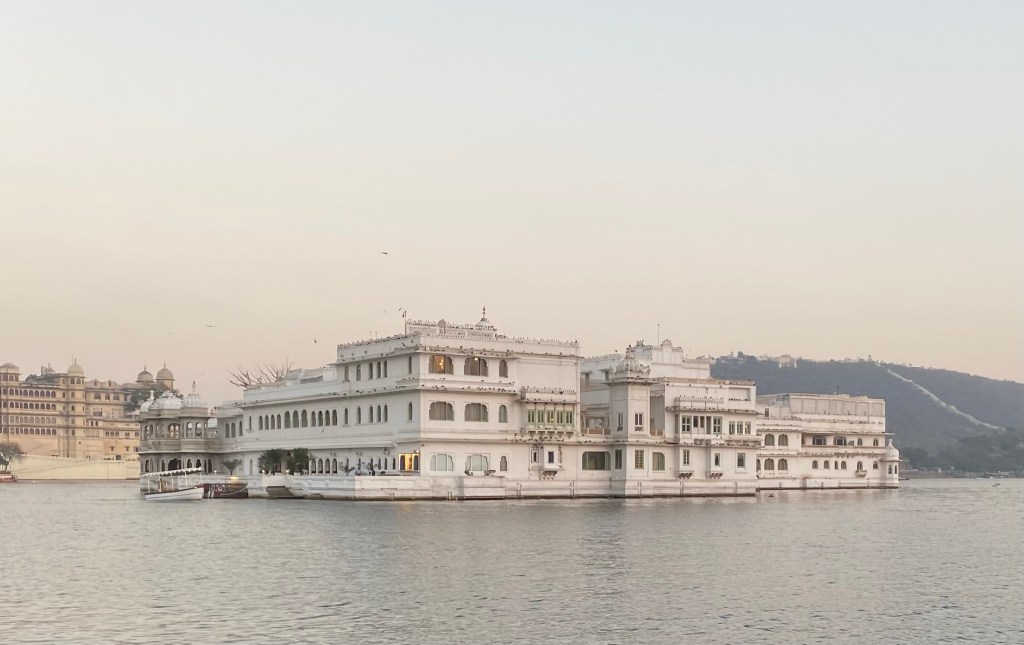
The views from the boat were impressive – the lakeside architecture, city palace, Taj Lake Palace and the surrounding hills. The smog does lend a bit of mystique to the views….
Lakeside architecture City Palace Jagmandir palace – island hotel Smoggy mountain sunset Taj Lake Hotel – 5 star hotel (my aunt actually stayed here almost 40 years ago, but way out of my price range now at nearly $1000 a night)
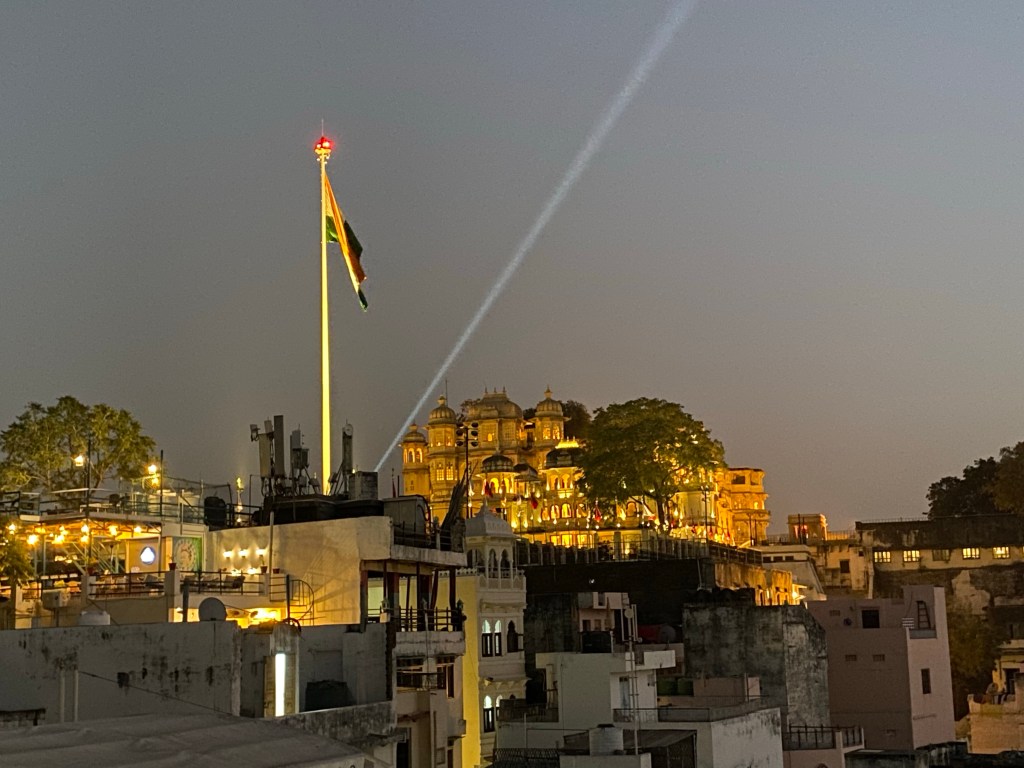
Dinner was on another rooftop restaurant (actually the hotel where parts of the movie, The Best Exotic Marigold Hotel, was filmed) with spectacular sunset and night time views.
Sophia and our dinner table City palace and flag of India
On the way back to the hotel we got to experience an Indian traffic jam – mostly motorbikes and motorized rickshaws with only a smattering of cars.
The next morning we had the opportunity to tour a Jain temple (Jain is another religion that originated in India) and the city palace – a structure built over 400 years started in 1559. It currently houses a museum, two five star hotels and the King of Rajasthan. Beautiful architecture and a complicated history!
Sun god on the exterior of the palace for the people to come worship daily Obligatory photo of me in the palace
We had an unbelievably delicious street lunch of chai, samosa with chutneys and poha!
Poha is the flat rice at the top of the photo – also served with various garnishes Samosa smothered in chutneys
After lunch we got to experience a palm reading by a local teacher and astrologer. Jyotish means astrology and those who practice were part of a historical caste under the broader Brahmin caste and are currently considered to belong to the OBC (other backward caste). I’m still trying to comprehend the historical and modern manifestations of the caste system and feel woefully inadequate at trying to explain here! These astrologers go through extensive training. I’m glad I did it and was grateful for some of the insight I was given!
Our final day in Udaipur started with a trip to a local market led by the instructor of our cooking class.
Note the red, not orange, carrots This sweet lady bought me chai!Intently adding cumin seeds to see if the oil is hot enough! Another incredible meal! Especially the okra!
After this meal, things took a turn for the worse. My stomach had been upset for the last 24 hours off and on, but it became clear to me that I had finally succumbed to ‘Delhi Belly’. Quick stop for a miniature painting demonstration and a purchase of 3 small paintings on silk (easily packable) and then it was back to the hotel for me. I had about 5 hours to medicate and recover before we boarded our 16 hour overnight train to Mumbai. It wasn’t looking good 🤢.
2 doses of Imodium and 1 high dose of Gravol later, we headed out in rickshaws and pouring rain to make our way to the train. To compound my misery, the bottom of my skirt got wet from water splashing up into the rickshaw from the road, the thought of which turned my already angry stomach. The walk to the train and the process of setting up my upper bunk (home for the next 16 hours) almost finished me, but I managed and the Gravol kicked in until 4:30am. I took another 50mg and was mostly asleep off and on until an hour before we arrived in Mumbai. I felt surprisingly good (other than the pain in my hips and shoulders from sleeping on upholstered plywood) and took in the views of Mumbai from the train window.
Mumbai was shocking, polluted, beautiful and vibrant – more to come!
First views from the taxi View from my Krishna Hotel window
I’m writing this from the prettiest ornate swing in Castle Bijaipur in the countryside near Bijaipur town. It’s nice to put the din of the city behind us for a bit in exchange for the peacefulness of the country.
3 days have past since my last post, spent in Agra and Jaipur. 13 hours of those 2 days were spent in our minibus travelling between Agra and Jaipur and Jaipur and Bijaipur. Fortunately the trips were broken up by stops for chai and lunch. Also, my trtl neck pillow affords me the luxury of being able to sneak a nap. Unfortunately, the fog/smog especially in the mornings means there’s not much to see out the windows. And it’s probably best I don’t pay attention to what’s going on outside of the vehicle anyhow – these are some of India’s busiest highways with freight running between Delhi and Mumbai in an endless stream of TATA trucks.
Agra (Red Fort, Taj Mahal, Cooking demonstration at homestay)
Let’s start by saying that the Taj Majal was absolutely everything I’d expected and hoped it would be. Leighton asked me a completely reasonable question after seeing the photos I’d posted ‘what’s so amazing about actually being there – your photos look like every other photo I’ve ever seen of it?’. And I had trouble answering that question because it really is so beautiful that it’s surreal. Until you’re standing right beside it, gazing up at all of the details, it almost looks like a photo even in real life!
When I’d imagined visiting the Taj Majal, I’d always assumed I’d get up before dawn and be the first one at the gates in an effort to avoid the crowds. In reality, the mornings are extremely foggy/smoggy and if I’d shown up at that time, it’s likely that I wouldn’t have been able to see it from the entry gates. We ‘waited out’ the fog by occupying ourselves at the Red Fort, itself an absolutely stunning palace/Fort combination that was never actually attacked. All of these Moghul structures are engineering masterpieces with so many carefully thought out details. And the opulence is undeniable even after they’ve been stripped of the jewels, gold, carpets and tapestries. It still doesn’t take a lot of imagination to picture them in their full glory.
Lunch consisted of delicious vegetarian samosas and Indian coke – Thumbs Up at a hand knotted rug shop. And there may have been a shopping incident….
The speed with which these artisans hands moved was mind boggling. And the way they kept track of the patterns, ingenious – chanting the colours at the beginning of each row
Finally it was time to make our way to the Taj Mahal. Despite the appearance of throngs of people, it was less busy than usual according to our guides.
We snapped a bazillion photos and just took it all in from every possible angle before making our way back out to the vehicle. Our final stop for the day was a a cooking demonstration at a local homestay. The food was mouthwatering – I can’t wait to try the recipes at home (once I find all the spices and make my own yogurt and paneer…)
Jaipur (The Palace of the Wind – Hawa Mahal, cooking demonstration at our guide’s house, Amber Fort, Old City)
Jaipur is our guide, Saurabh’s, home and the pride he shows for this city is impressive! I can’t say enough how lucky we are to have him sharing India with us. He’s so genuinely enthusiastic and passionate! Our first few hours in Jaipur came after a long drive from Agra so we only had time for a walking tour through the Old City before our cooking demonstration at Saurabh’s family home.
Jaipur is known as the Pink City and is a ‘planned city’ from the 1700’s architecturally designed in a grid pattern. So it’s easy to become disoriented as the streets and squares all begin to look similar. Its buildings are predominantly a pink terracota color with white accents.
See the ‘pink’ color in the background of the local elephant passing by on the street beside us
Similar to Agra and Delhi, Jaipur is a cacophony of street sounds – horns, cars, motorbikes, dogs and people. But for whatever reason, I find it enchanting and even as I’m navigating the crowds of people, animals, vehicles, items for sale and the ever present garbage it’s impossible to erase the awestruck grin from my face!
I’m rambling too much and need to move this along so here’s a photo dump of the rest of the sights we saw in Jaipur.
Saurabh’s multi-talented wife (chef, director, model, future hotel owner) giving us a cooking demonstration. And the unbelievable meal we enjoyed!Hawa Mahal (The Palace of the Winds) – much photographed landmark in Jaipur. Actually a 5 story facade with 953 windows created as a viewing point for royal women to observe activities on the street. Hawa Mahal at night
Jaipur, like any other city, comes alive at night and Saurabh took us out on a jeep tour to observe its awakening.
Amber FortLake at the base of the Amber Fort One of the 9 major gates to the Old CityAlbert Hall Museum
I’ll end this post with a couple of photos from the inside of the Amber Fort during our afternoon tour. This impressive structure was built in the 1500’s primarily of sandstone and marble and is remarkably well preserved. Note the elephant being ridden up to the Fort in the bottom right corner of the first picture – a controversial practice that is slowly being phased out.